





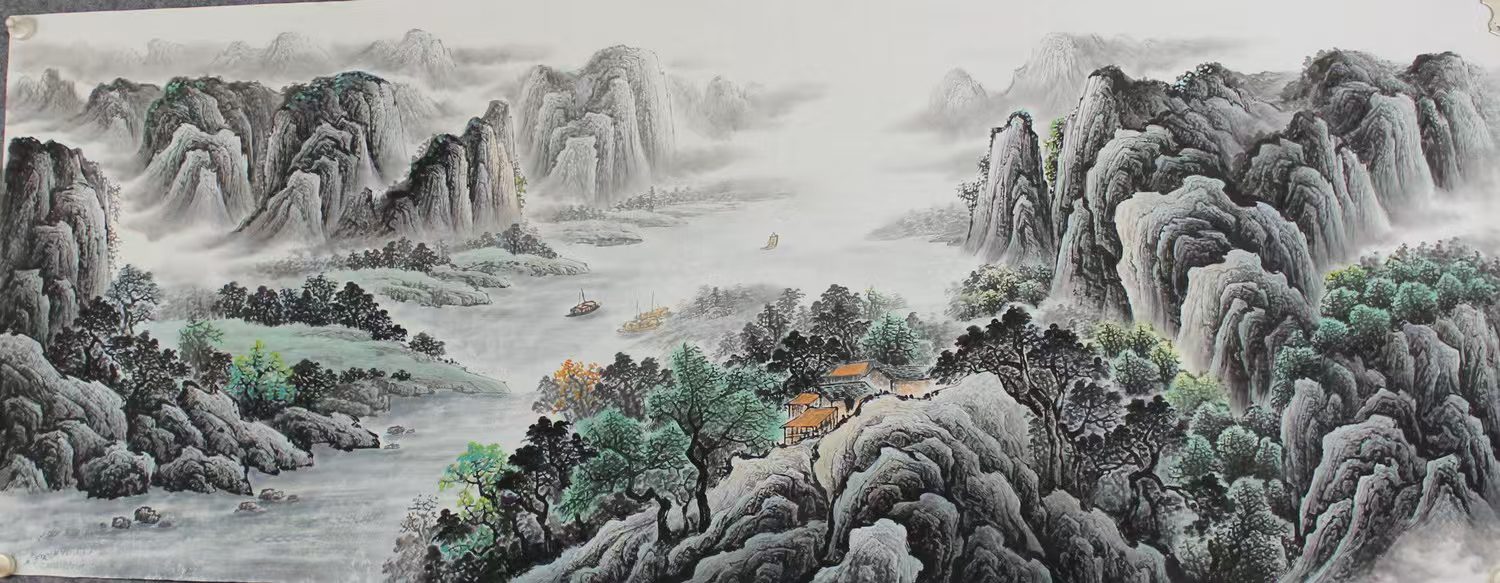
Ink Landscape Painting "Smoke and Haze Wonderland-Pine Breeze Listening to the Spring
Single Size
0 Review
*Size
180cm x 70cm "Small Six Feet
$860.00$1,000.00
Special Features:




Description
Paintings featured
- Traditional landscape with magnificent weather:
- The composition adopts the “profound and distant method”, the main peak is lofty and steep, the distant mountains are stacked and pushed far away, the smoke and haze are dyed horizontally with “wet brush and broken ink”, and the clouds flow as if they were gossamer, showing that “the mountains are floating on the clouds, and the clouds are hidden between the mountains The clouds are flowing like a light veil, showing a fairyland weather of “mountains floating on clouds and clouds hidden among mountains”;
- The rocks are sketched with rounded texture by “Phi Ma Chou”, leaving white on the sunny side like moonlight pouring down, and chapping the moss traces on the yin side by mixing ink with flower and green, showing the natural charm of both rigid and soft.
- The details are subtle and poetic:
- Nearby ancient trees lush and verdant, pine needles with fine strokes in the center to save clusters, branches and leaves between the light Shi green highlighting, the trunk of the gnarled posture of the focal ink hook, the roots of the coiled stone such as a dragon claw grip the ground;
- A hexagonal pavilion is hidden in the mountains, the eaves and corners are outlined with the technique of boundary painting, the green tiles are dotted with light ink, and the window lattices are left white like translucent light, concealing the literati’s interest in “visiting the secluded mountains”.
- The color tone is elegant, and the light and shadow are blended together:
- The mountains are covered with layers of light ochre and stone green mineral pigments, which are as rich as emerald in the near distance and as light as light smoke in the far distance; the clouds are edged with water and ink to form a halo of light and seepage, and the sky is pushed away with a gradation of light blue to build an ethereal mood.
Detailed depiction
- Mountains and clouds:
- The backlit surface of the main peak is dyed with seven layers of mixed ink and blue, the stone crevices are dotted with wild chrysanthemums like stars, the rock walls are “pimply chapped” like silk, and the edges of the clouds and mist are broken with water to form a plush texture;
- The distant mountains are blurred with light ink in “Rice Dot Chapped”, blending with the milky white sea of clouds to create a hazy poetic realm of “mountain color with or without”.
- Water and trees:
- The stream meanders, the water surface with “net towel water” technique outlines the fine ripples, the tip of the wave decorated with titanium white like broken jade floating waves, reflections of the real and virtual overlap;
- Pine and cypress branches and trunks to “crab claw chapped” performance of a thousand years of frost, pine needles in five groups of “wheel-shaped” radiation, the top of the Shi green brighten the surface of the light, and darken the logic of light and shadow.
- Humanity and ecology:
- The pavilion is hidden in the hillside, with green tiles and white walls mirroring the pines, and the stone steps in front of the door are mottled with age by using withered brushstrokes and flying white;
- Cliff moss traces are colored with flowers and greens, the water is sparsely populated with duckweed, and in the air, a lone crane spreads its wings, and its feathers are dyed with light ink to look like it is dancing in the air.
Artistic Value
- Condensed expression of traditional techniques:
- Inheriting the craftsmanship of Song Dynasty courtyard landscapes and the literati writing of Yuan Dynasty literati paintings, the cloud treatment is integrated into the air perspective method of Western paintings, giving new life to the ancient method;
- Visual sublimation of natural philosophy:
- Through the collision of imagery of “clouds moving and mountains quieting” and “springs singing and pines chanting”, the philosophical view of Taoism’s “unity of heaven and man” is interpreted, and pavilions and cranes constitute a symbolic dialog between the “worldly and the transcendental”. The pavilion and the lonely crane constitute a symbolic dialog between the “worldly and the transcendental”;
- Cross-cultural aesthetic resonance:
- It can be used as an elegant object for the Chinese study, and its elegant color and simple composition can also connect the modern minimalist space, becoming a bridge between traditional and modern aesthetics.
Suitable Scene
- Living room/study: framed in a dark walnut wood frame, with a celadon vase and a bamboo incense sticker, it creates a literati atmosphere of “seeing the mountains through the window and people in the painting”;
- Tea room/meditation space: with the withered landscape sand table and cast iron tea ware, the sound of the stream can emphasize the Zen realm of “listening to the spring and tasting tea”;
- Cultural exhibition hall/corporate clubhouse: the giant is presented on the light gray art wall, the mountains symbolize the cultural heritage, the smoke and haze metaphorical strategic vision, conveying the corporate spirit of “landscape has the way”.
Purchase
- Framing suggestions:
- Traditional: azure damask silk mounted on a vertical scroll with a carved rosewood cloud pattern header, suitable for Chinese style spaces;
- Contemporary: frameless acrylic suspension mount, retaining the natural bleed edge of the ink, fitting the minimalist style.
- Conservation Guide:
- Avoid direct sunlight to cause mineral pigments to fade, it is recommended that every three years to ask the non-heritage master with the ancient method of “full color” repair details;
- Humid areas need to be equipped with electronic moisture-proof cabinets, dusting covered with silk, with a badger brush in one direction to sweep gently.
✨ Core highlights
- Four times into the painting: morning fog with Diane, afternoon forest verdant, twilight sunset gold, night mountain ink, a volume of all the natural cycle;
- Five senses: watch the clouds can touch the wet mountain wind, listen to the spring like hearing the echo of the valley, tasting the pavilion like smelling the pine smoke and ink, realizing the immersive experience of “swimming in the painting”;
- Symphony of the past and present: the majesty of Fan Kuan’s “Journey to the Mountain” and the sparseness of Ni Zan’s “Rong Knees Zhai” are blended here, giving new life to the traditional landscapes.
Collector’s significance
Smoke and Haze Wonderland – Pine Breeze Listening to Spring” is not only an ink painting, but also a “spiritual epic of oriental aesthetics”. Whether it is used as a family heirloom to continue the cultural gene of “the benevolent people are happy with the mountains”, or hung in modern space to show the aesthetic realm of “getting the source of the heart”, it can make the viewer think of Wang Wei’s “After the new rain on the empty mountains, the weather is late and autumn comes” in the dense ink. The weather is late in the fall”, the ancient Zen, in the hustle and bustle of the world to keep a side of the soul of the return to the source of paradise.

 Product Reviews
Product Reviews
Write A Review
Related Products