





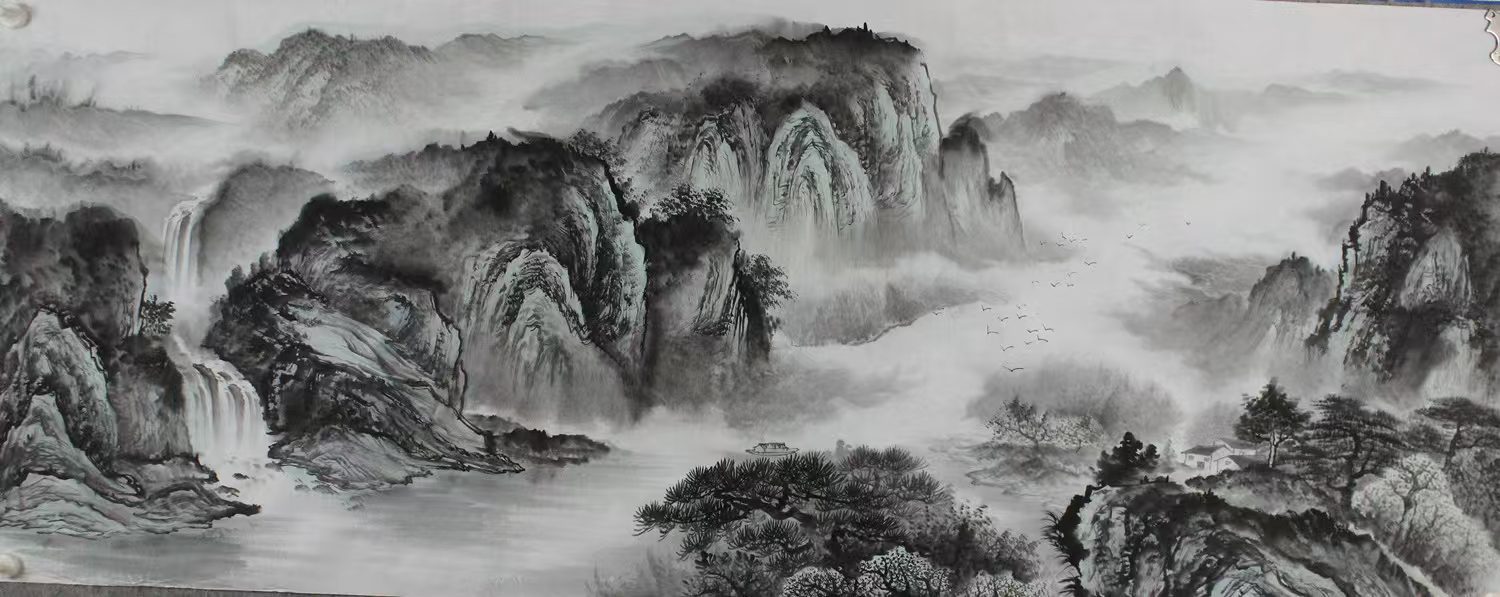
Ink Landscape Painting "Smoke and Haze Wonderland - Four Seasons of Morning and Evening
Single Size
0 Review
*Size
180cm x 70cm "Small Six Feet
$860.00$1,000.00
Special Features:




Description
Paintings featured
- Panoramic landscapes with a wide range of weather:
- The composition adopts the “three far away method”, with the main peak as lofty as a screen, the layers of mountains and peaks pushed far away by light ink stains, and the clouds and mist in the distant landscape swept horizontally by the “splash ink method”, forming the “mountains floating in the sea of clouds, clouds hidden in the peaks” of the The clouds and mist in the distance are swept horizontally, forming the meteorology of “mountains floating on the sea of clouds and clouds hiding the green peaks”;
- The stream in the mountains runs through the picture, with the “swimming silk” outlining the fine ripples in the near distance, and the white space in the far distance to show the vastness of the smoke and the hidden depth of space of “thousands of miles at hand”.
- Ink and water are blended together, and movement and static are born together:
- The mountain body with thick and light ink color accumulation of seven layers, the sunny side of the white as the moonlight pouring, Yin side of the “axe chopping” outlined jagged rock walls, the top of the peak of the titanium white to be the first condensation of snow;
- Waterfalls to “nail head rat-tail description” outlines the flow straight down, the tip of the wave decorated with clams powder such as broken jade splash, the pool surface reflection with light ink spiral pattern painted whirlpools, and the formation of airborne cranes “waterfalls fall into the nine heavens, the crane at the top of the empty valley” of the static and dynamic symphony.
- The vitality of the hidden seclusion, the eye of the painting:
- Ancient trees in the mountains have gnarled branches outlined with “crab-claw branches”, pine needles are clustered into umbrellas with fine brush strokes in the center, and maple leaves are dotted with cinnabar as if they were leaping with stars and fire, concealing the life sequence of “spring, blossom, and autumn”;
- The woodcutter walking along the mountain path with his load, his hat with a single stroke of focal ink, his clothes withered and white brush strokes to imitate the mountain wind, the details of which allude to the wild poetic meaning of “after the new rain on the empty mountain”.
Detailed depiction
- Mountain rocks and clouds:
- The backlit surface of the main peak is chapped with moss traces in a mixture of blue and white ink, and the stone crevices are embellished with cinnabar-colored wild maples that look like iron armor hiding red;
- The clouds are dyed with “wet brush and broken ink” technique, the edge of the plush texture if touchable, the middle layer of white like raw silk hanging sky, the peak reflects the sunlight, building the “sea of clouds and mirror sky” illusion.
- Water and trees:
- The waterfall is divided into three stacks of pouring, the middle layer of the torrent to “iron line drawing” outline the silver chain flying down, the water mist dry brush chapping proposed cold smoke and frost;
- Pine and cypress branches chapped like dragon scales, pine needles in five groups of “wheel-like” radiation, the top of the stone green to brighten the light surface, the bottom of the blue rendering shadows, darkening the logic of natural light and shadow.
- Color and light and shadow:
- The morning sunlight with light ochre paves the peak, the twilight mist with rouge lightly sweeps the sky, the red leaves with vermilion overdyeing three times with golden lines to imitate the slanting sun penetrating through;
- The sunny side of the mountain is as white as silver foil, and the shaded side is dyed with seven layers of light ink, simulating the time and space changes of “sunrise, sunset and sunset, and a myriad of meteorological phenomena”.
Artistic Value
- The condensed inheritance of traditional techniques:
- Combining the rigidity of Ma Yuan’s “Axe Chopping” of the Southern Song Dynasty and the sparseness of Ni Zan’s “Folding Ribbon Chopping” of the Yuan Dynasty, and incorporating the air perspective method of Western painting into the handling of clouds and mist, it gives a new lease of life to the traditional landscapes;
- A visual poem of natural philosophy:
- Through the contrast of “cloud movement and mountain quietness” and “waterfall and pool depth”, the dialectical aesthetics of Taoism’s “great skill is like clumsiness” is interpreted, and the woodcutter and the lone crane constitute the “smoke and fire” and “transcendence”. The woodcutter and the lone crane form a symbolic dialog between “smoke and fire” and “transcendence”;
- Cross-cultural aesthetic container:
- It can be used as an elegant object for oriental literati to “recline and observe the Tao”, and its simple white space and color rhythm can also connect with modern minimalism, becoming a visual focus in both art museums and home scenes.
Suitable Scenery
- New Chinese living room: with plain wood furniture and porcelain vase, the flow of clouds can activate the space aura, creating a sense of entry “push the window and see the mountains”;
- Tea room meditation space: mounted on a bamboo screen, with cast iron pots and Jianjian, the ethereal mood of the painting can emphasize the Zen atmosphere of “one tea, one painting, one Qiankun”;
- Office of corporate executives: framed on the walnut background wall, the mountains symbolize the foundation of the company, the sea of clouds is a metaphor for the strategic vision, and the waterfall implies the auspicious meaning of “a long history”.
Purchase Information
- Framing suggestions:
- Traditional: azure damask silk mounted on an established scroll with a carved rosewood cloud pattern header, suitable for elegant gatherings to display scrolls for appreciation;
- Contemporary: ultra-thin titanium frame with matte linen backing, retaining the natural bleeding edge of the ink, suitable for minimalist spaces.
- Care Guide:
- Avoid direct sunlight to oxidize the cinnabar, and it is recommended to have it repaired by a non-heritage master every three years using the ancient method of “full-color” repair;
- When dusting, cover the silk image, use the badger hair board brush to sweep gently in one direction, and place acid-free hygroscopic agent to prevent mildew in the humid season.
✨ Core highlights
- Four times of the day and night: morning fog with Diane, afternoon forest verdant, twilight sunset gold, night mountain ink, a volume of time flow;
- Five senses: watch the clouds and touch the moist mountain wind, listen to the waterfall as if hearing the echo of the valley, taste the pine as if smelling the fragrance of grass and trees, realizing the immersive experience of the “painting in the realm”;
- Symphony of the past and present: the majesty of Fan Kuan’s “Journey to the Brook and Mountain” and the innovation of Shi Tao’s “theory of one painting” are blended here, so that the traditional landscape and contemporary aesthetics collide with the newborn.
Collection Significance
Smoke and Haze Wonderland – Four Seasons of Morning and Evening” is not only an ink landscape, but also a “time and space hand scroll of oriental aesthetics”. Whether it is used as a family heirloom to continue the cultural gene of “landscape is better than virtue”, or suspended in modern space to highlight the aesthetic realm of “getting the source of the heart”, it allows the viewer to think of Wang Wei’s “walking to the end of the water, sitting and watching the clouds rise” in the ink and mist. When sitting and watching the clouds rise”, the viewer can be reminded of Wang Wei’s millennium of Zen, and keep a side of his mind in the hustle and bustle of the earthly world.

 Product Reviews
Product Reviews
Write A Review
Related Products