




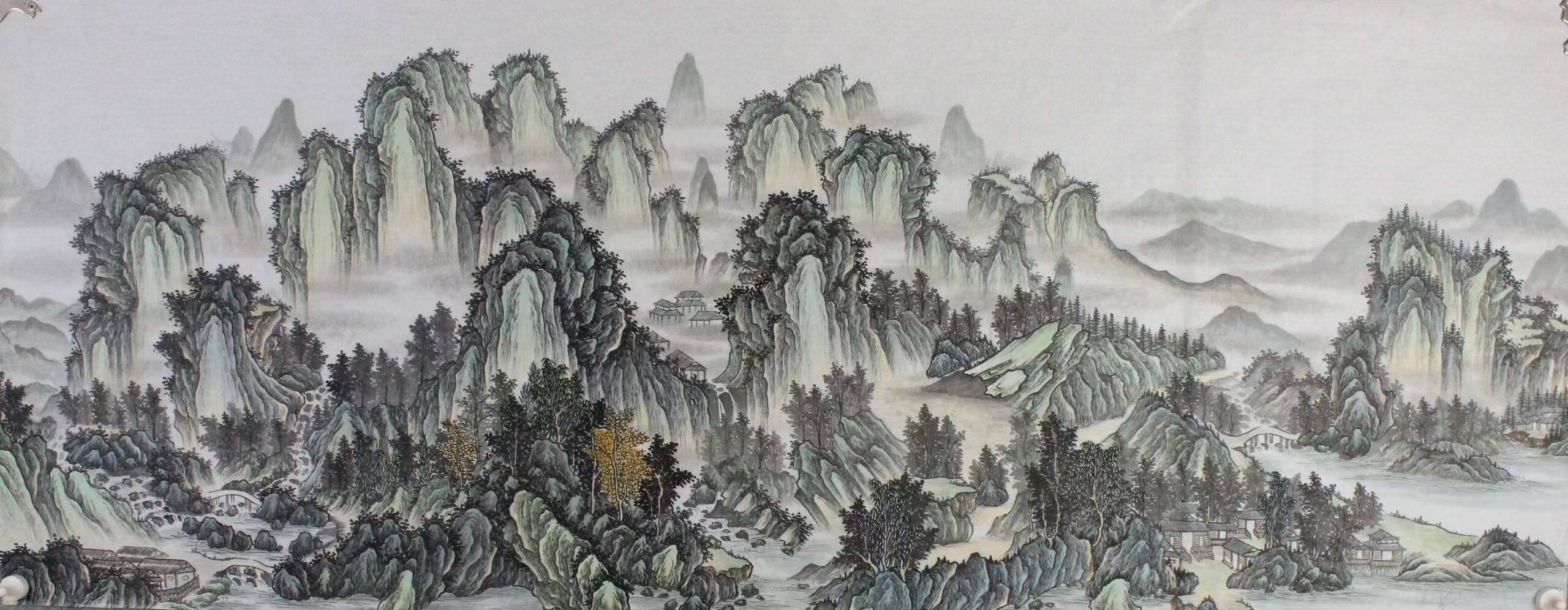
Ink Landscape Painting "Smoke and Haze Wonderland
Single Size
0 Review
*Size
180cm x 70cm "Small Six Feet
$860.00$1,000.00
Special Features:




Description
Paintings featured
- Traditional technique with vivid flavor:
- The panorama is spread out in the composition of “lofty method”, the main peak is lofty and steep, the clouds on the mountainside are swept horizontally by “splashing ink method”, the smoke and haze flow as if a dragon is coiled up, and the distant view is hidden in the greenish gray mist, forming the “mountains floating on the clouds and clouds hidden among the mountains”. The distant view is hidden in the greenish gray mist, forming a “mountain floating on the clouds, clouds hidden between the mountains” of the fairyland;
- Mountain rocks to “axe chopping” outline jagged rock walls, the sunny side of the white as the moonlight pouring, the dark side of the moss traces of mixed ink chapped with flowers and greens, showing the “iron bone hidden clouds” of the rigid and soft collision.
- Green color, elegant and far-reaching:
- The mountains are colored with layers of stone green and flower green mineral pigments, as rich as emerald in the near distance and as light as light smoke in the far distance, simulating the gradation of natural light and shadow;
- The clouds are dyed with light ink with a wet brush, the ink on the edges is broken by water to form a plush texture, and the middle layer of white is like raw silk hanging in the sky, which conceals the imaginary and real meaning of “the color of the mountain is there or not”.
- The details of the painting are hidden, and the world is at your fingertips:
- In the near scene, the pine and cypress are written with burnt ink, the pine needles are clustered into umbrellas with fine brush strokes, the top of the stone green highlights the lighted surface, and the bottom of the flower green renders the shadows, following the logic of natural light and shadow;
- The woodcutter is walking along the mountain path with his burden, his hat is drawn with a single brush stroke in burnt ink, and his clothing lines are painted with withered brush strokes in white to simulate the mountain winds, the details of which imply the wild flavor of “after a new rain on an empty mountain”.
Detailed depiction
- Mountain stone texture:
- The backlit surface of the main peak is dyed with seven layers of light ink, the stone crevices are dotted with cinnabar-colored wild maples that look like stars falling to the ground, and the rock walls are “axe-chopped” as if they were carved by knives and axes, showing the vicissitudes of the millennium’s weather and the texture of the mountains;
- Distant mountains with “rice dot chapped” light ink virtualization, and the milky white sea of clouds blend, build “mountains in the misty” hazy poetic realm.
- Forest ecology:
- Pine and cypress branches and trunks with “crab claw chapped” performance of gnarled posture, the roots of the exposed disk of stone like a dragon claw to grasp the ground, pine needles in five groups of “wheel-shaped” radiation, implying the “wood to the sun” of the laws of nature;
- Mixed trees in the mountains with “mesquite point” “a character point” interlocking layers, ink color is appropriate, the proposed state of grass and trees.
- Light and shadow and color:
- The morning sunlight lightly sweeps the peaks with vine yellow, colliding with the green mountains to form a warm and cold collision, and the sky is covered with a light purple gradation like a thin veil;
- The edges of the clouds are brightened with titanium white to simulate the transient changes of the sky light penetrating the clouds, and the moss spots on the ground are densely covered with ochre particles to simulate the moist vitality of “rain and moss”.
Artistic Value
- Condensed expression of traditional aesthetics:
- Inheriting the rigor of Song Dynasty courtyard landscapes and the spontaneity of Yuan Dynasty literati paintings, interpreting the oriental philosophy of “the unity of heaven and mankind” with green and green colors, showing the eternal charm of traditional ink;
- The visual sublimation of natural philosophy:
- Through the contrast of “quiet mountains and moving clouds” and “the real and the imaginary”, it interprets the Taoist realm of clarity of “white in the empty room”, and the woodcutter and the lone crane constitute the “fireworks” and “transcendence”. The woodcutter and the lone crane constitute a symbolic dialog between “smoke and fire” and “transcendence”;
- Aesthetic resonance across generations:
- It can be used as an elegant object for the scholar’s study, and its elegant color and simple composition can also connect with the modern minimalist space, becoming a visual focus in both Chinese and contemporary scenes.
Suitable Scene
- Main wall of living room: framed in plain wooden frame or dark rock plate background, the green mountain color collides with Chinese furniture, symbolizing the auspicious meaning of “home is like a fairyland”;
- Tea room/study: with bamboo screen and celadon tea set, the flow of clouds can activate the aura of the space, creating an elegant atmosphere of “pushing the window to see the mountains, sipping tea and watching the clouds”;
- Cultural exhibition hall: the giant is presented on the light gray art wall, the majesty of the mountains symbolizes the cultural heritage, and the change of the sea of clouds is a metaphor for the depth of history.
Purchase Information
- Framing suggestions:
- Traditional style: azure damask silk mounted on an established scroll with a rosewood carved cloud pattern header, suitable for Chinese style spaces;
- Contemporary: ultra-thin titanium suspended frame lined with a matte linen backing, retaining the natural bleeding edge of the ink and wash, in keeping with the minimalist style.
- Care Guide:
- Avoid direct sunlight that may cause the green color to fade, and it is recommended that every three years the non-heritage masters use the ancient method of “full-color” repair;
- When dusting, cover the silk image and sweep gently in one direction with a badger brush, humid areas need to be equipped with electronic moisture-proof cabinets.
✨ Core highlights
- Four times into the painting: the morning fog with Diane, afternoon forest verdant, twilight sunset flowing gold, night mountain ink, a volume of time flow;
- The five senses: watch the clouds touch the moist mountain wind, listen to the pine like hearing the echo of the valley, taste the ink like smelling the fragrance of rice paper, realizing the immersive experience of “swimming in the painting”;
- Dialogue between the past and the present: the majesty of Fan Kuan’s “Journey to the Streams and Mountains” and the sparseness of Huang Gongwang’s “Dwelling in the Fuchun Mountains” are intermingled here, giving new life to the traditional landscapes.
Collector’s significance
Smokey Wonderland is not only a landscape painting, but also a “spiritual epic of oriental aesthetics”. Whether it is used as a family heirloom to continue the cultural gene of “the benevolent people are happy with mountains”, or hung in modern space to show the aesthetic realm of “getting the source of the heart”, it can make the viewer think of Wang Wei’s “walking to the end of the water, sitting and watching the clouds rise” in the dense ink. Sitting and watching the clouds rise,” the millennium of Zen, in the hustle and bustle of the world to keep a side of the soul of the return to the source of paradise.

 Product Reviews
Product Reviews
Write A Review
Related Products