




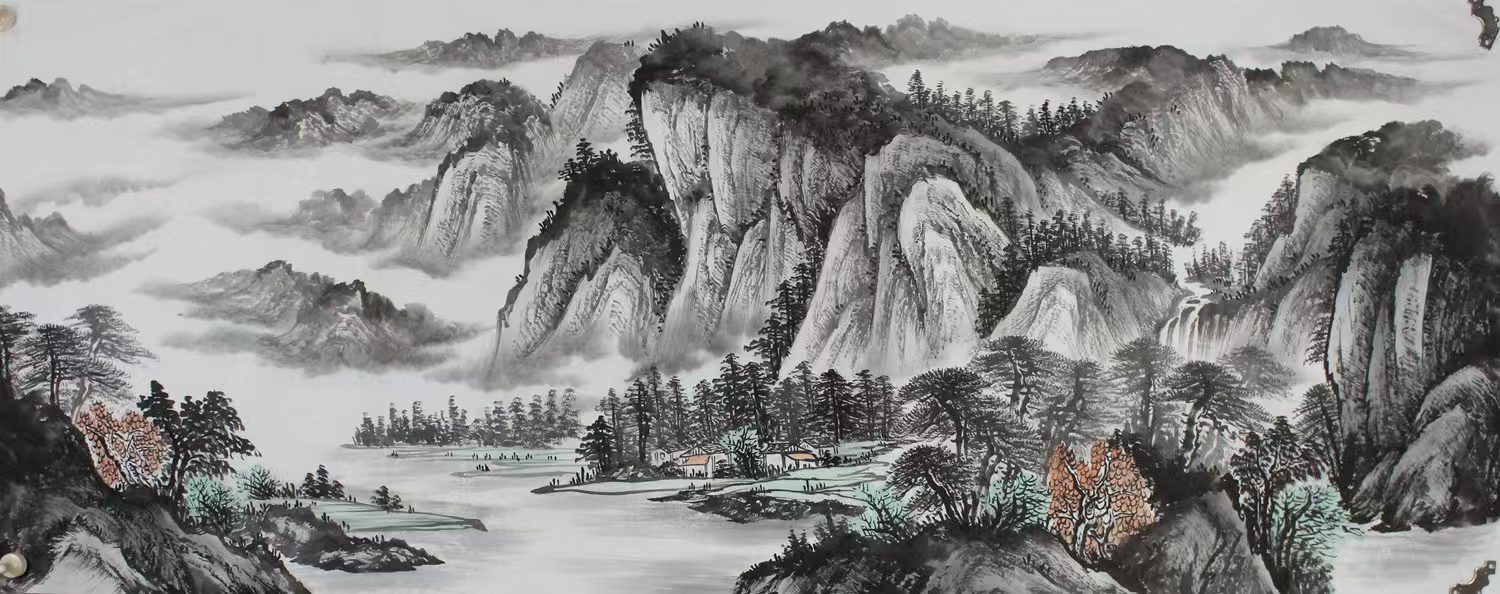
Ink Landscape Painting "Cloudy Sky and Light - The Secret Land of Smoke and Haze
Single Size
0 Review
*Size
180cm x 70cm "Small Six Feet
$880.00$1,000.00
Special Features:




Description
Paintings featured
- Dense ink and water, symbiosis between reality and reality:
- The traditional ink and wash technique is used to spread out the mountains with a combination of pima chapping and light ink staining, the distant peaks are hidden in the smoke and mist, and the rocks in the near view are as jagged as bones, and the gradual change of ink color is like a natural creation, which reveals the misty beauty of “the mountains are in the misty void”;
- The clouds are mainly in white, supplemented by very light blue horizontal chafing, such as a light veil rolled in the bottom of the valley, and the mountains are blended with the real and the imaginary, to build “at hand to hide thousands of miles” of spatial depth.
- Ink and color dotting the eyes, the vitality of the dark surge:
- The trees are painted in green and green, sparsely and densely scattered like stars, with light ochre between the leaves, concealing the metaphor of “one leaf knows autumn”;
- The surface of the water is painted with light ink and fine brush strokes, reflecting the shadow of the mountains and clouds, and the light of the waves is brightened by titanium white, which seems to have the clarity of “a half-mu square pond with one view”.
- The movement and static are suitable for each other, and poetry and painting are blended together:
- The stream in the mountains meanders down with flying white brushwork, and the water patterns are intermittent, forming a visual rhythm of “moving water and quiet mountains” with the quietness of the clouds and mist;
- In the lower right corner of the picture, half of a pavilion is hidden, in which a scholar is holding a scroll and watching the clouds, with his sleeves fluttering and the clouds moving in the same frequency, which alludes to the Zen meaning of “walking to the end of the water, sitting down to watch the clouds rise”.
Detailed depiction
- Mountain rocks and clouds:
- The main peaks are chapped with burnt ink, the backlit surfaces are rendered in light ink with a wet brush, and the foot of the mountain is densely covered with moss as if it were bursting after a rain;
- Clouds and mist using “Mi’s cloud mountain” technique, the edge of the sea of clouds at the bottom of the valley deflated, between the peaks of the band of smoke and haze to stroke the outline, like the immortal’s sash with the wind and pass away.
- Forest and water rhyme:
- Miscellaneous trees to double hook method to outline the branches and trunks, leaves to green, ochre dyeing, near the trees as dense as a cover, distant trees sparse as smoke;
- Reflection of the water surface to mirror chapped performance, mountain shadows overlapping clouds, ripples to fine brush “zigzag” pattern tracing, like a breeze brushing the moment.
- The humanities point of view:
- Thatched pavilion with bamboo curtains half rolled up, the desktop qin incense burner with a withered brush simple hook, a wisp of light smoke and clouds blended;
- The lone boat on the bank of the stream is slanting horizontally, and the fisherman in the boat is wearing a hat and hanging a silk ribbon, and the bamboo basket beside him has two points of thick ink to complete the spirit, which conceals the hidden interest of “returning from fishing without tying the boat”.
Artistic Value
- Poetic expression of traditional techniques:
- Combining the magnificent composition of Song Dynasty panoramic landscapes with the ethereal brushwork of Yuan Dynasty literati paintings, the white space in the clouds reveals the aesthetic wisdom of “counting white as black,” making it a model of ink and wash techniques.
- Philosophical sublimation of mood:
- Through the contrast between “real mountains and virtual clouds” and “static pavilion and moving water”, it interprets the Taoist cosmology of “the elephant is invisible”, and the design of the pavilion for viewing the clouds alludes to the life-affirming concept of “the unity of heaven and man”. The design of the pavilion to view the clouds alludes to the philosophy of life of “unity of heaven and mankind”.
- Aesthetic resonance across generations:
- The image can be used as a model for the study of classical landscapes, and its ethereal mood also meets the needs of modern people in pursuit of “spiritual healing”, injecting the natural energy of “hidden in the city” into the urban space.
Suitable Scene
- Main wall of living room: after the huge framed and modern minimalist furniture collision, clouds and landscape can neutralize the cold and hard industrial style, creating the visual focus of “entering the room is to see the mountains and rivers”;
- Tea room/study: hung next to the wooden screen, with bamboo tea utensils and incense, instantly enhancing the elegant atmosphere of “fine milk in a clear window and tea, sitting on the clouds and mountains and splashing ink”;
- Cultural exhibition hall/corporate lobby: as a symbol of oriental aesthetics, it is linked with calligraphy, bonsai and other elements to convey the cultural connotation of “tranquility leads to distance”.
Purchase
- Framing suggestions:
- Traditional choice: moon white damask cloth framed with a set-up shaft, with ebony shaft head and clay and gold surprised swallow band, restoring the sense of ancient painting appreciation ritual;
- Modern style: customized matte aluminum alloy narrow frame, lined with light gray linen lining paper, highlighting the elegance of ink and the suspension of clouds.
- Conservation Guide:
- Avoid direct sunlight and environments with humidity > 65%, it is recommended to seal and care for it with a professional moisture barrier every fall;
- Cleaning with a soft brush with badger hair along the texture of the stone one-way flick, stubborn stains need to contact a professional antiquarian book restoration institutions to deal with.
✨ Core Highlights
- A volume of four seasons: the ink contains the changes of morning and evening – the blue peaks are like the dawn, the ochre autumn leaves are like the evening sun, the white clouds hide the meaning of snow, and the green moss traces are pregnant with spring opportunities.
- The painting can be traveled and lived in: from the lonely boat by the stream, the pavilion on the mountainside to the peak outside the clouds, it builds a three-dimensional spatial and temporal dynamic line of “looking up to see the greatness of the universe, and looking down to see the abundance of the categories”.
- Dialogue between ancient and modern aesthetics: Song and Yuan brushwork meets modern spatial design, making the thousand-year-old ink and wash a “flowing poetic barrier”.
Significance of the Collection
Cui Tianguang – The Secret Land of Smoke and Haze is not only a work of art, but also a “portable source of spiritual enlightenment”. Whether it is hung in one’s home to observe the “clear sound of the landscape” or gifted to an acquaintance to convey the elegance of the Orient, the viewer can hear the ancient sound of Wang Wei’s “After the new rain on the empty mountain” in the clouds and haze, and enjoy a piece of the secret landscape in the midst of the hustle and bustle of the world.

 Product Reviews
Product Reviews
Write A Review
Related Products