




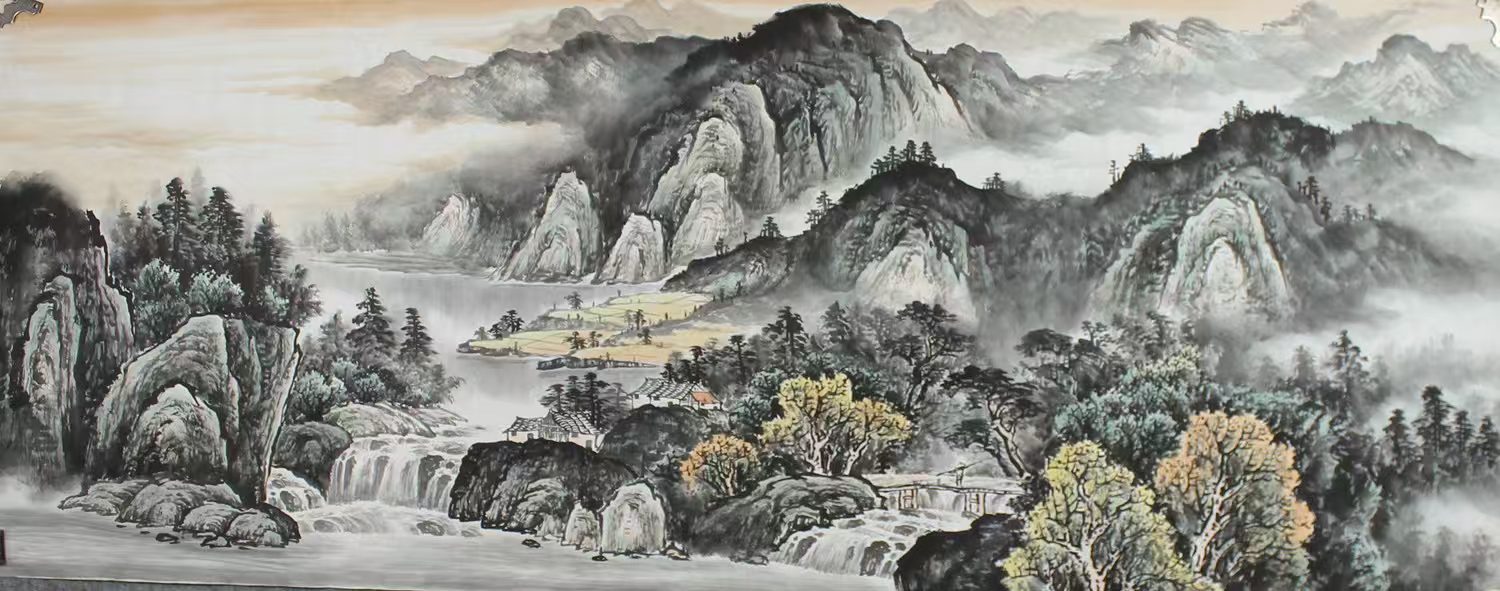
Ink Landscape Painting "Cloudy Mountain Wonderland - Ten Thousand Pieces of Clarity
Single Size
0 Review
*Size
180cm x 70cm "Small Six Feet
$860.00$1,000.00
Special Features:




Description
Paintings featured
- Panoramic landscapes with a chiaroscuro:
- The panorama is spread by the “three far away method”, the main peak is like a giant screen towering, the clouds on the mountainside are dyed into a band of smoke and haze by the “splash ink method”, the rocks in the near view are strengthened by “axe-chopping”, and the peaks in the far view are blurred by “rice-dot chapping”, forming a “thousand miles” sense of spatial depth. “rice point chapped” light ink virtualization, the formation of “thousands of miles at hand” sense of spatial depth;
- The junction of clouds and mountains using the “dyeing method”, ink color from thick to light as breathing in and out, if the virtual place is too virtual piece of cloud, the real place like iron casting tendons, darkly Taoist “virtual room white” of the clarity of the realm.
- The movement and the static are born from each other, and everything has a spirit:
- Ancient trees in the mountains with “crab claw branches” outlines the gnarled branches, pine needles with a fine brush in the center of the cluster, maple leaves with cinnabar dots as if the star fire leaping, bamboo bushes with “median point” cascading as the blue waves, showing the “juxtaposition of four seasons showing the vitality of the “four seasons”;
- Waterfall in three stacks pouring, the top of the mist to dry brush chapping proposed cold smoke and frost, the middle layer of the water flow to “swimming silk depiction” outlines the silver chain flying down, the bottom of the deep pool to spiral ink lines to express the whirlpool turbulence, and the air cranes to form a “dynamic to the static” of the balance of the Zen.
- The details are hidden and the eye is drawn:
- The back of the woodcutter is hidden in the cliff trestle, the bucket hat with a stroke of burnt ink, and the two sections of the stretcher with withered strokes, implying the poetic situation of “not seeing anyone in the empty mountains, but hearing the sound of people’s voices”;
- Deep in the sea of clouds hides a green tiled Taoist temple, the eaves are outlined in titanium white as if the moon is shining at the beginning of the day, and the window lattice is embellished with ochre as if the candle flame is dimly lit, the details build up the narrative tension of the “fairyland smoke and fire”.
Detailed depiction
- Mountain stone texture:
- The backlit surface of the main peak is dyed with seven layers of light ink, the ridges are outlined in burnt ink like the brushwork of seal script, and the mossy spots in the rock crevices are mixed with blue and white ink to save three and gather five, which suggests the vicissitudes of the texture of the “rain erosion and wind cutting”;
- Nearby lying stone surface with “chaotic firewood chapped” intertwined, the sunny side of the white as snow over the rock edges, the dark side of the stone green cover dyeing like moss trails diffuse.
- Forest ecology:
- Ancient pine branches and trunks with “dragon scale chapped” performance cracked bark, pine needles in five groups of “wheel-shaped” radiation, the top of the Shi green highlighting, the bottom of the rendering of shadows with a flower green, follow the “wood to the sun” logic of light and shadow. Following the logic of “wood grows towards the sun”;
- Autumn maple is dyed three times with cinnabar, the leaf veins are outlined in gold to imitate the slanting sun penetration, and the fallen leaves are scattered with ochre like butterflies dancing in the empty valley, which constitutes the philosophical carrier of “a moment of eternity” with the evergreen pines and cypresses.
- Water flow and clouds:
- The middle level of the waterfall uses “nail head and rat tail” to write fast, and the tip of the wave is decorated with clam powder to brighten it up, forming a collision of cold and warmth with the greenish-gray cliffs on both sides;
- Clouds and mist using “wet accumulation method”, the ink color from the foot of the mountain green-gray gradient to the peak of the creamy white, the edge of the water to break the ink to form a plush texture, like a fluffy cloud that can be touched and stroked.
Artistic Value
- Contemporary translation of the Song and Yuan legacy:
- Inheriting the rigidity of Ma Yuan’s “axe-chopping” in the Southern Song Dynasty and the warmth of Huang Gongwang’s “light-red coloring” in the Yuan Dynasty, and integrating the air perspective method of Western painting into the treatment of clouds and fogs, traditional landscapes are revitalized with the new life of “Dialogue between the Ancient and the Modern”. It also incorporates the air perspective method of western painting in the treatment of clouds and mist, giving traditional landscape a new life of “dialog between ancient and modern”;
- The visual poetics of the unity of heaven and man:
- Through the haze of “cloud-locked mountainsides” and the exuberance of “waterfalls cascading down a thousand paths”, the dialectical aesthetics of the Tao Te Ching’s “Great Dexterity is as Great as Awkwardness” is interpreted, and the juxtaposition of the woodcutter and the Taoist view is symbolized. The juxtaposition of the woodcutter and the Taoist view symbolizes the life realm of “entering the world and practicing”;
- Cross-cultural aesthetic container:
- It can be used as a carrier for the oriental study, and its simple composition and color rhythm can be integrated into the modern minimalist space, becoming a visual anchor in the white walls of art museums and the log background of B&Bs.
Suitable Scene
- New Chinese living room: with the official chair and porcelain vase, the flow of clouds and mist can neutralize the heaviness of mahogany furniture, creating an elegant atmosphere of “not down the hall feast, sitting in the forest spring”;
- National academy: as a contemporary echo of the “Xi Shan Xing Gui Tu”, with the display of bamboo books, guiding the students to realize the “materialism and knowledge” of the landscape way;
- Executive Office: mounted on a walnut screen, the stability of the mountains symbolizes the foundation of the company, the movement of the sea of clouds is a metaphor for strategic leaps, and the waterfall implies the auspicious meaning of “prosperity”.
Purchase
- Framing Program:
- Traditional style: damask silk framed as a blue and green landscape vertical scroll with a rosewood carved cloud patterned header, suitable for ceremonial scroll display and enjoyment;
- Contemporary style: aluminum alloy narrow frame with matte acrylic panel, retaining the natural seepage of the edge of the clouds, suitable for LOFT industrial style space.
- Conservation Guide:
- Avoid direct sunlight to cause mineral pigment fading, it is recommended that every three years to ask a professional master with the ancient method of “full-color” repair;
- When removing dust, cover the picture with ripe Xuan, and sweep it gently in one direction with a badger brush, and wipe the moldy spots with white wine and Xionghuang powder.
✨ Core highlights
- Three far into the painting: high and far to see the mountains and steep, deep and far to explore the valley and the strange, flat and far to see the clouds and clouds, a painting of the essence of Guo Xi’s “Linquan Gaozhi”;
- Five senses are connected: watching the clouds can feel the moist mountain wind, listening to the waterfall is like hearing the echo of the valley, tasting the pine is like touching the gnarled branches of the old tree, realizing the immersive experience of “there is a realm in the painting”;
- Folding of time and space: morning and evening light and shadow are combined with the four seasons of grass and trees, so that the majesty of Fan Kuan’s “Journey to the Streams and Mountains” and the ethereal spirit of Mi Youren’s “Wonderful View of Xiaoxiang” can resonate together here.
Collection Significance
Cloudy Mountain Wonderland – Ten Thousand Images of Clarity” is not only a landscape on paper, but also a “gene pool of oriental aesthetics”. Whether it is used as a family heirloom to continue the cultural lineage of “mountain and water are more than virtue”, or hung in modern space to show the aesthetic taste of “obtaining the source of the heart”, it allows the viewer to think of Wang Wei’s “white clouds looking back, green mist looking into nothing” in between the intensity of the ink and the light. The Zen-like wonder of Wang Wei’s “white clouds looking back, green mist looking into the sky” can make the viewer think of a place of seclusion in the reinforced city.

 Product Reviews
Product Reviews
Write A Review
Related Products