




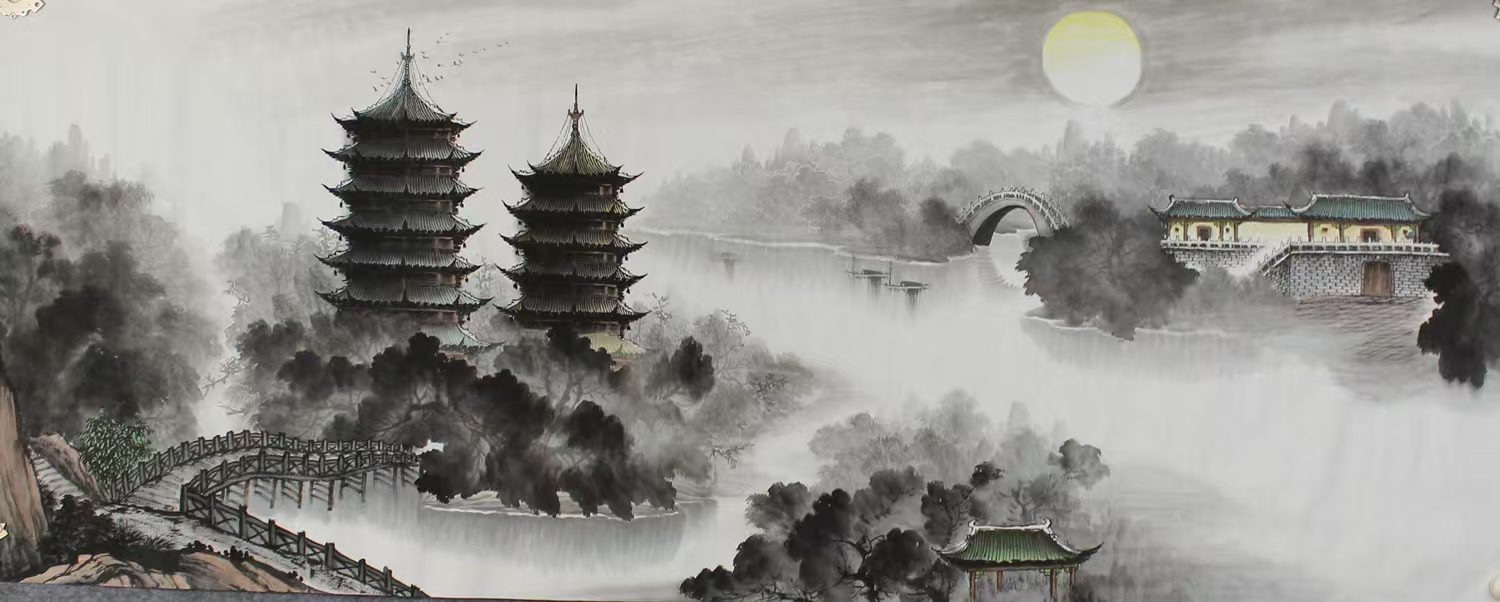
Ink and Color Painting "Smoke and Rain in Jiangnan-Ink and Dense
Single Size
0 Review
*Size
180cm x 70cm "Small Six Feet
$850.00$1,000.00
Special Features:



Description
Paintings featured
- Dense ink and gray scale creates a realm:
- Gray-scale ink is the main tone, rendered in layers through the technique of “wet brush and broken ink”, the sky and the water are blended as a smoky veil, the distant mountains are defocused with light ink, and the near scene is refreshed with thick ink, constructing the ethereal mood of “near reality and far emptiness” of the smoky rain;
- Towers, arched bridges and weeping willows are outlined in burnt ink, with sparse and dense lines, forming a visual rhythm of “flesh and bone” with the ink-dyed background.
- The poetic layout is appropriate to the movement and static:
- The towers are scattered in the middle of the picture, the eaves and corners are sketched with “nail head and rat’s tail strokes”, the tiles are dyed with light ink to imitate the mottled rain traces, and the window panes are left in white as if translucent light, concealing the meaning of life of “there are people in the pavilions in the rain”;
- The ripples on the surface of the water are described by “silk stroke”, and the moonlight is lightly dotted with titanium white like broken silver, which overlaps with the reflection, forming the “one color of water, static and dynamic” charm of Jiangnan.
- The eye of the living spirit, wild and interesting:
- Willow branches overhanging the water, the leaves with “mesquite point” cascade, the ink color from thick to light analogous to the rain and dew infiltration, between the branches of the hidden lonely boat a leaf, fisherman Demoiselle a burnt ink condensation, the details of the implicitly “fishing alone in the cold river snow” of the literati arrogance.
Detailed depiction
- Architecture and Nature:
- The bricks and tiles of the tower are chapped with light ink, and the wind chimes at the eaves are sketched with burnt ink, which are hidden in the rain and fog;
- Arched bridge arc like the moon, the bridge reflection with wet ink coloring, and the real bridge to form a contrast between reality and reality, the bridge surface slate with withered pen flying white proposed wear and tear over the years.
- Trees and Water:
- Willow branches to “crab claw chapped” performance of gnarled posture, willow leaves are divided into three groups of clusters, near the ink is as dense as a diadem, far away from the light as light smoke;
- Water ripples to “net towel water” technique of interweaving fine lines, moonlight reflection at the white as a mirror, the edge of the light blue light dyeing to simulate water vapor.
- Light and shadow and atmosphere:
- The sky to the blue mixed ink gradient, the edge of the clouds water broken ink to form a plush texture, rain to dry brush silk hair technique oblique sweep, seemingly absent;
- The eaves of the tower are brightened with titanium white to simulate the light of the sky after the rain, and the moss traces on the ground are lightly dotted with stone green.
Artistic Value
- A visual poem of Jiangnan culture:
- Through the imagery combination of smoke and rain, pavilions and water waves, the symbols of Jiangnan “small bridges and running water” are sublimated into an ink and wash mood, interpreting the oriental philosophy of “the unity of heaven and mankind”;
- Concentration and innovation of traditional techniques:
- Combining the craftsmanship of Song Dynasty courtyard painting and the literati painting of Yuan Dynasty, the gray scale ink and wash levels control is in line with the logic of western painting, breaking through the traditional rain scene theme of programmed expression;
- A carrier of emotional resonance across time and space:
- Not only can it be used as a bookstore “reclining tour” for elegant appreciation, but also its hazy mood can be connected with modern minimalist space, triggering the viewer’s poetic reverie of the Jiangnan water town.
Suitable Scene
- Study/tea room: framed in a plain wooden frame, with celadon tea set and bamboo incense sticks, the flow of rain and mist can activate the aura of the space, creating an elegant literati environment of “windows containing smoke and rain, curtains rolled with ink”;
- Hotel/Club Lobby: The giant painting is presented on the light gray art wall, where Jiangnan imagery collides with modern design, conveying the cultural concept of “Oriental aesthetics meets contemporary life”;
- Cultural theme exhibition hall: as the core visual symbol of Jiangnan culture exhibition, with sound and light installations to restore the sound of gurgling rain, creating an immersive viewing experience.
Purchase Information
- Framing suggestions:
- Traditional: framed as a hand scroll on azure damask silk, with a rosewood carved water ripple patterned box, suitable for Chinese style spaces;
- Contemporary style: frameless acrylic suspension framing, retaining the original ink bleed of the picture, suitable for minimalist style.
- Conservation Guide:
- Avoid direct sunlight to cause ink fading, it is recommended that every year before the rainy season to ask the non-heritage master with the ancient method of “full-color” repair;
- Dusting covered with silk, wool board brush one-way light sweeping, humid areas need to be equipped with constant temperature and humidity display cabinets.
✨ Core highlights
- Four times of Jiangnan: spring rain, summer willow green, autumn moon reflection, winter fog condensation cold, a volume of the four seasons of the water town;
- Five senses: watching the rain can be touched by the moist breeze, listening to the waves seems to hear the sound of the sculling boat, tasting the ink is like sniffing the fragrance of rice paper, realizing the immersive experience of “swimming in the painting”;
- Dialogue between the ancient and the modern: the spirit of Ma Yuan’s “Water Picture” and Wu Guanzhong’s abstraction of ink mingle here, so that the traditional Jiangnan and contemporary aesthetics compose a new chapter.
Collection Significance
Smoke and Rain in Jiangnan – Dense Ink is not only an ink painting, but also a “liquid poem of oriental aesthetics”. Whether as a visual archive of Jiangnan culture, or suspended in modern space to convey the concept of poetic living, it allows the viewer to think of Du Mu’s thousand-year lament of “four hundred and eighty temples in the South, many buildings in the smoky rain,” and to guard a side of the soul of the crow’s nest amidst the hustle and bustle of the city, in the midst of the ink and color dizziness.

 Product Reviews
Product Reviews
Write A Review
Related Products