




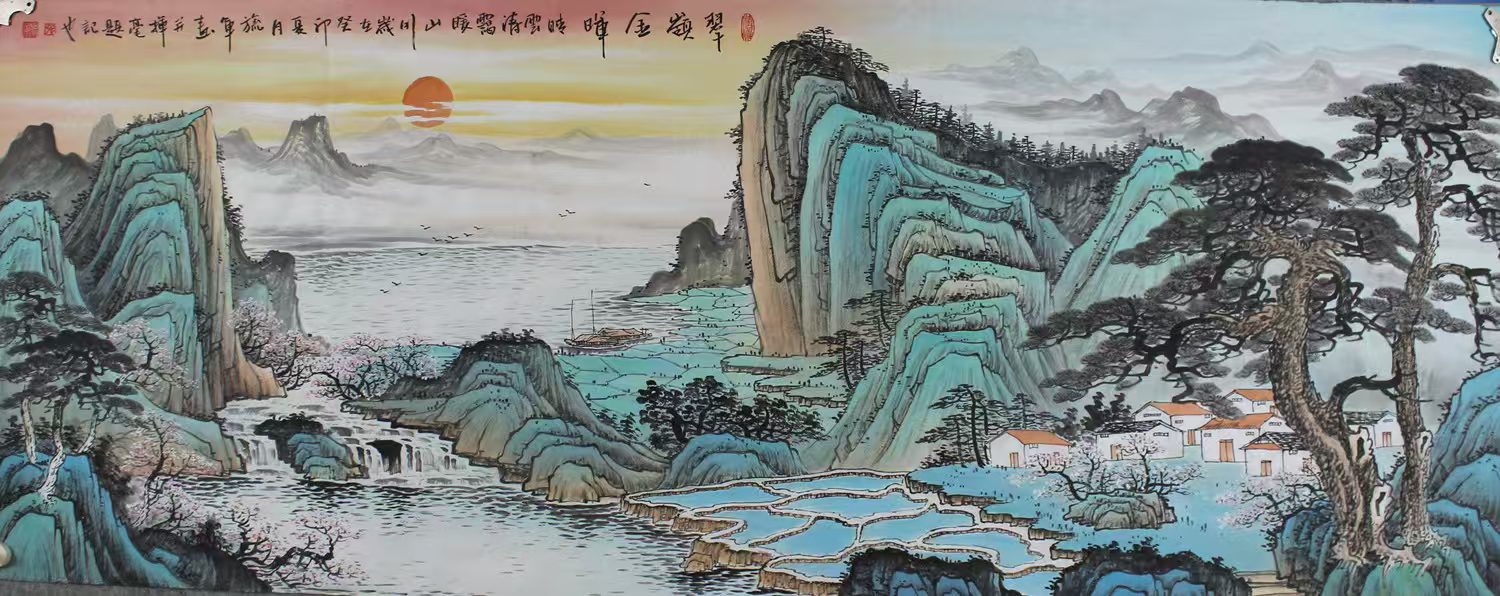
Green Landscape Painting "Cold Goose and Clear River-Crested Peak and Clear Villa
Single Size
0 Review
*Size
180cm x 70cm "Small Six Feet
$860.00$1,000.00
Special Features:




Description
Paintings featured
- Traditional green and blue, with a blend of color and ink:
- The painting is based on a green landscape, with the peaks of the mountains covered in layers of stone green, the foot of the mountains in ochre to simulate the texture of earth and stone, and the sky in a gradation of light blue, hiding the time and space meaning of the “morning sunrise”;
- The geese are outlined in burnt ink, with their wings spreading like the brushwork of seal script, forming a visual rhythm of “contrasting work and writing” with the fine brushwork of the houses in the mountains.
- The landscape is a narrative, and the movement and static are appropriate:
- The main peak is as high as a screen, the clouds on the mountainside are blurred by the technique of “wet brush and broken ink”, the stream is outlined by the technique of “wandering silk”, and the waves are embellished with titanium and white like the splashing of broken jade;
- The houses in the mountains are finely depicted with the technique of boundary painting, the tiles are colored with indigo, the window panes are left white like translucent light, and the details conceal the life interest of “hermits living in seclusion”.
- The inscription adds the finishing touch to the painting, adding brilliance to the stone and stone:
- In the upper left corner of the picture, it is inscribed with “Cold geese and clear villa, clear green mountains and rivers”, with a regular script like the breeze of a pine tree, and inscriptions in vermilion, “Made in the year of Kangxi”, and “Inscribed by the Historical Records” in white, with a strong and vigorous seal cutting technique, which echoes the texture of the mountains and rocks. The seal-carving style is strong and pale, echoing the texture of the rocks and mountains.
Detailed depiction
- Mountains and water flow:
- The backlit surface of the main peak is chapped with azure moss traces, the rock crevices are embellished with cinnabar-colored wild maple, and the top of the mountain is painted with titanium white to simulate the remaining snow;
- The stream is divided into three folds and twists and turns, the middle rapids to “nail head rat-tailed description” outline the waterline, near the bank of the water plants to burnt ink “mesquite point” layers, floating pimple stone green light points such as jasper floating waves.
- Spirit and humanity:
- Cold geese fly in the shape of “human”, with light ink and silk feathers, and the tip of the beak is dotted with cinnabar as if it is holding Danxia, forming a balance of motion and stillness with the quietness of the houses in the mountains;
- The path in front of the house is outlined in ochre, showing a woodcutter walking with a loaded load, his hat in burnt ink and his clothes in withered ink to simulate the mountain wind blowing on his clothes.
- Color and light:
- The morning sunlight sweeps over the peaks in vine yellow, colliding with the green mountains to form a collision of warmth and coolness, and the sky changes to light purple like a thin veil overlay;
- The eaves of the house are left white like plating the morning light, and the windows are lightly colored with rouge to simulate the candlelight, concealing the poetic meaning of “the clear sky reflects the golden glow of the cold house”.
Artistic Value
- Inheritance and Innovation of the Ming and Qing Courtyard Style:
- Integration of the Qing dynasty “four kings” green landscape work of elegance and the Southern Song dynasty Ma Yuan “axe chapped” strong brushwork, the house boundary painting technique is rigorous, cold geese writing free, showing the “courtyard style and literati paintings The aesthetic blend of “courtyard style and literati painting”;
- The visual expression of literati seclusion:
- By contrasting the imagery of “geese flying high in the cold” and “the quietness of the mountain house”, interpreting the free spirit of “free travel” of Zhuangzi, the inscription “Shiji title The inscription “Shiji” conceals the cultural weight of the depth of history;
- Aesthetic resonance across generations:
- It can be used as a traditional study for “lying down” appreciation, and its green coloring and compositional balance can also connect with modern home aesthetics, becoming a visual focus in both Chinese space and minimalist style.
Suitable Scene
- Chinese living room / study: framed in mahogany frame, with celadon vase and bamboo screen, the tranquility of the landscape can activate the aura of the space, to create “open the door to see the mountains, people in the painting” of the elegant atmosphere;
- Cultural theme tea room: with alabaster tea sets and inkstone display, the painting of the hidden mood can be emphasized “a tea, a realm, a Qiankun” Zen;
- Corporate club lobby: a huge framed in light gray art wall, the stability of the mountains and rivers symbolize the foundation of the enterprise, the movement of the stream metaphor for the development of vitality.
Purchase
- Framing suggestions:
- Traditional style: azure damask silk mounted on an established scroll with a rosewood carved cloud pattern scroll head, suitable for elegant gatherings to display scrolls for tasting;
- Contemporary style: ultra-thin aluminum frame lined with matte linen backing, retaining the original saturation of the lime green color.
- Conservation Guide:
- Avoid direct sunlight to cause the stone green color fading, it is recommended that every five years to ask the non-heritage master with the ancient method of “full-color” repair;
- When dusting, cover the silk image, use the badger brush to sweep gently in one direction, and put acid-free moisture absorber in the humid season.
✨ Core highlights
- Four times into the painting: the morning sun dyeing peaks, afternoon forest verdant, twilight mist condensation purple, night mountain with daisy, a volume of time flow;
- Five senses: the mountains can be touched by the moist breeze, listening to the stream seems to hear the echo of the empty valley, tasting the house like smelling the pine smoke and ink, realizing the immersive experience of the “painting in the realm”;
- Dialogue between the past and present: the magnificent green of Wang Ximeng’s “Thousands of Miles of Rivers and Mountains” and the spirit of Shi Tao’s “theory of one painting” are blended here, allowing the traditional courtyard to collide with the aesthetics of the literati for a new life.
Collector’s significance
Cold Goose Clear River – Cuifeng Qingshu” is not only a landscape scroll, but also a “time and space hand scroll of oriental aesthetics”. Whether it is used as a family heirloom to continue the cultural gene of “the benevolent people are happy with the mountains”, or suspended in the modern space to show the aesthetic realm of “getting the source of the heart”, it allows the viewer to think of Tao Yuanming’s “picking chrysanthemums under the east hedge and leisurely seeing the south mountain” in the dense green atmosphere. Seeing the South Mountain at ease” of Tao Yuanming, and keep the peach source of the mind in the hustle and bustle of the world.

 Product Reviews
Product Reviews
Write A Review
Related Products