





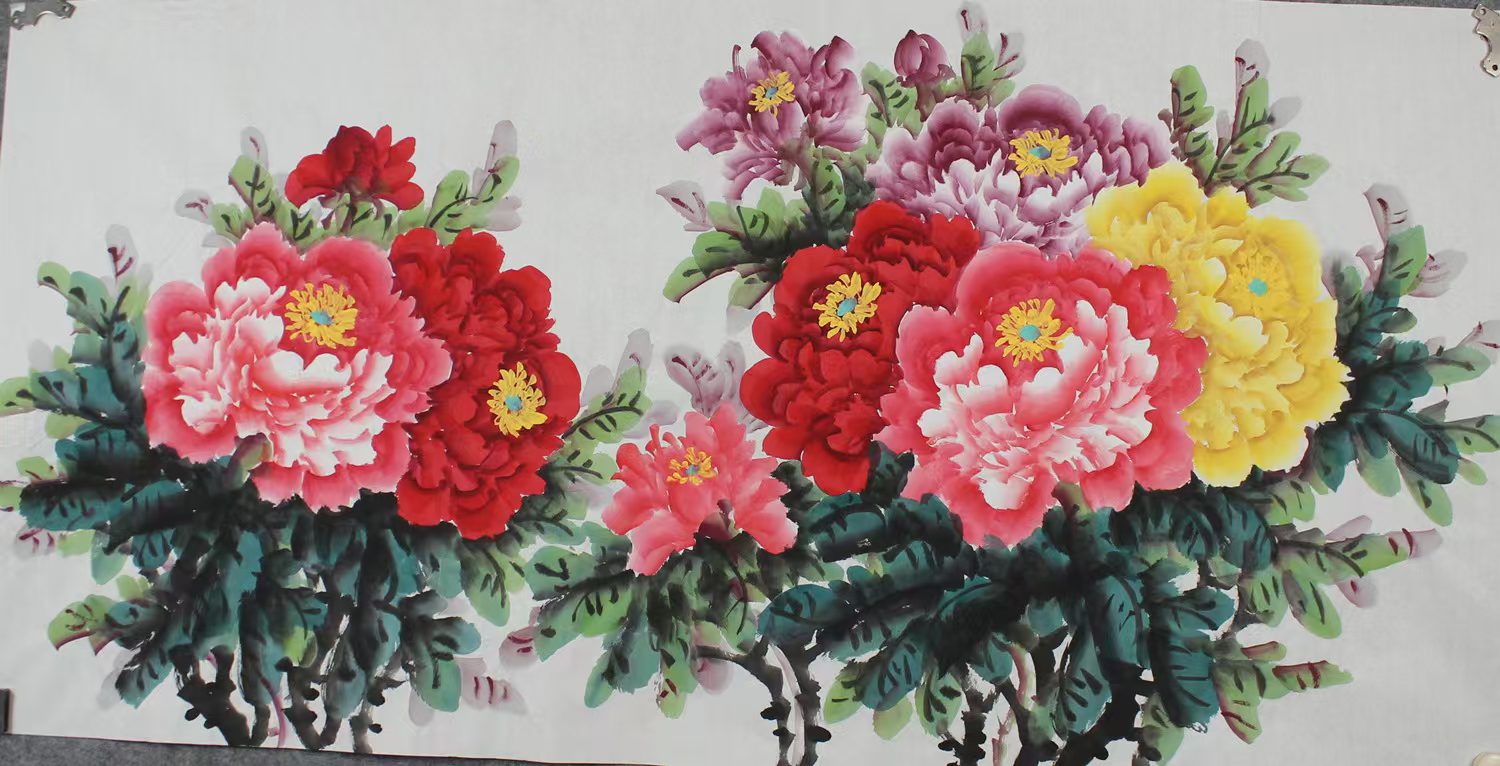
Work-brush Flower and Bird Painting "Blossom and Riches-Blossom and Heavenly Fragrance
Single Size
0 Review
*Size
138cm x 69cm "Four Feet Full Open
$850.00$1,000.00
Special Features:




Description
Paintings featured
- The ultimate rendering of heavy brushwork:
- Symphony of colors: Cinnabar, rouge, vine yellow, stone green and other mineral pigments are layered on top of each other to create the translucent texture of the petals through the “three alums and nine dyes” technique, with red peonies blazing like flames, pink peonies as soft as sunshine, and yellow peonies as graceful as gold, creating a feast for the eyes;
- Subtle realism: the edges of the petals are delicately curled with the technique of “silk tracing”, the stamens are outlined with gold powder like stars, the front and back of the leaves are dyed with stone green and dark green, and the veins of the leaves are accurately etched with the technique of wire tracing, demonstrating the “One Leaf, One World The veins of the leaves are accurately etched with iron lines, showing the craftsmanship of “one leaf, one world”.
- Contemporary expression of traditional symbolism:
- The three main flowers are hidden in the peony bush, symbolizing the three wishes of “happiness, wealth and longevity”, and the dew marks are dyed with light ink between the layers of green leaves, which is a metaphor for “everlasting wealth and prosperity”.
Detailed depiction
- Peony pouring:
- The main red peony has nine layers of petals, the outer layer of rouge is dyed like satin, the inner layer of cinnabar is like the sunset, and the center of the flower is covered with golden stamens, like the imperial crown with jewels and jades;
- The pink peonies on the side half cover their shy faces, the tips of the petals are dipped in titanium white to brighten them up, just like a beauty’s cheeks flying red; the yellow peonies are dyed with orpiment, and the buds are tightly wrapped around the green calyx, just like a gold ingot adorning the emerald branches.
- Ecological Narrative:
- The old branches are as gnarled as dragons exploring the sea, with cracks of years chapped by burnt ink; the new branches are dyed with green juice, and the young shoots are awakened by stone yellow; the philosophical thoughts of life are hidden between the contrasts of withering and honoring;
- In the background, the shadow of the bamboo can be seen, which not only balances the composition of the picture, but also metaphorically refers to the literati style of “the rich and the noble will not change the gentleman’s temperament”.
Artistic Value
- Technique inheritance and cultural symbols:
- Inheriting the spirit of the Song dynasty’s courtyard style of birds and flowers, and integrating the colorful ink of the Qing dynasty’s Yun Shouping’s “boneless method”, the petals of the flowers are dyed as if they were inked on raw Xuan Xuan, and the leaves are dyed as if they were silks;
- The inscription in seal script, “The National Colors are Unmatched”, is inscribed on the upper left, and the vermilion seal, “Fancy Forever”, is inscribed on the lower right, forming a classical layout of “diagonal echoes” and reflecting the beauty of painting and calligraphy of the same origin.
- It has the dual properties of decoration and collection:
- The picture is magnificent without losing elegance, which can be used as the visual focus of modern homes, but also has the academic value of studying traditional brushwork techniques;
- If it is the handwriting of a famous artist, its color innovation (such as the modern glossy use of titanium white and gold powder) has more potential for market appreciation.
Suitable Scenery
- Main wall of living room: hanging on the sofa background wall, with mahogany furniture and cloisonné vase, instantly enhance the space of noble atmosphere;
- Chinese banquet hall: as the main background painting, with carved screens and palace lamp arrays to create a banquet atmosphere of “blooming flowers”;
- Hall of Cultural Institutions: displayed in the reception area, with the decomposition of brush painting techniques on display boards, becoming a vivid carrier of traditional cultural education.
Purchase Information
- Framing suggestions:
- Palace style framing: Ming yellow ground with crane pattern damask frame, with rosewood relief frame, reproducing the royal aesthetics of the Qing Dynasty “Office of the Maker”;
- Modern minimalist frame: matte metal fine frame + gilt rice paper cardboard, weakening the traditional sense of heaviness, suitable for urban apartment space.
- Conservation Guide:
- Avoid light and moisture: store in an environment with less than 60% humidity, and avoid direct sunlight that causes mineral pigments to oxidize;
- Professional dusting: monthly soft brush with sable bristles to flick the picture along the texture, stubborn stains need to be handed over to the painting and calligraphy restorer to deal with;
- Display taboos: away from the kitchen fumes, strong light environment is recommended to install UV museum-grade glass.
**✨ Hide the ingenuity **
- Miniature Poem: The back of the leaf is inscribed with Li Bai’s poem “The Clouds Want Clothes, The Flowers Want Looks” in small caps, which can only be seen when viewed in side-light;
- Light and shadow code: the highlights of the petals are stacked with clam powder, which gives a three-dimensional relief effect under the light, simulating the concave and convex texture of real petals;
- Metaphor of the four seasons: the picture contains the first bloom (spring), blooming (summer), fruiting (fall), and withering (winter), implicating the way of reincarnation of all things.
Significance of the Collection
Flowering Fortune – Embroidery of Heavenly Fragrance” is not only a peak presentation of brushwork skills, but also an epic of blooming oriental aesthetics. The overlapping petals show the prosperity of the world; the intertwining branches and leaves realize the cycle of withering and rebirth. If you hang this painting in your room, there is no need to fill your door with gold and jade, but you will have your own national color and fragrance.

 Product Reviews
Product Reviews
Write A Review
Related Products