




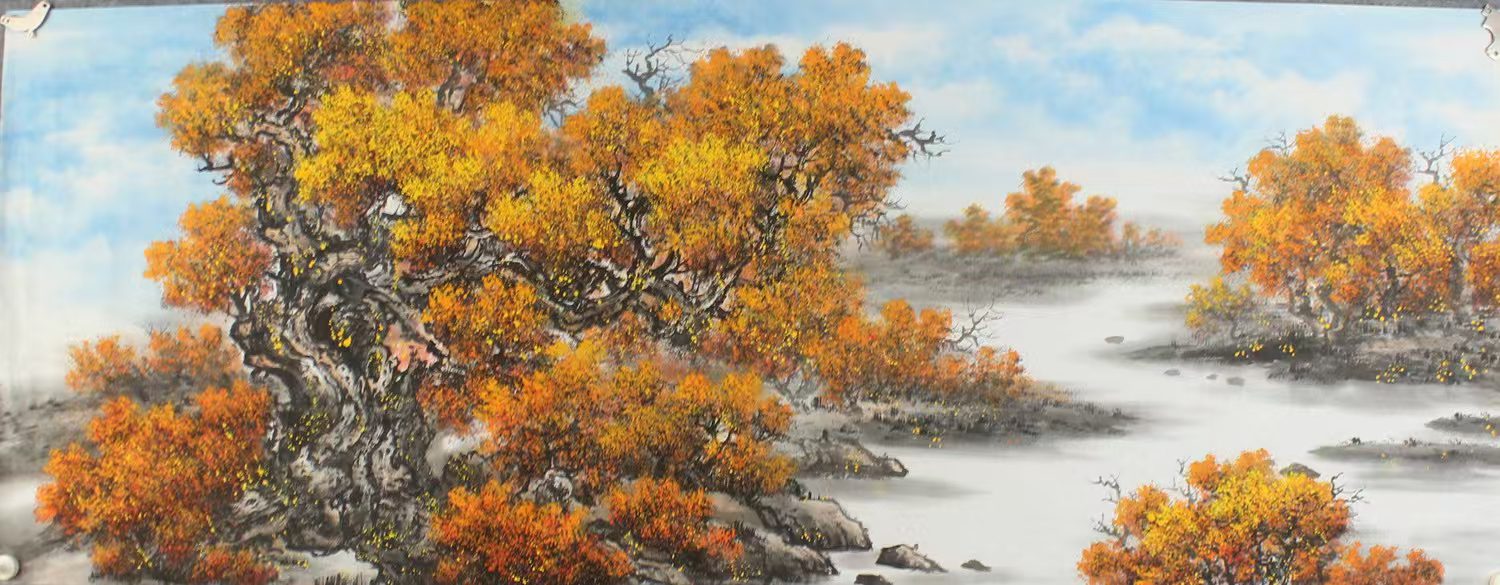
Ink and heavy color painting "Autumn - Poplar Gilt
Single Size
0 Review
*Size
180cm x 70cm "Small Six Feet
$860.00$1,000.00
Special Features:




Description
Paintings featured
- Golden Autumn Blaze, Salute to Life:
- Taking the poplar forest as the main body, the painting is rendered in gold, orange and ochre, and the leaves are dyed layer by layer by the “overlapping dyeing method”, simulating the transparent texture of the sunlight penetrating the leaf veins, showing the blazing vitality of the desert’s autumn colors;
- Branches and trunks of the tree are coiled and twisted like gnarled dragons, and the texture of the bark of the tree is “chapped with withered brushes” to portray the vicissitudes of the millennium, which forms a visual impact of “rigid and soft symbiosis” with the golden leaves.
- Space narrative, light and shadow magic:
- The background sky is pushed far away with gradient green-gray, the ridgeline is brightened with titanium white to simulate sunlight reflection, and the sky is dyed with light purple and light orange by the “wet painting method” to conceal the poetic meaning of “dancing with the sun and the mist at dawn and twilight” in space and time;
- The ground gravel is densely covered with ochre particles using the “moss-dotting method”, and the scattered dead leaves are dotted among them, revealing the natural cycle of “prosperity and silence” in every detail.
- The combination of work and writing is a perfect combination of form and spirit:
- The leaves are finely drawn with brushstrokes, with gold lines on the edges to simulate the refraction of sunlight; the branches and trunks are written in spice, and the ink is thick and light, implying the calligraphy’s fleur-de-lis brushstrokes, which creates an aesthetic balance of “subtlety and boldness”.
Detailed depiction
- Poplar gesture:
- The main trunk is twisted like a dragon in the sky, the scars are dyed with vermilion to simulate the scars of the years, and the roots are exposed with coiled stones, which is a metaphor for the spirit of poplar, which is “born and will not die for a thousand years”;
- The leaves are colored in four layers: the bottom layer is ochre, the middle layer is garcinia cambogia, the surface layer is brightened with gold powder, and the tips of the leaves are dotted with rouge to simulate the dipping of autumn frost, and the light and shadow are intertwined like the flow of gilt.
- Background ecology:
- The camel caravan in the distance is presented in silhouette, the camel outline is outlined in burnt ink, the pack is embellished with indigo and vermilion, forming a color collision with the golden leaves;
- In the air, the geese are arranged in a herringbone shape, with their feathers dyed in light ink, as if they are traveling through the sunlight, giving the picture a dynamic narrative.
- Layers of light and shadow:
- The backlit side of the tree trunks is rendered in cool-toned shadows with a mixture of blue and black ink, while the lighted side is left in white like gold leaf plating;
- Ground projection with “mesh chapping” interweaving deep ochre and charcoal black, simulating the folded texture of sand dunes under the slanting sun.
Artistic Value
- Visual transformation of a natural epic:
- Through the imagery of the poplar “desert hero tree”, the desolation of the wilderness is sublimated into a hymn to life, with both geographical symbolism and humanistic symbolism;
- Contemporary expression of traditional techniques:
- Combining Song Dynasty bird and flower brushwork with Dunhuang mineral colors, the gold tones are embedded in a green landscape mood, breaking through the programmed expression of autumn landscape themes;
- Cross-cultural resonance carrier:
- It can be used as the focal point of the new Chinese space, and its intense colors and abstract texture can also connect with modern decorative arts, triggering a philosophical dialogue between “life and time”.
Suitable Scene
- Main wall of living room: huge framed on beige rock plate background, poplar gilt and leather/metal furniture collision, symbolizing the warm meaning of “home is like an oasis”;
- Corporate Lobby: Desert-themed art installation conveys the corporate culture of “resilience and upward mobility”, and the streamlined framing strengthens the sense of depth of the space;
- Tea room/study: silk albums are displayed on the Pokou shelves, and the golden color of the autumn leaves is reflected with the purple sand and bamboo utensils, which alludes to the literati’s interest in “knowing autumn by its leaves”.
Purchase
- Framing Program:
- Traditional: antique silk mount with carved poplar wood frame, the texture echoes the tree trunk in the painting, suitable for cultural themed spaces;
- Contemporary: frameless acrylic suspension framing, retaining the mottled ink, in line with the minimalist style.
- Conservation Tips:
- Avoid direct spotlights on the gold dust part, and use a wool brush to gently sweep the floating dust in the fall;
- Humid areas equipped with electronic moisture-proof box, mold emergency treatment can be used high purity white wine gently wipe and contact professional restoration.
✨ Core highlights
- Three thousand years of time and space folding: poplar newborn branch, strong dry, dead wood in the same frame, solidified “life, death, immortality” of the epic of life;
- Five Senses Theater: Hearing the tinkling of camel bells and feeling the roughness of wooden frames, realizing a multi-dimensional art experience;
- Regeneration of civilization symbols: Dunhuang gold and blue collide with literati ink, allowing Zhang Daqian to splash colors and Xu Beihong to reach an aesthetic reconciliation.
Collection Significance
Autumn Love – Poplar Gilding” is not only a painting, but also a “gene pool of desert aesthetics”. Whether as a visual archive of the Silk Road culture or a totem of contemporary spatial energy, it allows the viewer to hear Wang Wei’s thousand-year-old aria of “the lonely smoke of the desert” between the golden waves, and to guard a spiritual oasis in the steel city.

 Product Reviews
Product Reviews
Write A Review
Related Products