




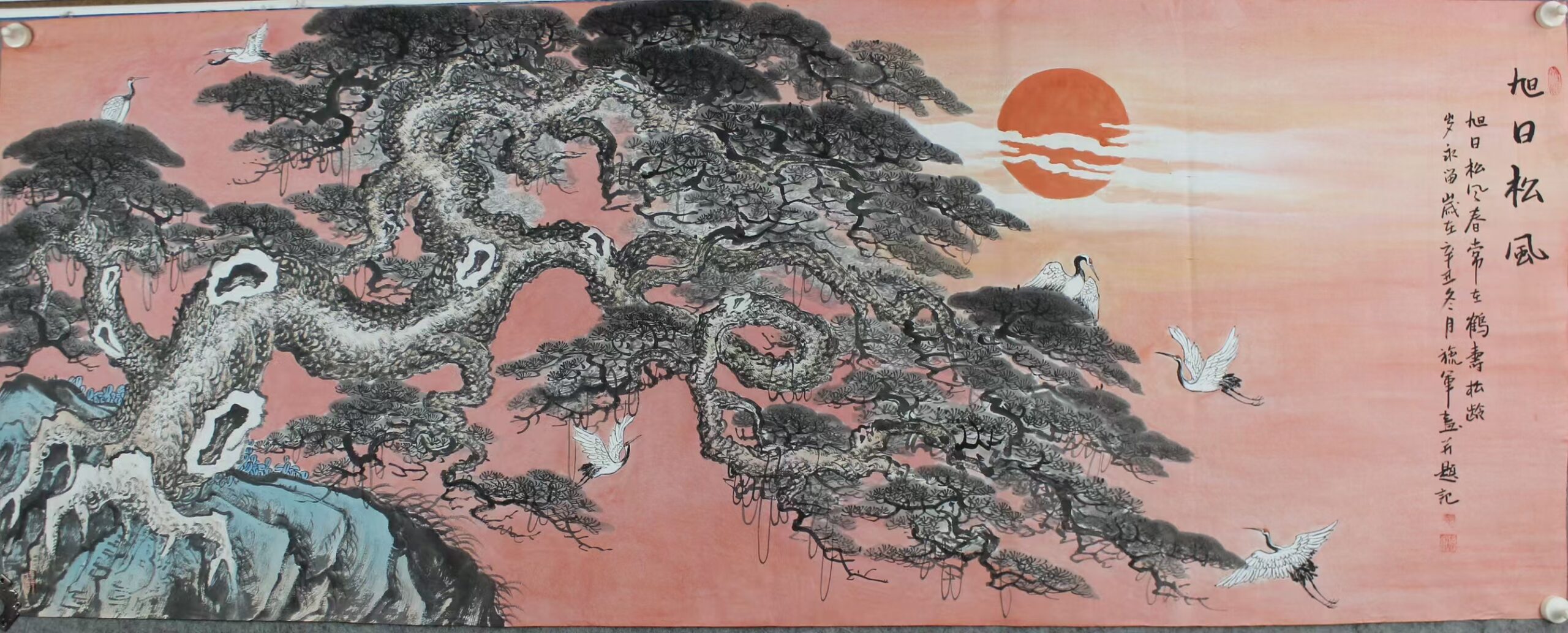
Ink and Color Painting "Crane Longevity and Pine Age - Rising Sun and Pine Breeze
Single Size
0 Review
*Size
180cm x 70cm "Small Six Feet
$860.00$1,000.00
Special Features:




Description
Paintings featured
- Traditional imagery, auspicious narrative:
- The three core elements of the painting are the pine, the crane and the rising sun. The main trunk of the pine tree is painted with “crab-claw chapping” to outline the gnarled branches, the bark of the tree is chapped with charcoal ink to simulate the vicissitudes of life, and the pine needles are clustered with a fine brush in the middle stroke to show the toughness of the “thousand-year pine bones”;
- The white crane is depicted with the silk hair technique, with light ink and coloring on the feathers, the tip of the beak is dotted with vermilion as if it is holding the Danxia, and the gesture of spreading the wings is like the brushwork of the seal script, which is in balance with the stillness of the pine tree to form the aesthetics of “the movement of static and static”.
- The color and ink are in symphony, and the light and shadow are in a poetic state:
- In the background, the rising sun is overlaid with vermillion three times, the edge of the painting is outlined with gold lines to reflect the halo, the sky is dyed with rouge and rattan yellow, and the clouds and sunshine are like flames burning in the sky, which is in line with the blazing mood of the title “Rising Sun and Pine Winds”;
- The backlit side of the pine forest is rendered in cool shadows with mixed ink and blue, the lighted side is left white like gold plating, and the moss dots on the ground are densely covered with ochre particles, revealing the natural vitality of “the earth bathed in glory” in every detail.
- The inscription is written in jinshi, and the style is strict:
- In the upper right corner of the picture, it is inscribed with “Heshou Songling” and “Rising Sun and Pine Wind,” with a line of regular script like the gnarled branches of a pine, and inscriptions in vermilion, “Dejun Recruitment Script,” and “Latto,” in white, in seal script. The seal script is pale and ancient, echoing the texture of the pine tree;
- In the lower left corner, the inscription reads “In the winter month of the year xinchou”, with a sparse and dense calligraphic layout, concealing the traditional chapter of “heaven is round and earth is square”.
Detailed depiction
- Pine and Crane Subtlety:
- The main trunk of the pine tree is scarred with ochre dyed to resemble the scars of time, the roots are exposed as a dragon claw grasping the ground, the pine needles are divided into five groups in the form of a “wheel-like” radiation, the top of the stone green to highlight the lighted surface, the bottom of the blue rendering shadows;
- The crane’s neck feathers are layered with light ink, the wing tips are brightened with titanium white like snow blades, the feet are staccato with burnt ink to imitate walking on the wind, and the pupils of the eyes are dotted with a bit of rattan yellow to show the spirit of the living.
- Layers of light and shadow:
- The edge of the rising sun with water to break the ink to form a halo seepage, the clouds using the “powder method” so that the natural blend of vermilion and titanium white, like molten gold flowing into the sky;
- Pine forest ground to “chaotic firewood chapped” sketch of falling leaves layered, between the stone green moss points densely covered, proposed “pine shade over the ground” of the deep mood.
- The title trekking evidence:
- “Heshou pine age” four words thick and heavy official script, “the rising sun pine style” cursive strokes like pine waves surging, seal “pulling the teeth” using the cutter method of carving, the sidebar is broken like an ancient monument topiary, adding a sense of historical weight. The seal “La Tooth” is engraved by the cutting method, and the sidebar is broken like an ancient tablet, which adds a sense of history.
Artistic value
- Sublimation of traditional auspicious themes:
- It elevates the folk symbolism of “prolonging life with cranes” to the literati painting context, combining the craftsmanship of Song Dynasty courtyard painting with the spontaneity of Ming and Qing Dynasty pictorialism, creating a new artistic realm of auspicious themes;
- A breakthrough expression of color and ink techniques:
- The blazing sun of vermilion sand and the cold silence of flowers and pine shade form the visual philosophy of “yin and yang”, and the golden line outlining draws on the technique of fresco painting, which makes the traditional coloring glow with modern tension;
- Cultural symbols resonate across generations:
- It can be used as a birthday gift to convey good wishes, and its composition and color can be connected to contemporary space aesthetics, becoming a spiritual totem in tea rooms, study rooms, and art exhibition halls.
Suitable Scene
- Main wall of living room: mounted on dark wood background, the golden and vermilion colors of the pine and crane form a visual focal point with Chinese furniture, symbolizing “good fortune and longevity in the family”;
- Lobby of a cultural institution/corporation: a large format on a light gray art wall, the toughness of the pine tree is a metaphor for the spirit of the enterprise, and the spirit of the crane dance symbolizes the vitality of development;
- Longevity Banquet: as the centerpiece of the birthday celebration theme, it is paired with a celadon incense burner and a mahogany table to strengthen the sense of cultural rituals of “Pine and Crane in Spring”.
Purchase Information
- Framing suggestions:
- Traditional: antique silk mount with redwood carved pine pattern frame, echoing the theme of the picture, suitable for Chinese space;
- Contemporary style: frameless acrylic suspension framing, retaining the original ink color seepage of the picture, in line with the minimalist style.
- Conservation Guide:
- Avoid direct sunlight leading to oxidization and darkening of the cinnabar, it is recommended that every three years with a soft silk cloth to gently wipe the picture floating dust;
- Humid areas need to be equipped with constant humidity moisture cabinet, if there is mold and mildew need to immediately contact a professional restorer using the “ancient method of full-color” repair.
✨ Core highlights
- Folding time and space: the pine tree’s “thousands of years of vicissitudes” and the crane’s “momentary movement” in the same frame, solidifying the “eternal and instantaneous” philosophy of life;
- Five senses: the view of the pine can touch the rough bark of the tree, listen to the wind like hearing the rustling of the pine waves, taste the crane as seen walking in the clouds, realizing the immersive experience of “outside the picture”;
- Ancient and modern dialogue: the royal weather of Song Huizong’s “Ruihe Tu” and Bada Shanren’s lonely writing in this blend, so that the auspicious theme beyond the folklore, sublimation of art classics.
Collection Significance
Crane Longevity and Pine Age – Rising Sun and Pine Breeze” is not only an auspicious painting, but also a “poem of life with oriental aesthetics”. Whether as a “totem of good fortune and longevity” inherited by the family, or hanging in the modern space to highlight the cultural taste, can make the viewer in the vermilion and gold, remote thinking of Tao Yuanming’s “long time in the cage, back to nature,” the aria of seclusion, to protect a side of the heart in the chaotic world of the The center of the world is the peach source of the soul.

 Product Reviews
Product Reviews
Write A Review
Related Products