




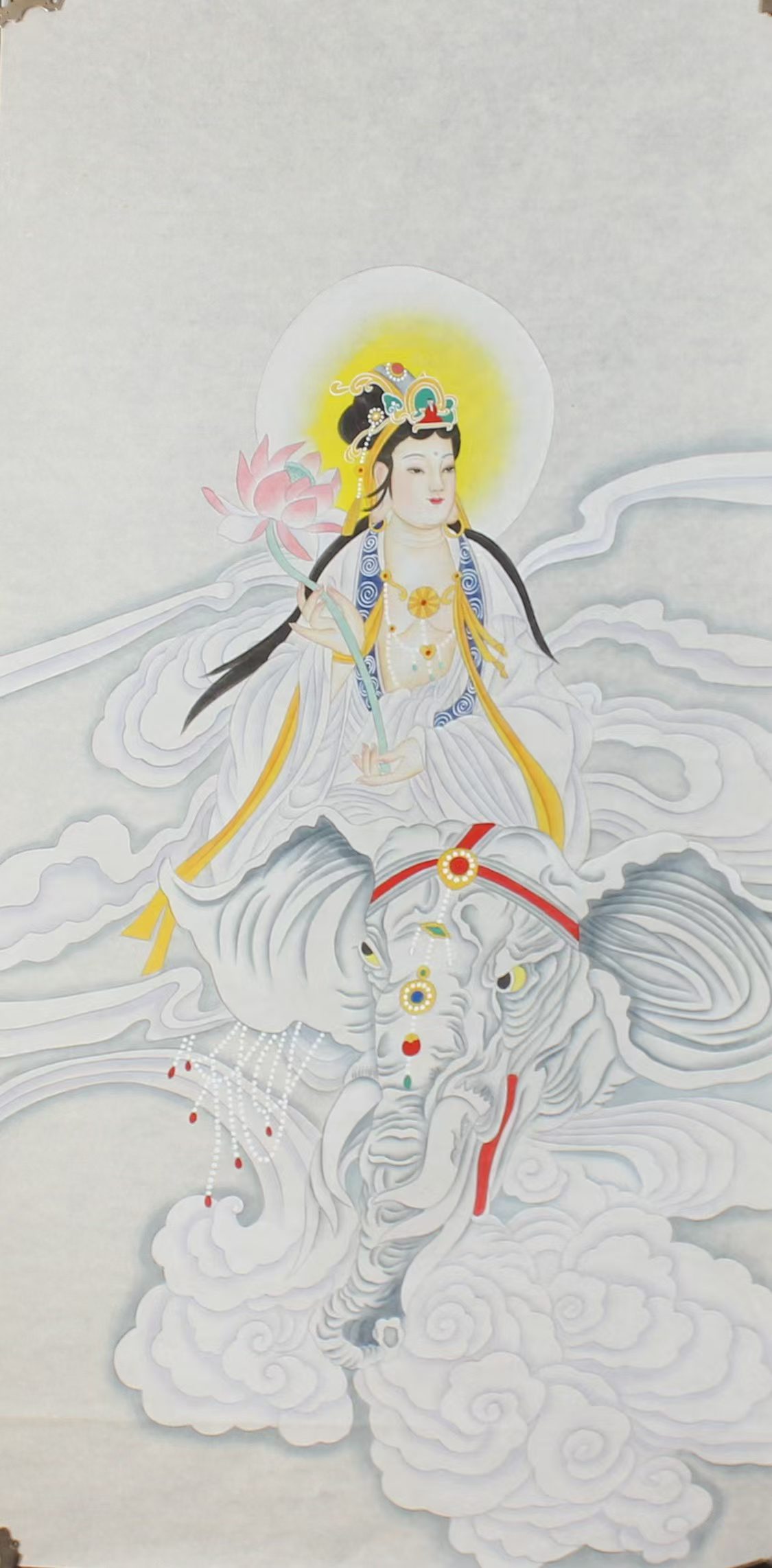
Work-brush Heavy Color Painting "Cihai Pudu-White Elephant Auspicious
Single Size
0 Review
*Size
138cm x 69cm "Four Feet Full Open
$860.00$1,000.00
Special Features:



Description
Paintings featured
- Buddhist art of brushwork and heavy color technique:
- Lines and colors: Guanyin’s clothes are outlined by smooth brushwork, with gold lines to show the nobility, the robe pattern is complicated and exquisite, and the celluloid bead strings are dyed with mineral pigments, with a glossy luster like the real thing; the picture is dominated by the tones of green, vermilion, and clay gold, with the bodhisattva’s body dyed with light gold, and the skin of white elephants brightened with silver powder, and the overall colors are soft and sacred.
- The combination of static and dynamic: Guanyin is standing on a cloud with her eyes lowered and holding a lotus flower, showing her compassion; the six-tusked white elephant is treading on an auspicious cloud, with a long snout slightly curled, and the elephant’s body is gnarled with muscles, the details of which symbolize the essence of the Buddhist teachings of “compassion is static, and wishing for power is dynamic”.
Detailed depiction
- Subtle portrayal of subjects and scenes:
- Goddess of Merc y: Her face is rich and kind, the white hairs between her eyebrows are embellished with pearl powder, and her eyes are lowered to show her compassion for all living beings; she wears a crown embedded with seven jewels, with necklace hanging down her shoulders, and the lines of her folds of clothing are like flowing clouds and water; she holds a vase in her left hand, and her right hand bears the Seal of Fearlessness, and the lotus blooms on her fingertips, the petals of the flower are dyed with light powder, and the heart of the stamen is outlined in clay and gold.
- White elephant with six tusks: the body of the elephant is as white as jade, the six tusks symbolize the “six degrees of Paramitas”, the feet step on the seven-colored clouds, the cloud pattern is overdrawn with green and green; the elephant’s ears are hanging down like a lotus leaf, the trunk is curled up like a conch, and the lotus throne underneath the feet is outlined with cinnabar, and the gold powder is dotted with stamens, which reveals the mighty etiquette of the Buddhists in all the details.
- Background rendering: the clouds are lightly colored with wet ink, revealing the outline of the spiritual mountain; mandala flowers are scattered in the air, and the Sanskrit seed characters are hidden; the distant mountains in the background are thinly dyed with stone green, forming a contrast between warm and cold with the light of the Bodhisattva’s body, as if the Pure Land was reflecting on the earth.
Artistic Value
- Visual interpretation of Buddhist culture:
- Strictly following the “Statue Measurement Sutra”, the proportions of Guanyin and the shape of Dharma vessels are exquisite, the six-tusked white elephant symbolizes the six practices of the Mahayana Bodhisattva, and the picture conceals the Buddhist philosophy of “both compassion and wisdom”;
- This is the pinnacle of traditional brushwork techniques:
- The clothing pattern is presented by the technique of “three alums and nine dyes”, and the mineral pigment will not fade away for thousands of years; the hair of the white elephant is outlined by the method of light ink and silk hair, and the lotus petals are dyed in clear layers, which reproduces the extraordinary skills of the Tang and Song Dynasty Buddhist painting artisans;
- The dual value of religion and aesthetics:
- It is both a religious and aesthetic value, providing practitioners with an icon to visualize and a collector’s item, witnessing the stylistic changes in Chinese Buddhist art from Dunhuang to the Ming and Qing dynasties.
Suitable Scenery
- Temple hall: mounted as a scroll hanging in the Guanyin Hall, for the faithful to worship and pray for blessings, to strengthen the solemnity of the Taoist temple;
- Home Buddhist niche: with incense burner and wooden fish, it creates a pure space for “home cultivation and bodhisattva protection”;
- Cultural exhibition hall: as a special exhibit of Buddhist art, juxtaposed with thangkas and land and water paintings, it conveys the essence of oriental religious aesthetics.
Purchase
- Framing suggestions:
- Traditional style: antique silk mount with gilt spindle head, covered with green satin sutra booklet, suitable for Buddhist rituals;
- Modern style: acrylic floating frame with dark sandalwood frame, suitable for the new Chinese Zen space.
- Offerings for conservation:
- Avoid light and moisture: keep away from direct sunlight, start dehumidifying equipment when humidity is higher than 70%;
- Regular incense: sandalwood light smoke offerings, avoid wiping with a wet cloth, dust with a soft brush to sweep lightly.
**✨ Core highlights**
- Dharma solemnity: Guanyin’s face combines the richness of the Tang Dynasty with the elegance of the Song Dynasty, and her clothing pattern is based on the records of the Avatamsaka Sutra, which can be called “walking Buddhist iconography”;
- Tantric elements: the Sanskrit mantra wheel in the background and the mandala petals conceal the Pure Land practice steps, which can be practiced by qualified believers;
- Thousands of years of technology: the clay and gold outlines are as fine as a hair, and the white elephant silver powder is as bright as the moonlight pouring down, recreating the legacy of Dunhuang Mogao Cave frescoes.
Collection Significance
Cihang Pudu – White Elephant Auspiciousness” uses brushwork as the bone and heavy color as the soul, condensing Buddhist wisdom and artistic craftsmanship in a square inch. When the Goddess of Mercy lowers her eyebrows in compassion for the living, and when the white elephant protects the Dharma on its feet, this work is not only a condensation of skills, but also a bridge connecting the earthly world and the Pure Land. Worshipping this painting will transform the space into a place where “the Bodhisattva always resides, and compassion shines through”.

 Product Reviews
Product Reviews
Write A Review
Related Products