





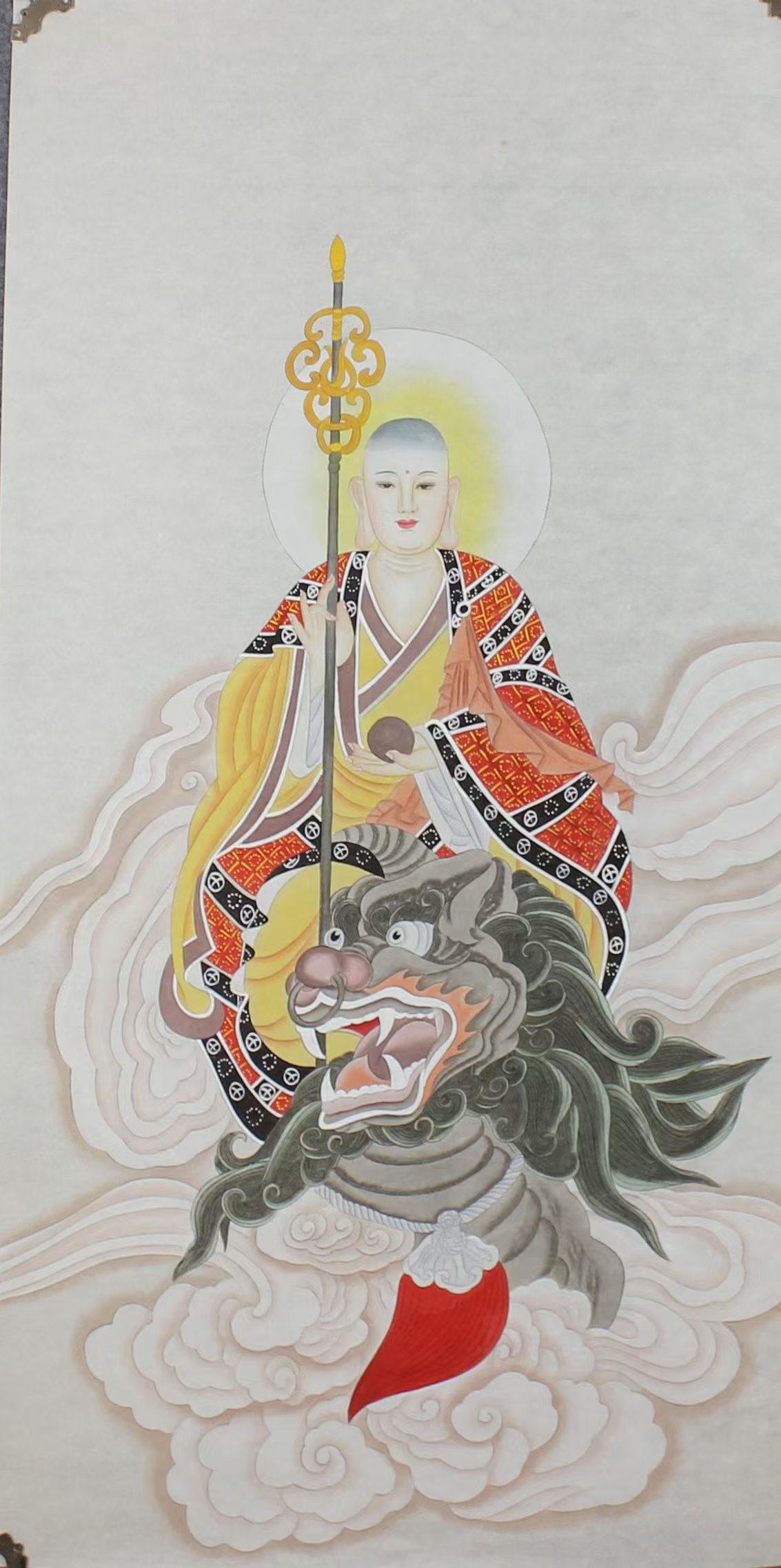
Work-brush and heavy color painting "Jizo Dharma - Shimei Protector
Single Size
0 Review
*Size
138cm x 69cm "Four Feet Full Open
$850.00$1,000.00
Special Features:




Description
Paintings featured
- Buddhist art of brushwork and heavy color technique:
- Fine outlining: the traditional brushwork and heavy color technique is adopted, with the bodhisattva’s clothes and ornaments outlined in gold thread, the robe pattern intricate and gorgeous, and the celluloid beads and strings dyed with mineral pigment, with a luster like the real thing;
- Dense ink and heavy color: the picture is dominated by cinnabar, stone green and clay gold, the bodhisattva’s body is dyed with gold powder, and the hair of the beast is chapped with layers of ink in a strong contrast of colors, highlighting the solemnity of the Buddha.
- The depth of religious symbols is expressed:
- Jizo Bodhisattva holds a tin staff to symbolize “opening the door to hell”, and his feet on the lotus platform is a metaphor for “purity and immaculateness”; the beast of Shimeji has furious eyes and fangs, and its feet are on fire, reflecting the power of “subduing the evil and protecting the righteousness of the Dharma”. The beast of Shizhen has angry eyes and fangs, and its feet are in flames, reflecting the power of “subduing evils and protecting the righteous Dharma”.
Detailed depiction
- Subtle portrayal of subjects and scenes:
- Jizo Bodhisattva: the face is square and full, the white hair between the eyebrows is embellished with pearl powder, and the eyes are lowered to show the compassionate attitude; the robe is decorated with the pattern of the precious flowers and the curly grass pattern, and the folds of the robe are as smooth as the flowing water; the staff in his hand is interlocked with nine rings, and the six-ringed golden wheel on the top symbolizes the “six paths of reincarnation”.
- Shimei beast: the head of the beast looks like a lion or a dragon, with ears standing up as if listening to the three worlds, fangs exposed to deter evil spirits; feet on the red flames of the auspicious clouds, tail curled like a dragon, hair in burnt ink and silk hair method of outlining, rooted and clear; the back of the flame pattern in cinnabar overdyeing, blazing as incineration.
- The background is rendered in light ink and wet dye, revealing the outline of Mount Sumeru; the round light behind the Bodhisattva is outlined with Sanskrit mantra wheels in gold powder, and mandala petals are scattered in the air, hiding elements of Tantric rituals.
Artistic Value
- A visual classic of Buddhist culture:
- Strictly following the rituals of the Statue Measurement Sutra, the proportions of bodhisattvas and the shapes of dharma vessels are elaborate, reflecting the rigorous inheritance of Han Buddhist art;
- The pinnacle of the technique of heavy brushwork and coloring:
- Clothing patterns and texture of gods and animals are presented by the technique of “three alums and nine dyes”, with mineral pigments remaining fresh for a long time, and the clay and gold outlines remaining intact for a thousand years, showing the extraordinary skills of the ancient Buddhist painting craftsmen;
- Religious and aesthetic values:
- It can be used as a religious and aesthetic value: it can be used as an icon for practitioners and as a collection of art, witnessing the stylistic changes of Buddhist art from Dunhuang murals to Ming and Qing land and water paintings.
Suitable Scene
- Temple hall: mounted as a scroll and hung on the side wall of the Maharajah’s Hall or the Earth Store Hall for the faithful to worship and pray for blessings;
- Home Buddhist niche: with incense burner and sutra streamers, it creates a pure path of “home cultivation and bodhisattva protection”;
- Cultural exhibition hall: as a special exhibit of Buddhist art, juxtaposed with thangkas and land and water paintings, displaying the oriental religious aesthetic system.
Purchase
- Framing suggestions:
- Traditional: antique silk mount with gilt spindle head, covered with yellow satin sutra booklet, suitable for Buddhist rituals;
- Modern style: acrylic floating frame with dark walnut wood frame, suitable for new Chinese Zen space.
- Offerings for conservation:
- Avoid light and moisture: stay away from windows to avoid UV fading, and start dehumidifying equipment when humidity is higher than 70%;
- Regular incense: sandalwood, incense light smoke offerings, avoid using chemical cleaners to wipe the picture.
**✨ Core highlights**
- Solemnity of Dharma: The Bodhisattva’s face combines the richness of the Tang Dynasty with the beautiful bones of the Song Dynasty, and his clothing pattern is based on the records of the Great Tibetan Sutra, which can be called “walking Buddhist iconography”;
- Tantric elements: the Sanskrit seed characters and mandala petals in the background conceal the Tantric practice steps, which can be practiced by qualified practitioners;
- Thousands of years of technology: the gold outline is as fine as a hair, and the cinnabar overlay coloring is distinctive, reproducing the skills of the muralists of the Mogao Caves in Dunhuang.
Significance of the Collection
With brushwork as the bone and heavy colors as the soul, “The Dharma of Jizo – Listening to the Dharma Protector” condenses Buddhist wisdom and artistic craftsmanship within a square inch. When the Bodhisattva lowers his eyebrows to show compassion for all living beings, and when Shizhen raises his head to deter demons, this work is not only a condensation of skill, but also a bridge of dharma that connects the earthly world with the Pure Land. Worshipping this painting will transform the space into a place where “the Bodhisattva abides and the Dharma endures”.

 Product Reviews
Product Reviews
Write A Review
Related Products