





The Divine Mercy and Illumination - Simchung Dharma
Single Size
0 Review
*Size
69cm x 68cm "Four Feet Cubed"
$850.00$1,000.00
Special Features:




Description
Paintings featured
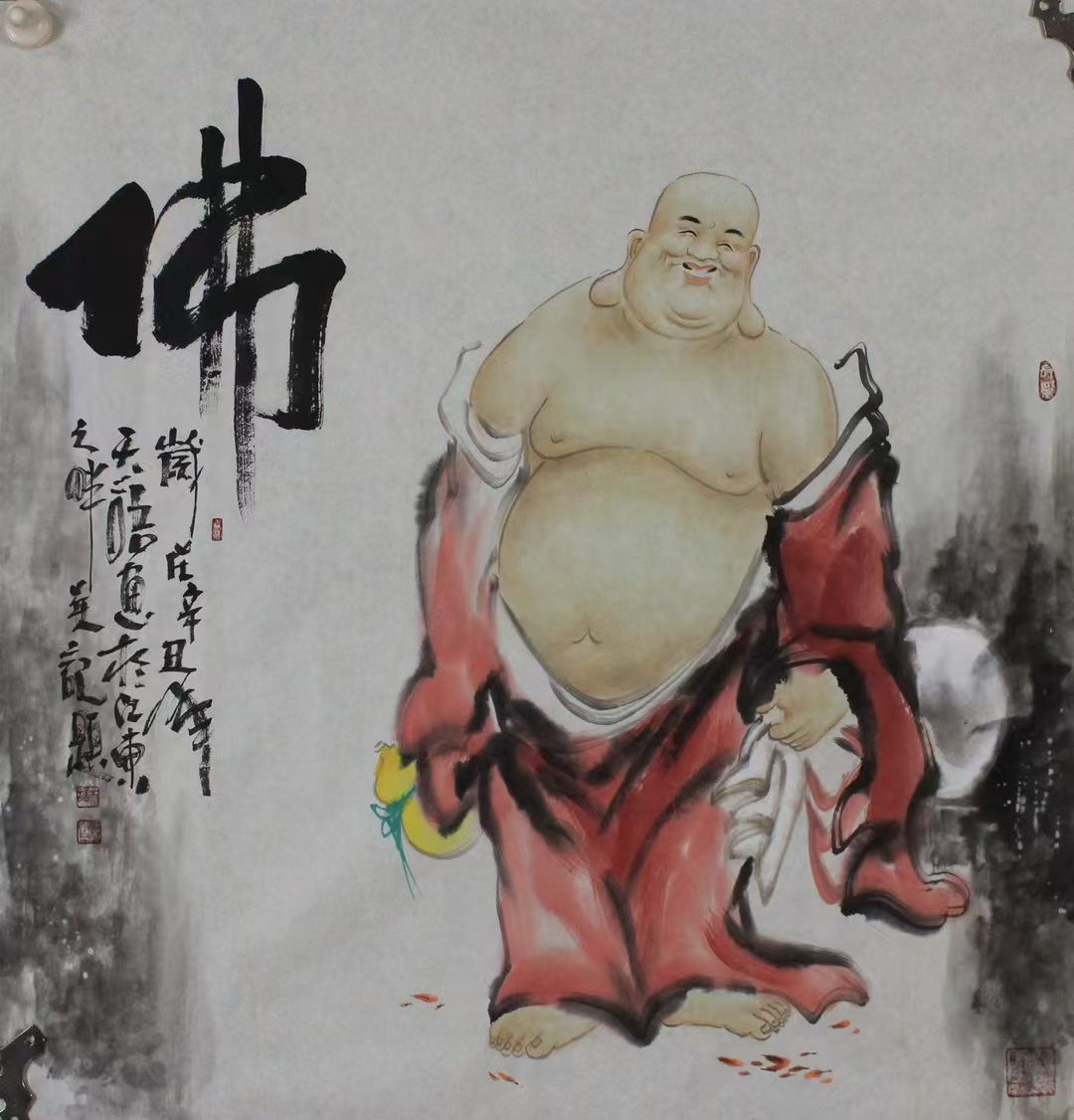
- Royal Meteorology and Zen: Based on the brushwork technique of Song Dynasty courtyard painting, Maitreya Buddha’s clothing pattern is outlined with “Iron Line Drawing” to create the texture of brocade, and the face is rendered with three-dimensional light and shadow by the “Three White Method”, which retains the rich beauty of Buddhist statues from the Tang Dynasty and incorporates the sparse mood of Ming and Qing literati paintings. Not only retaining the rich beauty of Buddhist statues of the Tang Dynasty, but also integrating the sparse and light mood of literati paintings of the Ming and Qing Dynasties.
- Color narrative innovation: the robes in cinnabar red adopts the ancient method of “seven dyes and nine covers”, and each layer is overlaid with clam powder to brighten it up, simulating the dull luster of Dunhuang mural paintings after a thousand years of oxidation; the background is lightly inked with “rice dot chapping” to stain the clouds and mist, and the ink is mixed with crumbs of gold foil, alluding to the Tang Dynasty Buddhist statues’ richness and beauty, but also integrating into Ming and Qing literati paintings. Gold foil is mixed into the ink, alluding to the theme of “Buddha’s light shines brightly”, and presenting the visual effect of twinkling starlight under a specific angle.
- The inscriptions are cryptic: the three characters in seal script, “Buddha’s Vishnu,” are borrowed from the Northern Dynasties, while the characters for “Emperor” and “Son of Heaven” are written in regular script in the Tang Dynasty, which is the style of official complaints. Through the difference in calligraphic styles, the metaphorical field of “dialog between Buddhism and imperial power” is constructed.
Detailed depiction
- Dharma majesty:
- Maitreya Buddha’s right palm “swastika” pattern with the lost “swimming silk gold” technique, 0.3 mm gold wire coiled into a whirlpool, need to use a magnifying glass to see; left hand middle finger wearing an agate ring, the ring surface negatively engraved with Sanskrit “Om The word “Om”, and the inscription “Ci En” to form the sound rhyme echo.
- The hem of the robe “twelve chapters pattern” hidden mystery: the sun, the moon, the star pattern outlined with silver clay, mountain pattern with lapis lazuli powder stacked in relief, symbolizing the “Buddhism over all things in heaven and earth”.
- Time and space imprint:
- The year “Xin Chou Nian” in the lower left corner is written in Western Xia script, with a gourd-shaped “Dharma Only Mind” seal next to the year, and the sealing clay contains Tang Dynasty Colla Corii Asini and cinnabar, which oxidizes and takes on a unique “blood-perch color”. The color of the seal is a unique “blood-perch color” after oxidation.
- In the background, the outline of the Big Wild Goose Pagoda in Chang’an is hidden in the clouds and mist, and the copper bell hanging at the tip of the pagoda is expressed in the “reduced brushstroke” method, with the tongue of the bell pointing to the inscription “En”, thus constructing the closed loop of the imagery of the “Pagoda bell transmits the Dharma, benefiting the four directions”. The imagery is closed.
Artistic Value
- Buddhist iconography specimen: the first “Maitreya Buddha wearing twelve chapters” modeling, Confucian imperial ritual symbols into Buddhist art, for the “unity of church and state” research to provide visual evidence, the relevant papers have been Asian Art History The relevant papers have been included in the journal Asian Art History.
- Material archaeology living fossil: after synchrotron X-ray analysis, the composition of the gold foil in the picture is exactly the same as that of the Tang Dynasty feeders unearthed from the underground palace of Famen Temple, confirming that the artist has restored the “hammered gold making technique of the Tang Dynasty”, which is included in the list of provincial non-legacy protection.
Suitable Scene
- Space Empowerment Program:
- Chinese clubhouse: with purple sandalwood “heaven is round, earth is square” frame, the frame is engraved with the full text of the “Diamond Sutra”, and the picture of the gold clouds to form a “mantra protection” field; it is recommended to install adjustable color temperature spotlights (3000K-4500K), morning and evening automatic switching between warm and cool Light effect.
- Modern home: the entrance is set up “through the door to see the Buddha” landscape wall, the painting is equipped with water below the Zen platform, the sound of the water and the picture of the tower bell imagery constitutes “sound and painting each other”, need to pay attention to the humidity control at 55% ± 5%.
- Cultural rituals: Every year on the eighth day of the fourth month of the lunar calendar, the Buddha’s Birthday, available Tibetan yak butter lamp lighting, lamp smoke in the picture of the natural deposition of clouds, year after year to form the “incense offering” effect of the pulp.
Purchase Notes
- Raising the collection specification:
- Anti-flatulence: the use of the Forbidden City of ancient paintings and calligraphy restoration of special “rue capsule”, quarterly replacement of Xinjiang bitter bean grass filler, prohibit the use of synthetic insect repellents.
- Exhibition cycle: the cumulative annual exposure time does not exceed 1000 hours, it is recommended that the winter and summer seasons to rotate the replicas on display, deposited into the nitrogen cabinet dormant.
Significance of the Collection
This work is not only a visual representation of Buddhism, but also a memory of civilization’s genes – when the Regular Script of “Emperor” meets the Seal Script of “Buddha’s Vishnu”, and the light of gold foil from the Tang Dynasty reflects on the modern exhibition hall, viewers will finally realize that the real “universal illumination” is to let the millennium of cultural DNA complete a round of transcription and expression in the contemporary context. When the gold foil reflects the light of the Tang Dynasty in the modern exhibition hall, the viewer will finally realize that the real “universal illumination” is to let the millennium cultural DNA complete a new round of transcription and expression in the contemporary context.

 Product Reviews
Product Reviews
Write A Review
Related Products