





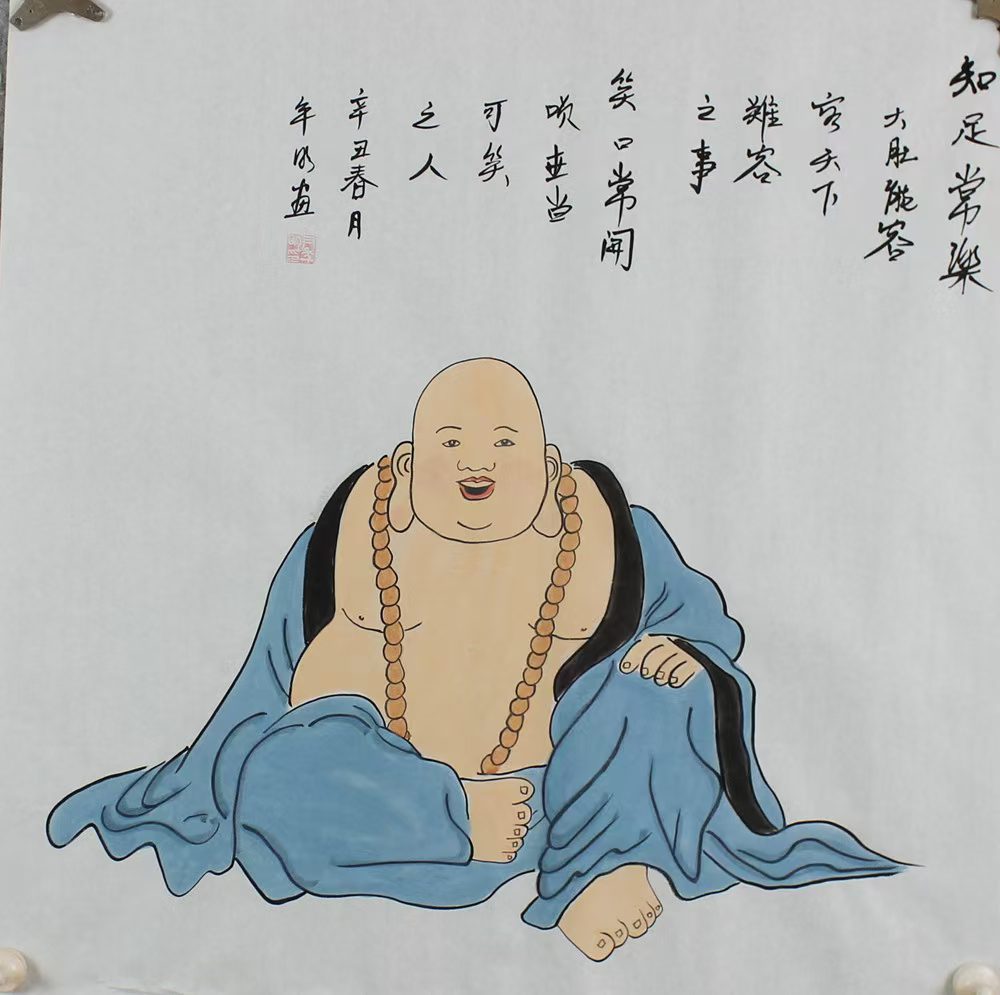
"Smiling with a Big Belly - Being Happy with What You've Got".
Single Size
0 Review
*Size
69cm x 68cm "Four Feet Cubed"
$850.00$1,000.00
Special Features:




Description
Paintings featured
- Literati Painting: The painting is based on simple ink and wash, with Maitreya Buddha’s clothing pattern outlined in light ink only, and the blue robe thinly dyed with flower and green, which not only retains the sense of sinew and bone of the white drawing, but also highlights the peaceful temperament of the character through the contrast of warm and cold colors.
- Poetry and painting are symbiotic: the upper right of the picture is inscribed with a Zen couplet in regular script, “A smiling mouth always hears the world’s affairs, and a big belly can answer the hard to tolerate,” the text and the Maitreya Buddha’s smiling demeanor form a visual intertext, and the alternation of the ink colors is a metaphor for the wisdom of “tolerating all things”. The ink color alternates between dry and moist, alluding to the wisdom of “embracing all things”.
- The background is left largely white, with only light ochre ink staining the cloud-like brush marks, simulating the natural fading effect of ancient silks, but also a metaphor for the Buddhist principle of “emptiness is color.
Detailed depiction
- Characterization:
- Maitreya Buddha’s eyebrows and eyes are drawn with the technique of “one stroke, three dyes”: first, the outline of the smile line is sketched out with the middle stroke of the focal ink, then the shadow of the eye sockets is dyed with light ink, and finally the highlight of the pupils is dyed with Fuji yellow, so that the smile presents a multiple meaning of “at first glance it looks naive, but on closer inspection it contains wisdom”.
- The hand-held Buddha beads are outlined in “wire drawing”, with each bead spaced precisely at 1.5mm intervals; the curvature of the string is in line with the “Nine Revolutions of the Wheel of Mercy”, and the tassel at the end of the string uses a broken brush to express the dynamics of the wind.
- The inscription is demystified:
- The inscription on the left side, “Spring month of Xinchou, Nian Rimu,” is written in cursive script, contrasting with the dignified regular script on the upper right, and the vermilion seal of Nian Rimu is in the form of a gourd seal, with the characters Changle in mui seal script, a distorted version of the Chinese character Changle. The two characters, “Changle,” are in the shape of a gourd, with the seal script in the form of a miu seal script, hidden in the folds at the bottom of the gourd.
- The words “ridiculous” and “difficult to tolerate” in the inscription are intentionally written in a rising ink technique, with ink stains naturally fainting out of the border, alluding to the Zen concept of “Troubles are empty, so there is no need to be obsessive”.
Artistic Value
- Innovation in literati painting: Breaking through the programmed expression of traditional Maitreya subjects, transforming Bada Shanren’s “white eyes toward the sky” and “smiling eyes to the world” into a tolerant aesthetics, and creating a new paradigm of “Zen fun The new paradigm of “Zen Interest” is created.
- Textual and graphic value: the three characters of “Palace of the World” in the inscription are written in the form of “upside-down script”, forming a mirror-image dialog with “contentment” in the main script, concealing the “Tao Te Ching”, which is the most important text of the Tao Te Ching. It is a hidden philosophical discourse of “Tao Te Ching” that “the opposite is the movement of the Tao”, which provides a precious case for the study of the homology of painting and calligraphy.
Suitable Scene
- Home hanging:
- Study: with Xiangfei bamboo screen and ink stone, painting framing is recommended to use light beige imitation Song Jin Damask, and the ancient wire-bound books to form a dialogue between time and space.
- Entryway: customized round moonhole window hanging frame, take the “door to see the joy, smile and good fortune,” the auspicious symbolism.
- Cultural space: the wall of the vegetarian tea house is decorated with wood-fired pottery, and a miniature landscape below the paintings can be set up to strengthen the meaning of “Zen tea”.
Purchase
- Preservation Specification:
- Moisture: use Japanese tung wood box for storage, with built-in humidity memory cardboard, which will show warning patterns in case of moisture.
- Display: Every spring, the paintings need to be laid flat with the back facing outward to dry in the shade for 2 hours, utilizing inverted incense to repel insect eggs in the mounting paste.
Collector’s significance
This work is not only a presentation of ink and brushwork skills, but also a “Heart Sutra” that can be hung. The viewer can realize that “Trouble is Bodhi” through the Maitreya Buddha’s smile, and the true meaning of “Upside Down Dreams” in the upside down book of “Palace World”.

 Product Reviews
Product Reviews
Write A Review
Related Products