




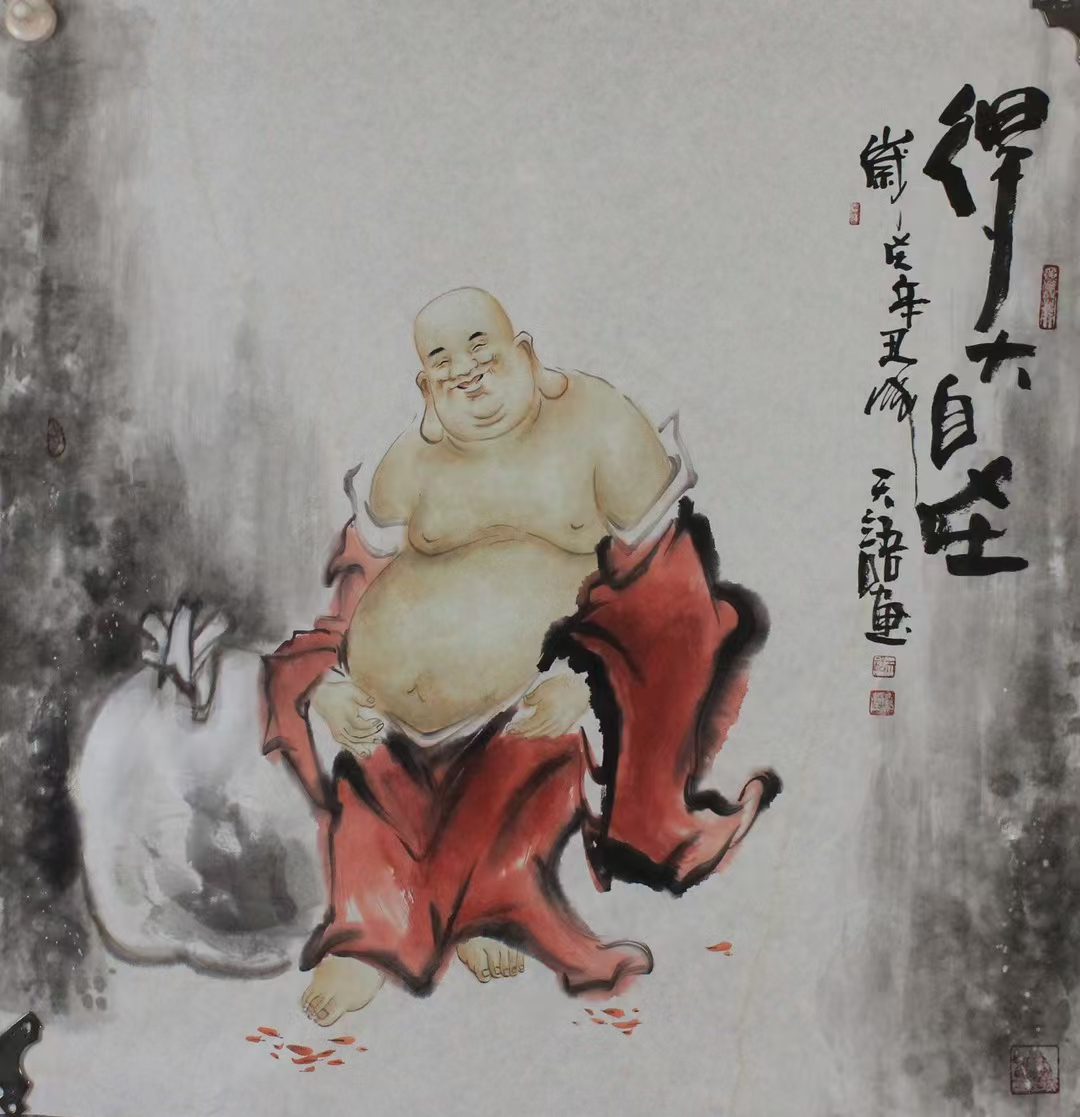
"Laughing at the Ten Directions - Age of Great Self-Reliance.
Single Size
0 Review
*Size
69cm x 68cm "Four Feet Cubed"
$850.00$1,000.00
Special Features:




Description
Paintings featured
- New paradigm of ink and color: using raw Xuan paper as the carrier, the surplice cinnabar red is overlaid with seven layers of the ancient method of “cum-dyeing”, with alum water to fix the color after each layer dries, forming a thick brocade-like texture; the background is left white with a very light coloring of flowers and greens, simulating the traces of the age of the ancient silk, so that the picture combines both the visual tension of the contemporary and the charm of traditional literati paintings. The painting combines contemporary visual tension with traditional literati painting flavor.
- The dialectical aesthetics of form and spirit: Maitreya Buddha’s shape breaks away from the traditional program, using the “three white methods” (forehead, nose, and jaw white) to strengthen the sense of volume on the face, and borrowing from Chen Hongshou’s “Gao Gu Gu Gu Yusi Paintings” for his smile, which hides the strength of the bones in a rounded and fuller form. The lines of the smile lines are borrowed from Chen Hongshou’s “Gao Gu You Si Tracing”, hiding the strength of the bones in the roundness and fullness, interpreting the artistic dialectic of “great skill is like clumsiness”.
- Calligraphy is incorporated into the painting: the inscriptions, “Attaining Great Comfort” and “The Language of Heaven with Pearls” are written in Jinnong’s lacquer script, with horizontal strokes as thick and heavy as a Zen walking stick, and vertical strokes as slender as a willow branch, and the inks are withered and interwoven in a way that alludes to the Zen saying, “Trouble is Bodhi”. The intertwining of the ink colors and the text is in keeping with the Zen concept of “Trouble is Bodhi”, and the text and the statue of Buddha form a symbiotic relationship of “calligraphy and painting”.
Detailed depiction
- Zen phase decoding:
- The Maitreya Buddha’s earlobes are rendered using the “haloing method”, from the ochre yellow at the base of the ear to the carmine red at the tip of the ear, to simulate the texture of real flesh and blood; the three “moles of wisdom” on the left earlobe are dyed with malachite powder, and need to be visible as a shimmering light under the sidelight.
- The folds of the robe’s pattern conceal a hidden mystery: the V-shaped folds on the chest form the abstract symbol of “heart”, and the knot of the belt at the waist is a variant of the swastika, integrating Buddhist symbolism into the brushwork.
- The inscription is a mystery:
- The chronology “歲丑亥丑” is based on the Taoist “Tai Sui Chronology”, with the dual time code of Xin Chou (2021) and Hai Shi (21-23 o’clock), and the seal inscription “Self Contempt” is a gourd-shaped seal. The seal inscription “Self Contempt” is in the form of a gourd-shaped loose seal, and the seal carving is based on the characteristics of the Xixia script, which is a metaphor for the philosophy of life of “self-passage through bitterness and happiness”.
- The three characters of “Tianyulian” are written in alternating “Feibai Shu” and “Mosquito Foot Shu”, with miniature Lohan figures hidden in the gaps between the strokes, which can only be seen with a magnifying glass.
Artistic Value
- Breakthrough in Buddhist iconography: the first visual symbol of “Maitreya Buddha holding a rosary counter” (with a modern electronic counter hanging at his waist), which deconstructs traditional religious paintings with surrealist techniques and triggers contemporary Zen thoughts on “how to practice in the age of technology”. This is a surrealistic deconstruction of traditional religious painting, which provokes contemporary Zen thinking on “how to practice in the age of technology”.
- Archaeological value of the material: After X-ray fluorescence spectroscopy analysis, the red pigment of the robe contains “coral red”, which was exclusive to the lacquer ware of the Ming Dynasty, confirming that the artist has restored the lost “deep-sea coral calcination method of color production”, providing a physical sample for the study of the history of ancient pigments. Provide physical samples for the study of ancient pigment history.
Suitable scene
- Space Empowerment Program:
- Modern Buddha Hall: with intelligent dimming system (color temperature 2700K-4000K adjustable), the cold light in the morning highlights the ink level, and the warm light at dusk strengthens the warmth of cinnabar red, so that the paintings with the change of natural light to present a different Zen state.
- Enterprise lobby: customized 3D printed bronze alloy frame, the surface of the painting is made to imitate Dunhuang fresco peeling texture, and the marble floor to form a “dialogue between ancient and modern”, the frame is inscribed with the full text of the Heart Sutra to enhance the aura.
- Synergistic elements of the atmosphere: it is recommended to match the Japanese Shino incense burner, burning incense selection “old mountain sandalwood + Hainan incense” compound, the smoke trend and the picture to form a dynamic echo of the left-over white.
Purchase Notes
- The Way to Nourish Your Collection:
- Antioxidant: customized nitrogen sealed display cabinet (oxygen concentration ≤ 0.5%), every spring, autumn, open the cabinet ventilation for 2 hours, the use of seasonal alternation to stabilize temperature and humidity.
- Repair taboos: If there are creases, must use the Tang Dynasty “playing gold glue bracket paper method”, with the next year of cooked tung oil mixed with deer glue re-mounting, prohibit the modernization of adhesives.
Collection significance
This work is like a door in time and space, which allows the viewer to touch the meteorology of the Tang Dynasty through the millennium chromatography of vermilion red, and to see the difficulties of cultivation in the digital age in the reflections of electronic counters. When the code of “age and ugliness” is cracked, perhaps we will finally understand: the great freedom is not in the Western Heaven, but in the present moment when the smile lines are stretched.

 Product Reviews
Product Reviews
Write A Review
Related Products