





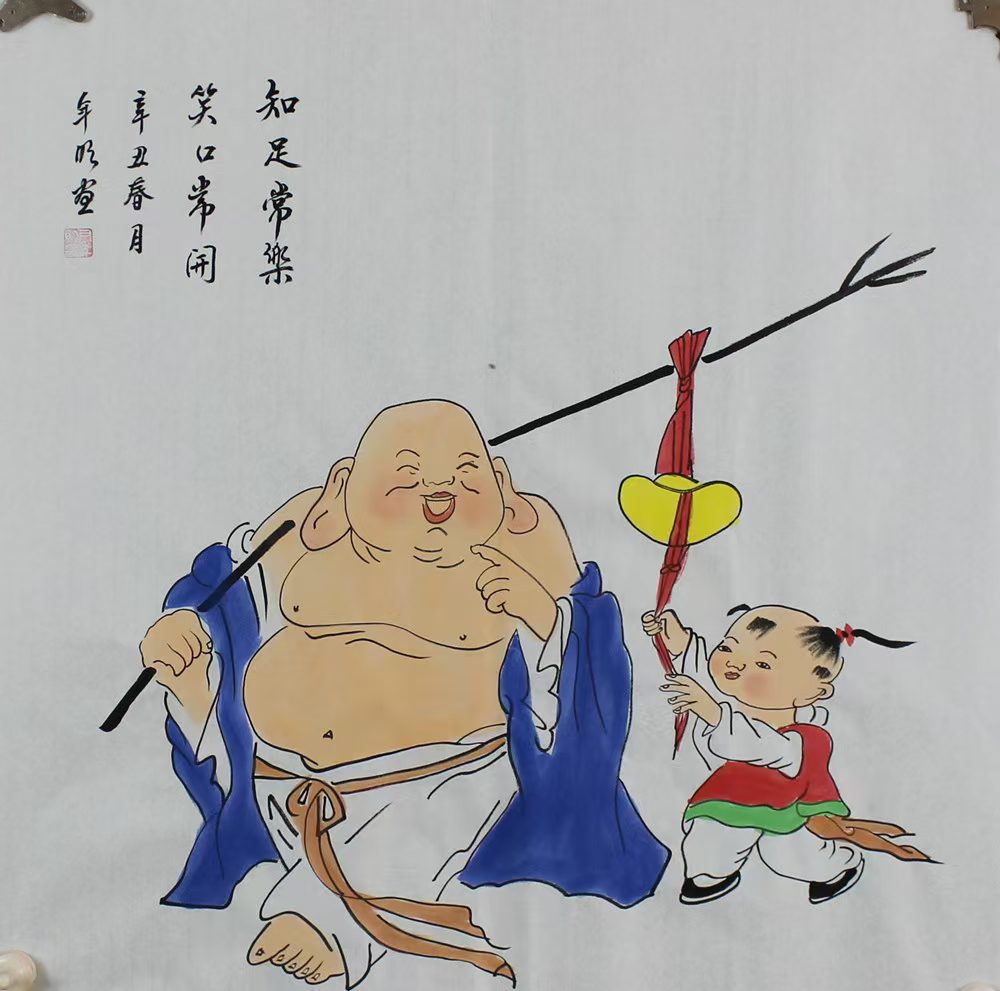
"Laughing and Fishing for the Spring Breeze - Contentment and Happiness".
Single Size
0 Review
*Size
69cm x 68cm "Four Feet Cubed"
$830.00$1,000.00
Special Features:




Description
Paintings featured
- A symbiosis of Zen fun and childlike innocence: the classic image of Maitreya Buddha with a wide robe and a big belly, smiling happily, is portrayed by the traditional realistic figure technique, with the clothes pattern outlined by the “nail-head and rat-tail depiction”, and the lines are free and flowing; the child beside him is holding fresh fruits in his hand, with a naive and naive attitude, and the two of them are in a good balance between motion and static, which interprets “Great Wisdom is as Foolish as Foolishness”, the oriental wisdom of returning to the basics. The two of them are in harmony with each other, interpreting the oriental wisdom of “being wise as fools and returning to the basics”.
- Elegant colors: the main colors are vine yellow and ochre rendering Maitreya Buddha’s robes, symbolizing a generous temperament that embraces all phenomena; the child’s lapel is embellished with stone green, the background is dyed with light ink to reflect the smoke and clouds, and the white space in the picture hides hidden distant mountains, creating a Zen space that is “empty, but not silent” between the reality and the reality.
- Poetry and painting in one: the upper left corner is inscribed in running script with the words “Laughing and laughing often” and “Being contented and happy always”, with the ink color echoing the rhythm of the picture, and the calligraphic strokes of the calligraphy like gnarled old branches, forming a contrast between rigidity and softness with Maitreya Buddha’s clothing pattern.
Detailed depiction
- Characterization:
- The earlobes of the Maitreya Buddha are full and fleshy by the technique of “triple-dyeing”, and the hairs between the ears are outlined with a single wolf-hair brush, which needs to be viewed within 10cm in order to be seen as subtle; the folds of the belt around the waist conceal the bat pattern, which is synonymous with the word “Fortune”, and needs to be exposed to the side-light in order to be recognized.
- The koi carp under the child’s feet is painted using the “wet brush and broken ink method”, with the tail of the fish naturally dispersed as a swimming shadow, and the eyes of the fish dotted with ceramic blue, forming a witty metaphor of “the one who wishes to be hooked” with the golden tip of the fishing rod in the hands of the Maitreya Buddha.
- The inscription is very elaborate:
- The inscription “Nianmingtang” is inscribed in vermilion with a gourd-shaped seal in the shape of a gourd, “The Heart is Wide and the World is Wide”, and the seal clay is made of vermilion sand mixed with coral powder, which has lasted for hundreds of years; the date of the creation of this work, “Spring Month of Xinchou”, is written in lower case, with a subtle and restrained stroke, and a darker, more subtle style of calligraphy. The writing style is subtle and introverted, which is in line with the Taoist meaning of “hiding the sharpness and guarding the clumsiness”.
Artistic Value
- Decoding of cultural symbols: Maitreya Buddha holds a fishing rod instead of a traditional bag, and innovatively incorporates the allusion to “Jiang Tai Gong fishing”, integrating Buddhist compassion and Taoist thought of inaction, providing a new perspective for the study of religious art.
- The technique is based on the ancient and the modern: the picture is painted using the “ink accumulation method” on raw Xuan paper, and the thick ink color of the Buddha’s robe has gone through seven dyes and nine chafes, which not only retains the random beauty of the ink and wash infiltration, but also controls the boundaries of the form accurately, which is a textbook-level model of realistic figure painting.
Suitable Scene
- Home space: Hanging above the tea room’s Pokugu shelf, with purple sand pots and bamboo incense burners to form a “Zen Tea Taste” collection; living room sofa back wall with dark brown mortise and tenon wooden frames to neutralize the cold and hard feeling of modern furniture.
- Business places: Vegetarian restaurant entrance display, with bamboo curtains, withered landscape landscape, to strengthen the “pure and natural” brand tone; corporate meeting room hanging can ease the tension of business negotiations.
Purchase
- Conservation Specification:
- Anti-moisture: use sandalwood box for storage, built-in Japan imported and paper moisture-absorbing layer, replaced every year before the rainy season;
- Anti-moth-eaten: regularly with mugwort smoke lightly smoked back of the painting, avoid using camphor pills to avoid chemical reactions with mineral pigments.
Collecting significance
Laughing and Fishing in the Spring Breeze – Contentment and Happiness” is not only a demonstration of brush and ink skills, but also a “spiritual prescription” for curing contemporary anxieties. When viewing the painting, the viewer can realize “letting go is freedom” in the depths of the Maitreya Buddha’s smile, and regain the heart of the child in the child’s innocence.

 Product Reviews
Product Reviews
Write A Review
Related Products