





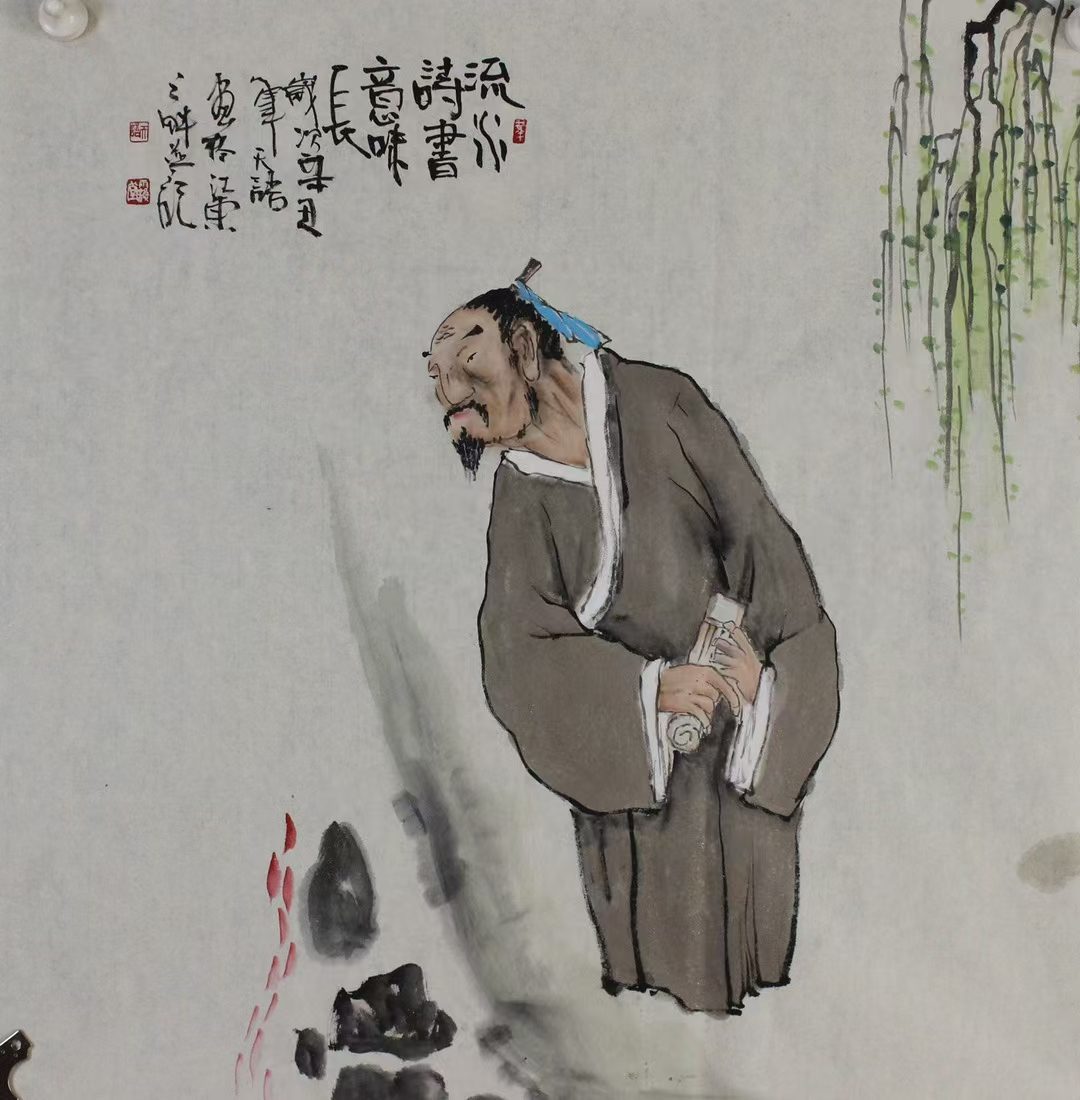
Ink and Watercolor Figure Painting "Poetry and Books - Riverside Chanting
Single Size
0 Review
*Size
69cm x 68cm "Four Feet Cubed"
$830.00$1,000.00
Special Features:



Description
Paintings featured
- Concentrated writing in traditional ink:
- Rhythmic lines: the characters’ clothing patterns are outlined in “Gao Gu Yusi Tracing”, with soft and smooth lines, the folds of the cuffs are like flowing clouds and water, and the texture of the pages of the scroll is outlined with fine brush strokes, which reveals the elegance and refinement of the literati;
- Ink color: light ink is used to stain the ripples of the river, thick ink is used to write the branches of the weeping willow, and a large area of the background is left white to create the ethereal mood of “the vastness of the river and the sky”, which conveys the oriental aesthetics of “simplicity over complexity”.
- The painting and poetry are one and the same as the literati’s interest:
- The inscriptions “之畔並江” and “诗書流水” are written in cursive on the upper right side of the painting, with a brushwork as unrestrained as the rushing waves of the river, while the seal in vermilion, “闲吟” is inscribed on the lower left side, and the character “韵” in seal script, “Rhyme” is inscribed on the lower right side. “Rhyme” in seal script, forming a complete literati system of poetry, calligraphy, painting and sealing.
Detailed depiction
- Characters are subtle:
- The scholar is leaning sideways against a rock, holding an unfolded scroll, with his eyebrows lowered as if he were concentrating on his reading, his hair in a bun outlined in burnt ink with fine strokes, the broken hair in front of his forehead blowing gently in the wind, and the hem of his robes stained with light ink in a rippling pattern, alluding to the situation of “viewing a book on the river”;
- The pages of the scroll are yellowed and the handwriting is hidden, the inscription “Jiangdong, Shu County” and “Seven Days in the Military” are hidden in the scroll, which is like the remnants of an ancient book, adding a sense of historical weight.
- Nature and text mood:
- In the background, the weeping willow is written with withered brush, the new leaves are lightly dotted with green juice, and the willow threads fall down like a curtain, echoing the title “The Drama Returns Early” and concealing the idle reverie of “Returning to the Boat on the Bank of the Willow”;
- The surface of the river is swept with a wet brush in light green, the ripples cascade like lines of poetry, and the small characters in seal script of the title “Saving its meaning” are hidden in the cracks of the stone, which requires a magnifying glass to realize its subtlety.
Artistic Value
- The double metaphor of cultural symbols:
- The scroll symbolizes the “inheritance of culture”, the river is a metaphor for the “passage of time”, and the willow sends the “thought of going back to seclusion”, and the combination of the three conveys the literati spirit of “sending poems and books to one’s heart, and the river and mountains to one’s dreams”. The combination of the three conveys the literati spirit of “sending poems and books to one’s heart and mountains to one’s dreams”;
- The inscription alludes to the allusions in ancient military books and local history (such as “Jiangdong in Shu County” and “Seven Days in the Military”), giving the picture historical depth and academic research value.
- A balance between technique and philosophy:
- Inheriting the style of Liang Kai’s reduced-brush figure painting from the Song Dynasty, and integrating the brushwork of the Ming Dynasty’s Wu Men School of Painting, the artist achieves artistic tension between the spontaneity of writing and the subtlety of the brushwork.
Suitable Scene
- Study/tea room: hung next to a bookcase or tea table, with bamboo furniture and celadon brush wash, creating an elegant atmosphere of “leaning against the river and reading a scroll, the fragrance of ink refreshes the heart”;
- Cultural exhibition hall: as an example of traditional literati paintings integrating poetry, calligraphy, painting and sealing, with “Wenxin Diao Long”, “Shui Jing Zhu” and other canonical books on display to deepen the aesthetic education;
- Chinese-style living room: reflecting with original wood-colored furniture and ink screen, it enhances the cultural taste and secluded style of the space.
Purchase Notes
- Framing suggestions:
- Traditional vertical scroll: indigo damask framed, with rosewood shaft head, ancient gluing process to prevent warping;
- Modern floating frame: matte metal frame + plain white cardboard, weakening the traditional form, suitable for new Chinese style, wabi-sabi style.
- Conservation Tips:
- Avoid light and moisture: storage humidity <55%, avoid direct sunlight leading to the yellowing of the rice paper;
- Professional Dusting: Use a soft brush with sable bristles to gently brush the picture along with the ink marks, avoid wet cloths or chemical cleaners;
- Restoration Note: If there is a crease or blurred handwriting, you need to contact an antiquarian book restorer to use the “full-color brush” process to deal with.
**Hidden Ingenuity
- Inscription: Li Bai’s poem “Only the Yangtze River Flows Between the Heavens” is inscribed on the edge of the scroll, which needs to be viewed with a side-light;
- Narrative of light and shadow: the ripples on the river surface are treated with special alumina, which gives the illusion of “sparkling water” when illuminated.
Collector’s significance
Poetry and Rhythm – Riverside Chanting” is not only an ink painting, but also a flowing epic of the literati spirit. When you spread the scroll on the river, you can see the poetry and books passed down to the world; when you return to the boat on the willow bank, you can realize the clarity of heaven and earth. Hanging this painting in the room, there is no need for gold or jade carving, but the fragrance of ink cleanses the heart, injecting an oriental poetic meaning of “leaning on the river and watching the book, the heart follows the flowing water” into the modern life.

 Product Reviews
Product Reviews
Write A Review
Related Products