




Ink and Color Painting "Zhong Kui Divine Kui - Exorcism of A-chen
Single Size
0 Review
*Size
138cm x 69cm "Four Feet Full Open
$860.00$1,000.00
Special Features:



Description
Paintings featured
- A blend of traditional ink writing and brushwork:
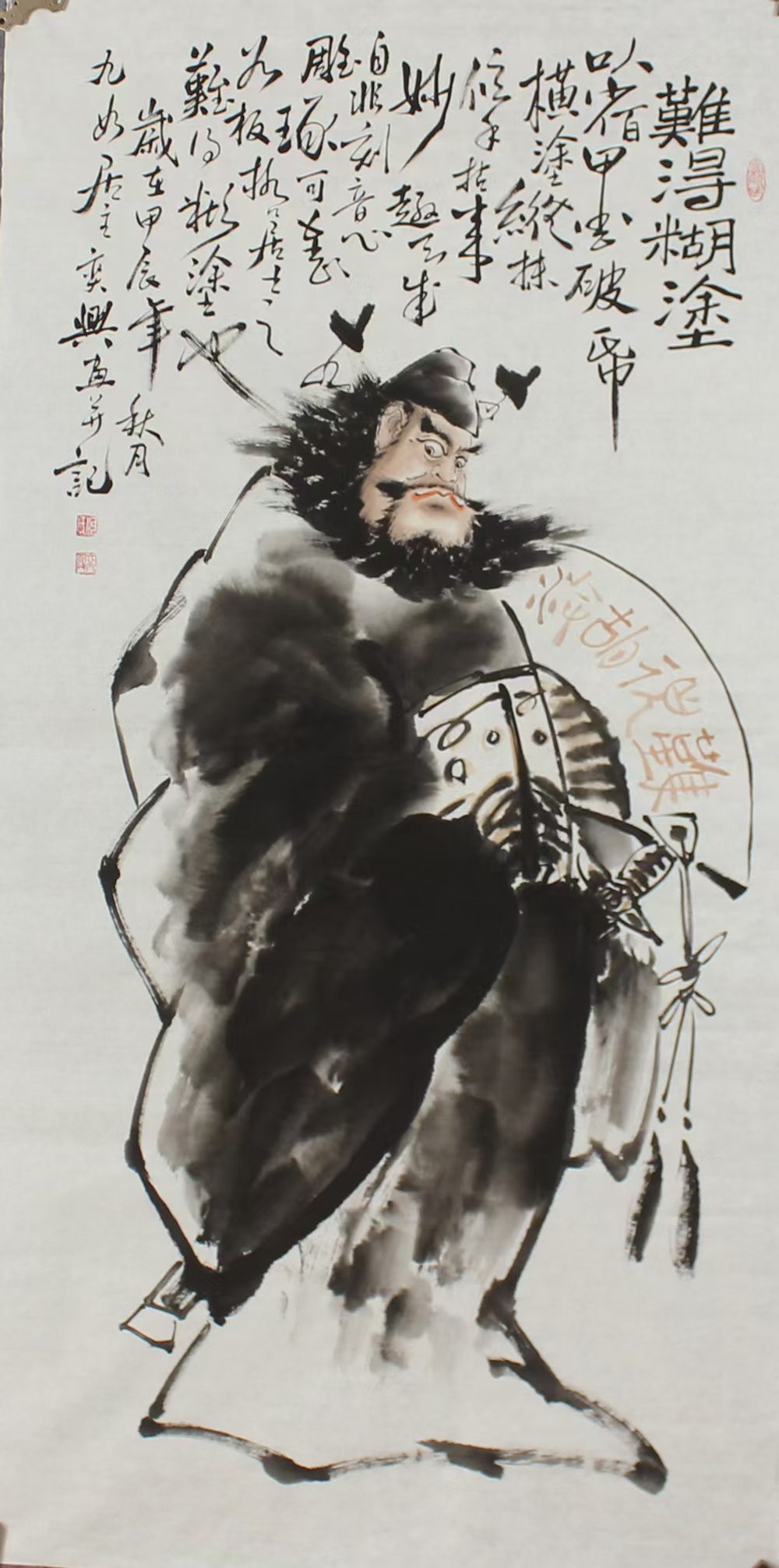
- Rhythm of ink: the background is rendered in light ink, the outline of Zhong Kui is sketched in burnt ink, the lines of his robes are as strong as a knife carving, and his beard is sketched with a fine brush, with a clear outline, showing the might of his “angry eyes and gnarled beard”. Cinnabar embellishments on the weapons and clothing patterns break the silence of the ink, symbolizing “evil spirits retreating, righteousness notorious”.
- Calligraphy: The four words “Hard to get confused” are inscribed at the top of the picture, with free and unrestrained strokes, which allude to Zheng Banqiao’s famous saying, echoing Zhong Kui’s folk image of “Great Wisdom is like Foolishness”, and also brightening up the picture with calligraphy, forming a “book in the painting, book in the painting, book in the painting, book in the painting”. The calligraphy is also used to brighten up the picture, creating a literati flavor of “a book in the painting and a realm in the book”.
Detailed depiction
- Subtle portrayal of subjects and scenes:
- Zhong Kui’s phantom: wearing a turban with burnt ink to show the hardness of the hat wings; wearing a wide robe with big sleeves, the folds of the coat are chapped with a dry brush to show the coarse texture, with a jade belt hanging diagonally from his waist and a tassel that rises gently with the wind; holding a sword to cut off the evils, with a chilly and cold light, the sword’s spike stained with cinnabar as if it were blood, and a hideous little kid, with its face stained with light ink to show the twisted pain, alluding to the phrase “good and evil are opposed, and the divine might suppresses sprites and demons”. This is a metaphor for “the confrontation between good and evil, the power of the gods to suppress the demons”.
- Seal of the artist: inscribed in cursive script at the upper right “Jiu Ru Jiu Master Yixing Dengfang Jie”, with the inscription in regular script “In the autumn month of the year jiachen”; inscribed in vermilion script at the lower left “Rarely Confused “The seal script is simple and clumsy, and the scattered inscriptions such as “Year of the Dragon’s Birth in the Year of the A-century” and “Your Majesty’s Naihe Man” form a staggered layout, which is similar to a literati’s handwriting annotations, and adds a sense of narration and playfulness to the painting.
- Composition and white space:
- A large area of the background is left white, and only a light ink sweep suggests the turbulence of the clouds, highlighting the main body of Zhong Kui; the inscriptions and characters form a diagonal composition, balancing the tension of the picture and concealing the traditional aesthetics of “the virtual and the real”.
Artistic Value
- Modern expression of folklore symbols:
- The image of Zhong Kui originates from the folk belief of “driving away evil spirits and calming down the house”, and the painting reconstructs the mythological theme with ink and wash writing, which not only retains the dramatic tension of “angrily catching ghosts”, but also integrates the “bookishness” of literati painting. It is a model of “elegance and popularity”.
- A breakthrough in brush and ink techniques:
- Ink splashes on the robes like angry waves, brushwork on the beards like steel needles, and wild cursive inscriptions like swords, all three of which are strong and soft, demonstrating the aesthetics of traditional ink and wash, which is “both form and spirit”.
- The depth of cultural metaphor:
- The inscription “It’s hard to get confused” is a hidden philosophy of life, echoing the image of Zhong Kui as “fierce on the outside, wise on the inside”, giving the painting the spiritual core of “great skill is like clumsiness”.
Suitable Scene
- Home entrance/study: hang it at the entrance or next to the book case, to “calm the house and drive away evil spirits, and protect the family with righteousness”;
- Tea room/cultural space: with log furniture and celadon tea ware, it creates an oriental aesthetic atmosphere of “harmony of strength and softness, elegance and vulgarity”;
- Corporate lobby/office: symbolizes “getting rid of small people, career frankness”, strengthening the space aura and cultural style.
Purchase
- Framing suggestions:
- Traditional style: dark gray damask cloth framed with ebony shaft, strengthening the contrast between ink and water, suitable for literati elegance;
- Modern style: frameless acrylic suspension framing, suitable for new Chinese style, industrial style space, highlighting the tension of the picture.
- Conservation Tips:
- Avoid light and moisture: avoid direct sunlight that causes color fading, store at less than 60% humidity;
- Regularly use a soft-bristle brush to gently sweep the screen of dust, avoid the use of chemical cleaners.
**✨ Core Highlights**
- One stroke, two meanings: the inscription “Hard to get confused” is not only a calligraphic art, but also a philosophical note, and the image of Zhong Kui constitutes a metaphor of “wisdom and courage”;
- The ink color is like a blade: the gnarled beard in burnt ink is like a forest of steel needles, and the vermilion magic weapon is like a bloody blade breaking through the air, showing the dramatic tension of “the battle between good and evil” between the ink and the lightness of the ink;
- Time and space code: the inscription “Autumn and Moon in the year of Jiachen” frames the moment of creation, and the inscription “Master of Jiu Ru Jiu” hides the author’s identity, giving the painting historical thickness and collector’s value.
Collector’s significance
Zhong Kui – Exorcising Evil in the Year of Jiachen” uses ink as the bone and calligraphy as the soul, condensing the eternal belief of “dispelling evil with righteousness” in Chinese culture within a square inch. When the gnarled beard of burnt ink angrily points at the monsters and demons, and when the furious cursive strokes turn into thunder, this work is not only a condensation of skills, but also a totem that connects the secular and the spiritual. Hanging this painting will fill the space with the oriental wisdom of “righteousness, no taboo”.

 Product Reviews
Product Reviews
Write A Review
Related Products