




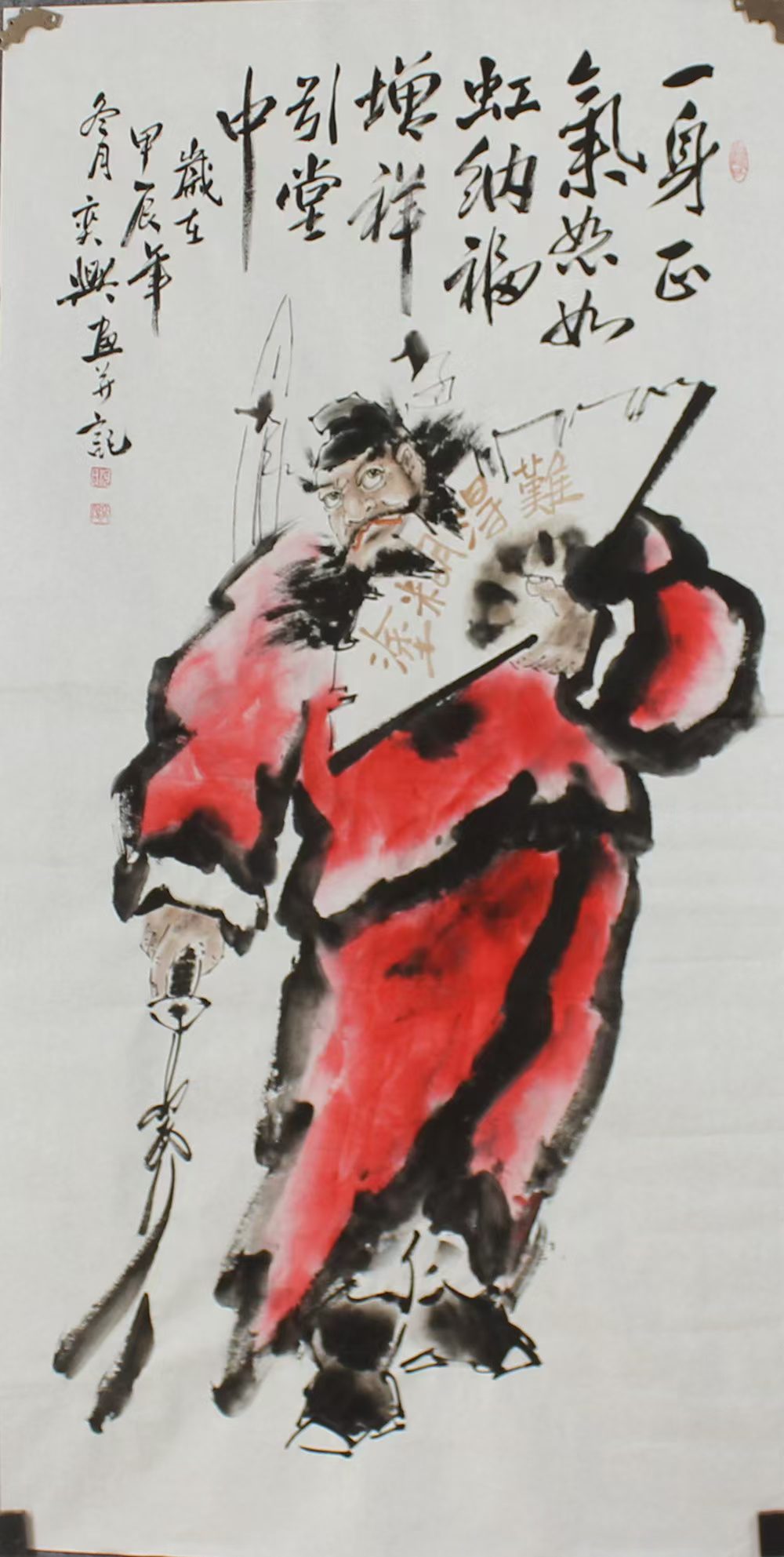
Ink and Color Painting "Zhengqi Zhong Kui - A-Chen Zhenxin" (The Righteous Zhong Kui - A-Chen Zhenxin)
Single Size
0 Review
*Size
138cm x 69cm "Four Feet Full Open
$860.00$1,000.00
Special Features:



Description
Paintings featured
- A collision of traditional writing and brushwork:
- Thick ink and heavy color: Zhong Kui’s figure is written in burnt ink, with his robes rolled up like angry waves, and a strong contrast between the vermilion official uniform and the black background, symbolizing the “confrontation between good and evil”; his face is described in fine detail by brushstrokes, with a leopard’s head and ringed eyes, a gnarled beard, and an angry eye like an electric charge, showing the “cynicism of hatred” majesty of the artist. “The face of the artist is depicted in fine brushstrokes, with an iron face and a gnarled beard.
- Calligraphy: the inscription in cursive script at the top of the picture is “A body of righteousness is as angry as a rainbow”, which is written like a sword unsheathing, echoing the Zhong Kui’s furious look; “Cicadas are auspicious and rainbows are blessed” is inscribed in seal script at the bottom left, which is both strong and soft, hiding the words “Righteousness protects the house, the house is protected by righteousness. The small characters of “Cicada Auspicious Rainbow Nafu” are inscribed on the lower left side, which is both strong and soft, concealing the auspicious metaphor of “righteousness protects the house, and good fortune lasts forever.
Detailed depiction
- Subtle portrayal of subjects and scenes:
- Zhong Kui ‘s phantom: wearing a black hat, with the wings of the hat outlined in gold; red official dress with hidden cloud and thunder pattern; jade belt embedded with lapis lazuli at the waist; holding the Demon Beheading Sword with a cold and sharp light, with the spike of the sword in a stone-green halo, stirring in the wind as a fiery flame; stepping on the evil ghosts, with the ghosts’ faces chapped with light ink to show the hideousness, highlighting the theme of “Evil does not oppress the righteous”. The inscription in calligraphy reads: “The evil is not overpowered by the good”.
- The inscription is in regular script, “Years old in the year jiachen”, and the seal “Zhongyintang” is carved in plain seal script; in the lower right of the picture, “Winter month, Yixing Zhengpinji The lower right side of the picture reads, “Winter Moon Yixing Zhengpinji”, indicating the time of creation and the author’s authentication, reinforcing the authenticity of the work.
- Color and composition:
- Cinnabar red, black and gold collision of three colors, official uniforms blazing like a flame, the background is as somber as the night, the golden sword light splits the picture, forming the visual tension of “a sword to break the chaos”; the layout of the inscription is sparse and dense, and the dynamic composition of the characters constitute a triangular composition, stable and hidden in the sharpness.
Artistic Value
- Classic symbols of folk culture:
- The image of Zhong Kui originates from the “God of Exorcism” in traditional Chinese culture, and the painting is a blend of folk beliefs and literati brushwork, which is not only a picture of the God who calms the house, but also an artistic creation, carrying the spiritual core of “dispelling evils with righteousness”.
- A double breakthrough in brush and ink techniques:
- The brush and ink technique is a double breakthrough: writing and inking show the heroic spirit of Zhong Kui, the fine brushwork depicts the facial hair and hair, and the wild cursive calligraphy injects dynamic rhythms, reflecting the aesthetics of the traditional ink and wash, which is “both form and spirit”.
- The dual value of decoration and faith:
- It can be hung to ward off evil spirits and good luck, and is also suitable for art collection, witnessing the fusion of folk culture and literati painting.
Suitable scene
- Home entrance/study: hang it at the entrance or beside the book case, to take the meaning of “suppressing the house and driving away evils, and filling the door with righteousness”;
- Corporate lobby/office: it symbolizes “getting rid of villains and having a smooth career” and strengthens the aura of the space;
- Cultural exhibition hall/folklore hall: as an example of the traditional Chinese Zhong Kui theme, it demonstrates the symbiotic relationship between folk beliefs and art.
Purchase
- Framing suggestions:
- Traditional style: black background with gold grain damask framing with mahogany shaft head, strengthening the contrast between vermilion and black, in line with folk aesthetics;
- Modern style: frameless acrylic suspension framing, suitable for new Chinese style, industrial style space, highlighting the visual impact of the picture.
- Conservation Tips:
- Avoid light and moisture: avoid direct sunlight that causes the vermillion to fade, store at less than 60% humidity;
- Professional maintenance:regularly use a soft brush to gently sweep the picture dust, avoid the use of chemical cleaners to prevent the paper from becoming brittle.
**✨ Core Highlights**
- Positive energy like a rainbow: Zhong Kui’s angry eyes and the sword’s powerful energy form the spiritual deterrence of “evil spirits retreating”, and the inscription “as angry as a rainbow” strikes the viewer’s heart;
- Folklore code: “Cicada Xiang” harmonizes with “good luck”, and “Rainbow Nafu” is a metaphor for “calamity disperses and good luck”. The details hide cultural ingenuity;
- The symbol of the millennium: Zhong Kui’s image spans from the Tang and Song dynasties to the present day, and this work not only inherits the ancient method, but also integrates the modern visual tension, which is called the living heritage of folk art.
Collector’s significance
With ink as the blade and color as the spirit, “Zhong Kui – A-Chen to Subdue Evil” condenses the eternal belief of “dispelling evil with righteousness” in Chinese culture within a square inch. When the vermilion official uniform splits the night, when the furious cursive brushwork turns into thunder, this work is not only a condensation of skills, but also a guardian totem connecting the secular and the spiritual. Hanging this painting will fill the space with the oriental wisdom of “righteousness, no taboo”.

 Product Reviews
Product Reviews
Write A Review
Related Products