





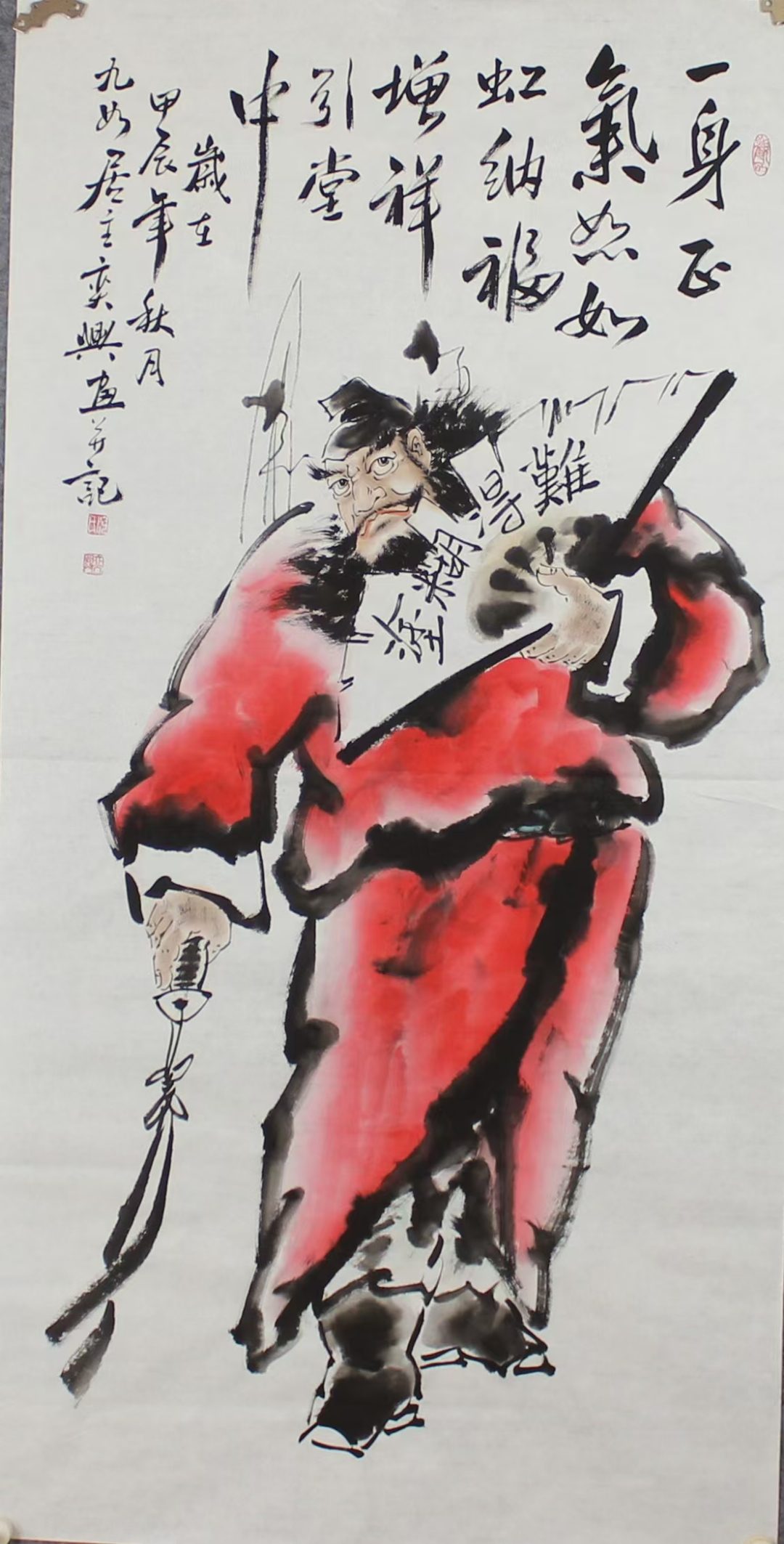
Ink and Color Painting "The Righteousness of the Rainbow-Bingchen Nafut
Single Size
0 Review
*Size
138cm x 69cm "Four Feet Full Open
$830.00$1,000.00
Special Features:




Description
Paintings featured
- The rigidity and flexibility of traditional ink:
- Cinnabar red eye-dotting: the character is dressed in a red official uniform, the robe is outlined in thick ink, the folds are as strong as a knife, and the red color is like a blaze breaking through the black background, symbolizing “righteousness breaks through the evil spirits”; the face is finely drawn in brushstrokes, with a furious sword eyebrow and a gnarled beard like a steel needle, showing the “righteous and awe-inspiring” power. “The face is depicted in fine brushstrokes.
- Calligraphy narrative: the upper right of the picture is inscribed with “a body of righteousness is as strong as a rainbow” in regular script, and the lower left of the picture is in wild cursive, “It’s hard to get muddled” with unrestrained strokes, which forms a philosophical echo of “external rigidity and internal wisdom” with the character’s expression. “The philosophical echoes of the character’s appearance; the scattered inscriptions, such as “Autumn and Moon in the year of the Bichen” and “Zhongyintang,” resemble the annotations of the literati, adding to the interest of literati paintings.
Detailed depiction
- Subtle portrayal of subjects and scenes:
- The character is wearing a turban, with the wings of the cap in burnt ink, showing the hardness of the brush; the vermilion official uniform is decorated with hidden cloud and thunder pattern, the jade belt at the waist is hanging diagonally with tassels, holding the evil sword with a cold and sharp light, and the spike of the sword is stained with a stone green color like a turquoise wave; the foot is stepping on the red flames of the auspicious clouds, and the cloud pattern is stained by vermilion sand, which is in collision with the black background, creating a visual tension of “Evil does not oppress the righteous”. The cloud pattern is dyed with vermilion, colliding with the black background to create the visual tension of “Evil is not overpowered by Justice”.
- Seal mark: upper right, “Jiu Ru Jushi” in seal script; lower left, “Zhongyintang” in positive seal script; scattered inscriptions, “Zengxiang rainbow nafu The inscription “Zengxiang Hong Nafu” and “Yingxiangzhao” are like auspicious phrases, and together with the “Autumn and Moon in the year of Bichen”, they build up a cultural narrative level.
- Color and composition:
- Vermilion, black and gold are intertwined, the official uniform is blazing like a flame, the cold light of the sword splits the chaos, and the inscription is brightened with gold powder like a star; the figure is in the center of the painting, and the inscription is surrounded by clouds, which is in line with the traditional concept of “the circle of the sky and the square of the earth”.
Artistic Value
- The intersection of folklore and literati aesthetics:
- The image of Zhong Kui as the prototype of righteousness is a blend of the folk belief of “suppressing and repelling evils” and the spiritual pursuit of the literati’s “spirit of greatness”, which is not only a symbol of folklore, but also a carrier of the literati’s style and spirit.
- Innovative expression of ink and wash technique:
- Ink is splashed on the robes as if the waves are rolling in, the brushwork on the beard is like a forest of steel needles, and the calligraphic inscriptions are in harmony with reality, breaking the boundaries between the traditional brushwork and writing, and demonstrating the oriental aesthetics of “painting and calligraphy of the same origin”.
- Cultural resonance across generations:
- Through the “B-chen” stem and branch chronology and the philosophy of “hard to get confused”, the work connects history and the present, giving the work the universal value of “righteousness is indestructible, wisdom endures”.
Suitable Scene
- Home entrance/study: hang it at the entrance or beside the book case, taking the meaning of “calming down the house and protecting the family, and filling the door with righteousness”;
- Corporate lobby/office: to symbolize the “elimination of villainy, business frankness”, to strengthen the space aura and cultural style;
- Cultural exhibition hall/art gallery: as an example of the fusion of folklore and literati painting, it demonstrates the diversified expression of traditional Chinese ink.
Purchase
- Framing suggestions:
- Traditional style: black background with gold grain damask framing with mahogany shaft head, strengthening the contrast between vermilion and black, in line with folk aesthetics;
- Modern style: frameless acrylic suspension framing, suitable for new Chinese style, industrial style space, highlighting the visual impact of the picture.
- Conservation Tips:
- Avoid light and moisture: store away from direct sunlight, humidity below 60% to prevent pigment oxidation;
- Regularly use a soft brush to gently sweep the picture dust, avoid using chemical cleaners.
**✨ Core Highlights**
- Positive qi like a rainbow: the red official uniform splits the mysterious night, the inscription “a positive qi like a rainbow” is like a thunderbolt through the air, hitting the viewer’s heart;
- Cultural code: the inscription “Autumn and Moon in the year of the Bichen” frames the historical moment, and “Increasing the auspiciousness of the rainbow” hides a metaphor of good luck, showing the craftsmanship in the details;
- Philosophy: The inscription “Hard to be confused” and Zhong Kui’s angry eyes constitute the wisdom of “hardness on the outside and softness on the inside”, giving the painting a spiritual resonance that transcends time and space.
Collector’s significance
With ink as the blade and color as the soul, “The Righteousness of the Rainbow – Nafu of the Bicentennial” condenses the eternal belief of “dispelling evil with righteousness” in Chinese culture within a square inch. When the vermilion official uniform is transformed into the light of dawn, and when the furious cursive brushwork is engraved with the spirit of the greatness, this work is not only a condensation of skills, but also a spiritual totem connecting history and the present. Hanging this painting will fill the space with the oriental wisdom of “righteousness and longevity”.

 Product Reviews
Product Reviews
Write A Review
Related Products