





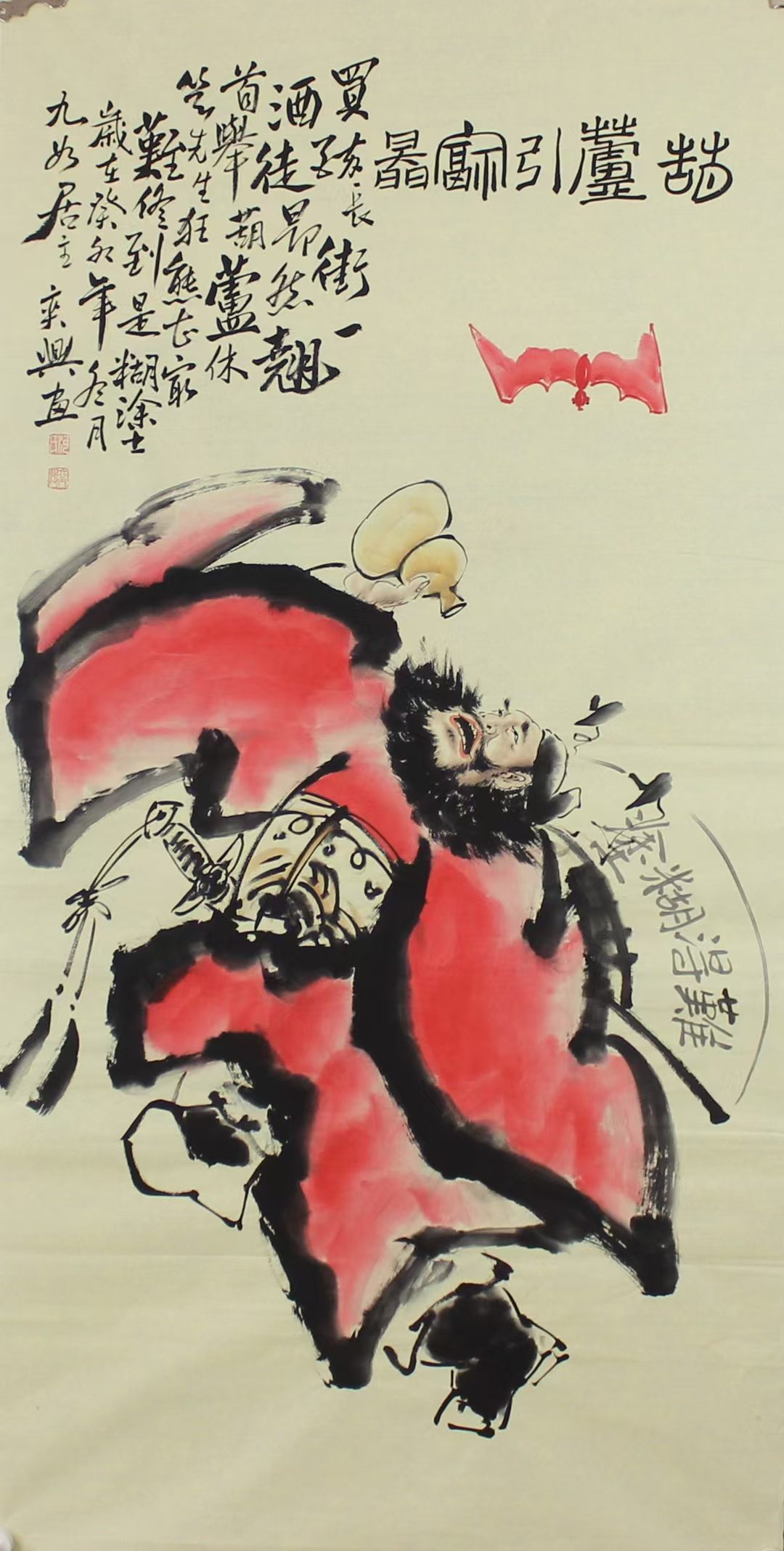
Ink and Color Painting "Drunken Immortal and Wild Ease - Ink Rhythm of Dec.
Single Size
0 Review
*Size
138cm x 69cm "Four Feet Full Open
$850.00$1,000.00
Special Features:




Description
Paintings featured
- A wildly written traditional ink and watercolor:
- Lines and colors: the immortal’s robes are rendered in red and black ink, red is like drunkenness, black is like drunkenness, the lines of the robes are as strong as the wind, showing the wantonness of “the dry universe is big in drunkenness”; the face is outlined in light ink in a drunken state, the cheeks are dyed with red haze of vermilion sand, and the beard and hair are flying as white as a wild dance in cursive, showing the crazy charm of “the immortal in drunkenness”. The face is depicted in light ink in a drunken state, with cheeks dyed in a reddish haze of vermilion and hair flying white like a wild dance in cursive, showing the madness of the “Immortal in Wine”.
- Calligraphy: the inscription on the top of the picture, “Jiu Ru Jushi Le Xing Sheng”, “Aged in the third month of the year Kui Chou”, is written in cursive strokes as if the drunken man is staggering, which echoes with the posture of the immortal; the scattered inscriptions, “Dukang The inscription “Dukang”, “storm”, “training”, etc. seems to be a drunken play of brushwork, and the picture constitutes the literati flavor of “painting and calligraphy of the same origin”.
Detailed depiction
- Subtle portrayal of subjects and scenes:
- Drunken Immortal: the immortal is bare-chested and bare-bellied, his red robe is draped diagonally and his sash hangs loosely, the gourd at his waist is depicted in burnt ink, and the wine stains are splashed like ink dots; he treads on the clouds with his bare feet, the tips of his toes tilted up as if in a dance, and his hand is tilted over to reveal that the wine syrup has been turned into ink traces and flowed downwards, a metaphor for the “mingling of wine and ink, and the writing of the brush while drunken”.
- Inscription and seal: upper right, “Jiu Ru Jushi Le Xing Sheng” in cursive script, as if wielding a brush in a drunken stupor; lower left, “Aged in the third month of the year Kui Chou” in regular script, hiding the clumsiness in the middle; seal: “Honey powder lubricates the hard” in vermilion, with a diagonal slant. The seal of the artist, “It’s hard to get the honey powder to be moist”, is in Zhuwen, the seal engraving is simple and witty, as if it is a playful remark after drinking, and the scattered inscriptions such as “All the madness and wickedness of the gentleman can be detested,” and “Firstly, I hold up a gourd of Hu Cai,” are interestingly staggered, which conceal the thoughts of self-mockery and liberation of the literati.
- Composition and white space:
- A large portion of the background is left white, with only a sweep of light ink to suggest the clouds, highlighting the main body of the immortal’s drunkenness; the layout of the inscription is sparse and dense, like a drunken man’s steps, which constitutes a “balance in the imbalance” with the dynamics of the character, alluding to the Taoist philosophy of “great skill is like clumsiness”.
Artistic Value
- A spiritual portrayal of literati madness:
- Taking “drunkenness” as the soul, integrating Li Bai’s poetic and alcoholic style and Bada Shanren’s spirit of ink play, reconstructing traditional immortal subjects through exaggerated ink and brushwork, and showing the spiritual realm of literati “escaping from the world through drunkenness, and sending out emotions through madness”.
- A breakthrough expression of ink and wash technique:
- The clothes and robes are splashed with ink as if they were stained with wine, the beard and hair are white as if they were written in cursive, and the brushwork of the inscriptions and the dynamics of the characters are integrated, breaking the boundaries between traditional brushwork and writing and creating a new paradigm of “drunkenness aesthetics”.
- A cultural symbol that is appreciated by both the common and the common people:
- It not only carries the literati ideal of “attaining Taoism in wine”, but also brings the public aesthetics closer to the public with folkloric images such as “Dukang” and “gourd”, which is a contemporary revitalization sample of traditional ink painting.
Suitable Scene
- Study/tea room: hung next to the bookcase or tea table, with the fragrance of wine and ink, it creates a space of “drunkenly picking lamps to look at swords” of the literati’s rhapsody;
- Art bar/cultural space: as a new Chinese aesthetic device, it collides with jazz music and modern art, interpreting the cross-border dialog of “ancient and modern drunkenness”;
- Corporate meeting area: it is a metaphor for the management philosophy of “the way of tension and relaxation”, injecting humanistic temperature into the commercial space.
Purchase Information
- Framing suggestions:
- Traditional style: indigo damask framed with ebony shaft, strengthening the contrast between red and black, suitable for literati yuppie temperament;
- Modern style: frameless acrylic suspension framing, suitable for industrial style, minimalist space, highlighting the tension of drunkenness.
- Conservation Tips:
- Avoid light and moisture: avoid direct sunlight leading to discoloration of the vermilion, and store at less than 60% humidity;
- Dusting taboo: use a feather duster to gently brush the picture, prohibit the use of wet cloth to wipe, to prevent the ink marks halo.
**✨ Core highlights**
- Drunken ink like madness: robes splashed with ink like wine stains made in heaven, hair flying white like crazy cursive writing, each stroke is “half drunk, half awake” the rhythm of life;
- Inscription code: the scattered inscriptions “Dukang”, “storm” and “training” conceal the self-deprecation of the literati, and the seal “honey powder is difficult to moisturize” is a playful irony. difficult” is a playful irony, constituting a narrative labyrinth of “true words in drunkenness”;
- Dialogue between the past and the present: traditional ink and wash is used to reconstruct the “Spirit of the God of Wine”, allowing the drunkenness of the literati of the millennium to resonate with the free souls of today.
Collection Significance
Drunken Immortal – Ink Rhythm of the Decapolis” uses ink as wine and brush as drunkenness, splashing out a crazy and transcendent rhapsody of life on rice paper. When the red robes are rolled into waves of drunkenness, and the inscriptions are scattered like half-talking after drinking, this work is not only a condensation of skills, but also a beam of drunkenness that connects the bones of Wei and Jin dynasties with the spirit of today. Hanging this painting, the space can be transformed into a dojo where “the Tao is hidden in the wine, and the truth is seen in the madness”.

 Product Reviews
Product Reviews
Write A Review
Related Products