





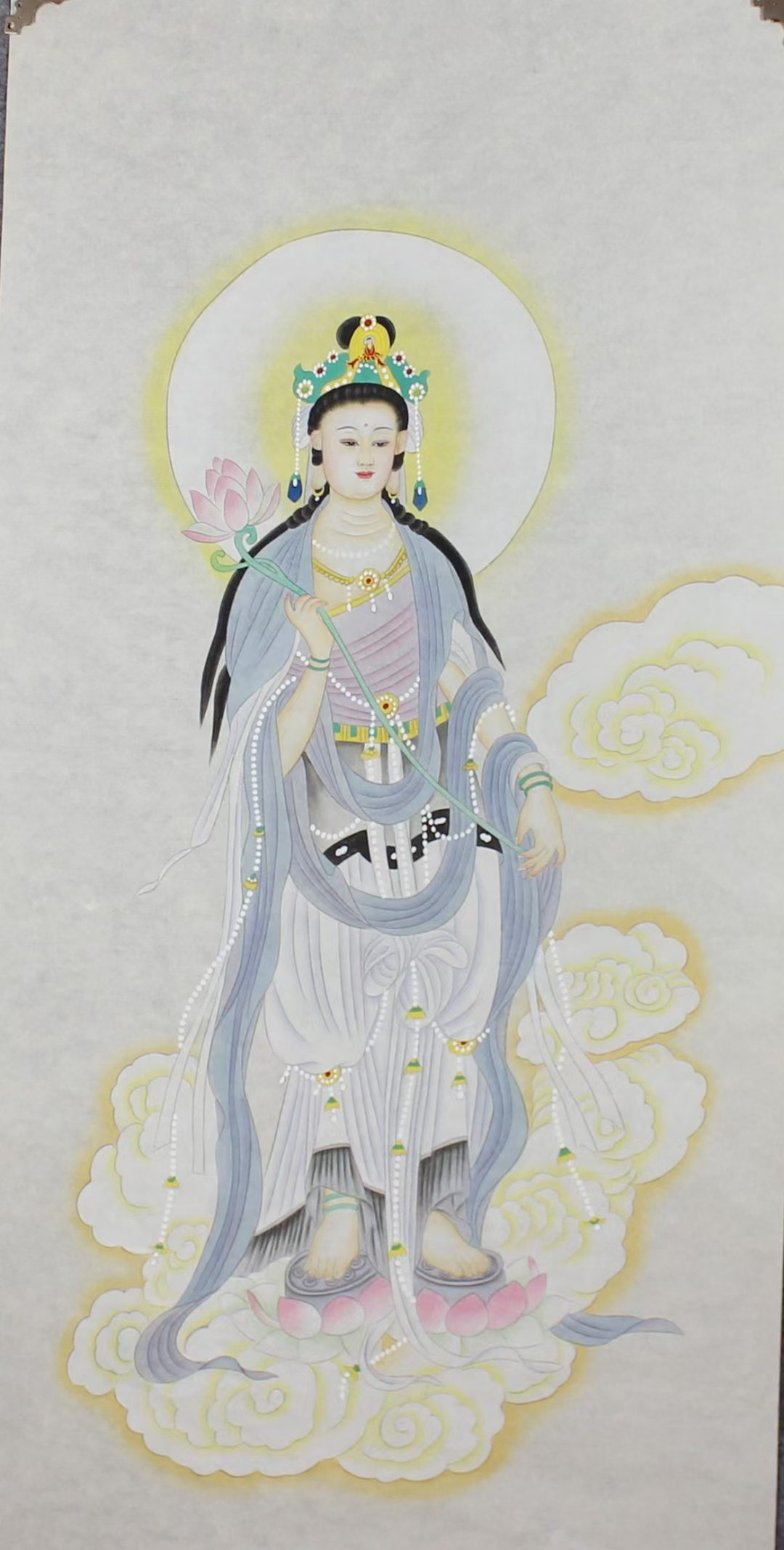
Heavy Brush Painting "Guanyin in Lotus Seat - Ciyun Pure Domain
Single Size
0 Review
*Size
138cm x 69cm "Four Feet Full Open
$860.00$1,000.00
Special Features:




Description
Paintings featured
- Delicate expression of traditional brushwork:
- Lines and Colors: Painted with the heavy color technique of Gongbi, the lines of Guanyin’s robe are as smooth as flowing clouds and water, the white veil is thinly dyed with clam powder, and the folds of the robe are haloed with a light green to show the sanctity and spirituality of the painting; the lotus flower is rendered with a gradation of vermillion and stone green, with petals overlapping like the real thing, symbolizing purity and freedom from dye.
- The combination of reality and reality: the clouds in the background are dyed with wet ink and light color, the ink color changes gradually from thick to light, and the quiet posture of Guanyin forms a visual rhythm of “movement in silence”, as if the pure land of Buddha surrounds the earth.
- The depth of the religious symbols is portrayed:
- Guanyin’s lowered eyebrows and eyes, holding a blooming lotus flower, with her left hand forming the wish-fulfilling seal, reflecting the Buddhist spirit of “compassion for the world, purity and immaculateness”; the water beneath the lotus platform ripples slightly, implying the “transmitting the sufferings of all sentient beings, and cleansing the world’s worries”.
Detailed depiction
- Subtle portrayal of subjects and scenes:
- Guanyin’s Dharma: wearing a crown with pearls and lapis lazuli, the central Buddha sits cross-legged; her face is rich and kind, the white hairs between her eyebrows are embellished with pearl powder, and her eyes are warm and compassionate. The robe is embellished with flowers and lotus twining branches, the cuffs of the sleeves are outlined with gold thread and the sash flutters in the wind, every inch of which shows the skill of the craftsmen.
- Lotus and the sea of clouds: the tip of the lotus petals dyed in cinnabar, the heart of the stamen outlined in clay gold, lotus stems meandering like a dragon; the background clouds rendered in the “boneless method”, the near clouds fine brush hooks, the distant mist, haze hidden gold dust, as if the Brahmins are surrounded by the sound of the Buddha.
- Spells and embellishments:
- Holding a lotus flower in hand, verdant, branches and leaves as fine as hair; waist jade pendant tassel, jade beads with clam powder to brighten up, implying the essence of the Buddhist teachings of “all virtues complete”; foot lotus platform cinnabar hook petals, and the clouds and the warmth of the cold echoed in the details of the sacred solemnity of the full display.
Artistic Value
- A visual classic of Buddhist art:
- Strictly following the tradition of Buddhist paintings in the Tang and Song dynasties, the pattern of clothes and crowns is based on the “Guanyin Pu Men Pin” of the Dharma Flower Sutra, and the modeling of the lotus pedestal is derived from Dunhuang murals, which is called the “living inheritance of Buddhist iconography”.
- It is the ultimate presentation of the brushwork technique:
- Adopting the ancient method of “three alums and nine dyes”, the mineral pigments (cinnabar, stone green and clay gold) are everlasting; the clouds are rendered with a mixture of reality and illusion, and the lines of the sash are smoothly and elegantly depicted by the “Gao Gu Yusi Tracing”, which reproduces the extraordinary skills of Buddhist paintings of the Tang and Song dynasties.
- Religion and aesthetics resonate together:
- It can be used as an icon for worship and as a collection of art, witnessing the aesthetics of Chinese Buddhist paintings, which is “both form and spirit”.
Suitable Scene
- Buddhist temple: framed as a scroll hanging in the Guanyin Hall, with incense offerings, to strengthen the “Buddha’s light” of the solemn Taoist temple;
- Quiet room at home: hung in the study, tea room, with wooden furniture, celadon incense, to create a Zen space of “the heart is like a lotus flower, purity of thought”;
- Cultural Gallery: as the core exhibits of the special exhibition of Buddhist art, juxtaposed with the Song and Yuan land and water paintings, it conveys the oriental religious aesthetic system.
Purchase
- Framing suggestions:
- Traditional style: antique silk mount with rosewood shaft, covered with yellow satin scripture book, in line with the temple etiquette;
- Modern style: frameless acrylic suspension framing, suitable for new Chinese style, wabi-sabi style home, highlighting the ethereal texture of the sea of clouds.
- Conservation Tips:
- Avoid light and moisture: store away from windows, start the dehumidification equipment when the humidity is higher than 65% to prevent pigment flaking;
- Dedicated toregular use of soft bristle brush gently clean the picture dust, avoid the use of chemical cleaners.
**✨ Core Highlight**
- Dharma like Dharma: every brushstroke is in line with Buddhist rituals, and the lotus platforms and necklaces conceal the secret meaning of cultivation;
- Lotus in the realm: the layers of lotus flowers are like the rise and fall of the breath, and the viewer can smell the fragrance of lotus when he or she concentrates on it;
- Thousands of years of technology: the gold threads of the clothes are as fine as the hairs of autumn, the gold hooks are as bright as the stars pouring down, reproducing the “pilgrimage on the tip of the brush” of Buddhist paintings of the Tang and Song dynasties.
Collection Significance
With brushwork as the bone and heavy colors as the soul, “Lotus Terrace Goddess of Mercy – Ciyun Pure Land” condenses the supreme compassion of Buddhism and the ultimate pursuit of artistic craftsmanship within a square inch. When the lotus flower lifts up the Bodhisattva’s lowered brow, and when the sea of clouds reflects the glory of the Pure Land, this work is not only a condensation of skill, but also a beam of dharma that connects the earthly world with the other shore. Worshipping this painting will transform the space into a place where “the heart is like a lotus flower, where blessings and wisdom are cultivated”.

 Product Reviews
Product Reviews
Write A Review
Related Products