





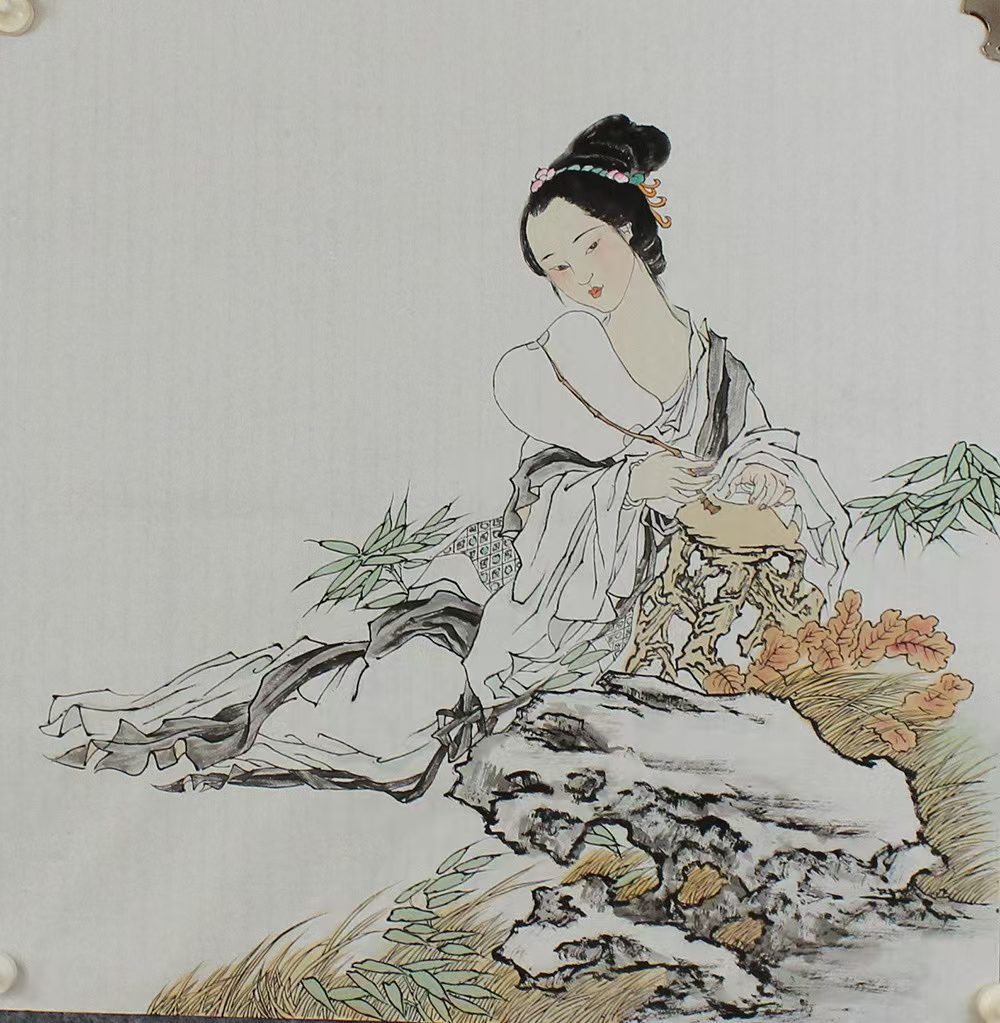
Appreciation of the work-brush figure painting "meditation on a beautiful woman".
Single Size
0 Review
*Size
69cm x 68cm "Four Feet Cubed"
$820.00$1,000.00
Special Features:




Description
Paintings featured
- Technique inheritance: traditional brushwork and heavy color technique is used to outline the silhouette of the figure with delicate strokes of “three alums and nine dyes”; the ink lines are as smooth as a silk worm spitting out silk, and the coloring is dyed in layers to present a clear but not too heavy texture.
- The contrast between reality and reality: the background is colored with light ink and wet brush to create a hazy screen and potted plants, contrasting with the details of the characters, alluding to the wisdom of traditional painting’s “white is as black as it is white”.
- Reference to the Ming Dynasty: the woman’s dress is based on a jacket and skirt pattern, with a finely-painted twining lotus pattern at the edge of the garment and pearl buttons at the neckline based on artifacts unearthed at the Dingling Mausoleum, which is a combination of artistry and historical restoration.
Detailed depiction
- Characters: the woman’s brows are lowered, her fingertips caress the scroll, and her lips are dyed with a faintly visible Zhuqian, condensing the implicit beauty of “wanting to speak but not yet resting” into a fleeting moment.
- Clothing texture: shirt and skirt with mineral pigment stone green, stone green layered overdyeing, fabric warp and weft can be identified; poncho using “ancient silk depiction”, lightweight seems to be able to move with the wind.
- Scholar’s room: desk Xuande furnace smoke curls, Ru kiln tea still exist, bronze goblet inserted diagonally in a branch of white plum, a metaphor for the owner of the “zither, chess, calligraphy and painting” of the life of the elegant scholar.
Artistic Value
- Textbook of Technique: It presents the complete creative process of brush painting from line drawing to coloring, and can be used as a model for teaching traditional painting.
- New interpretation of female subjects: breaking through the programmatic expression of ladies’ paintings, through micro-expressions and scene narratives, it creates a female image with both classical temperament and modern humanistic spirit.
- Carrier of literati spirit: the combination of artifacts implies the concept of “unity of Taoism and artifacts”, and the tea utensils, incense utensils, and scrolls constitute an aesthetic system of literati life, which is of value for cultural anthropological research.
Suitable Scene
- Cultural space: museums, cultural and creative areas, national academies, Chinese tea rooms, can strengthen the thickness of the cultural lineage of the space.
- Private furnishings: the study is hung above the book case, echoing the Four Treasures; the bedroom is equipped with bamboo shadow lamps, creating the mood of “poetry and books on the pillow, a good place to relax”.
- Commercial application: background wall of high-end cultural brand showroom, props for historical scenes of movies and TV dramas, which can enhance the cultural credibility of the scene.
Purchase
- Framing suggestions: framing selection of silk damask framing, heaven and earth rod with camphor wood pest control, to avoid chemical adhesive film damage to the silk fibers.
- Environmental control: display area humidity control at 45%-55%, configure professional-grade anti-ultraviolet spotlights (color temperature 2700K is appropriate).
- Maintenance advice:regularly sweep the dust along the grain with a soft bristle brush, and every three years, professional restorers need to check the stability of the alum glue layer.
Collector’s significance
This work is not only a condensation of skills, but also a time-traveling collection of scholars, allowing the viewer to see the classical state of mind of “listening to the rain on the idle window and spreading out the poetry scrolls” in the hustle and bustle of the earthly world.

 Product Reviews
Product Reviews
Write A Review
Related Products