





Ink Painting "Bamboo Panda - Ink Charms
Single Size
0 Review
*Size
138cm x 69cm "Four Feet Full Open
$850.00$1,000.00
Special Features:




Description
Paintings featured
- Condensed expression of traditional ink:
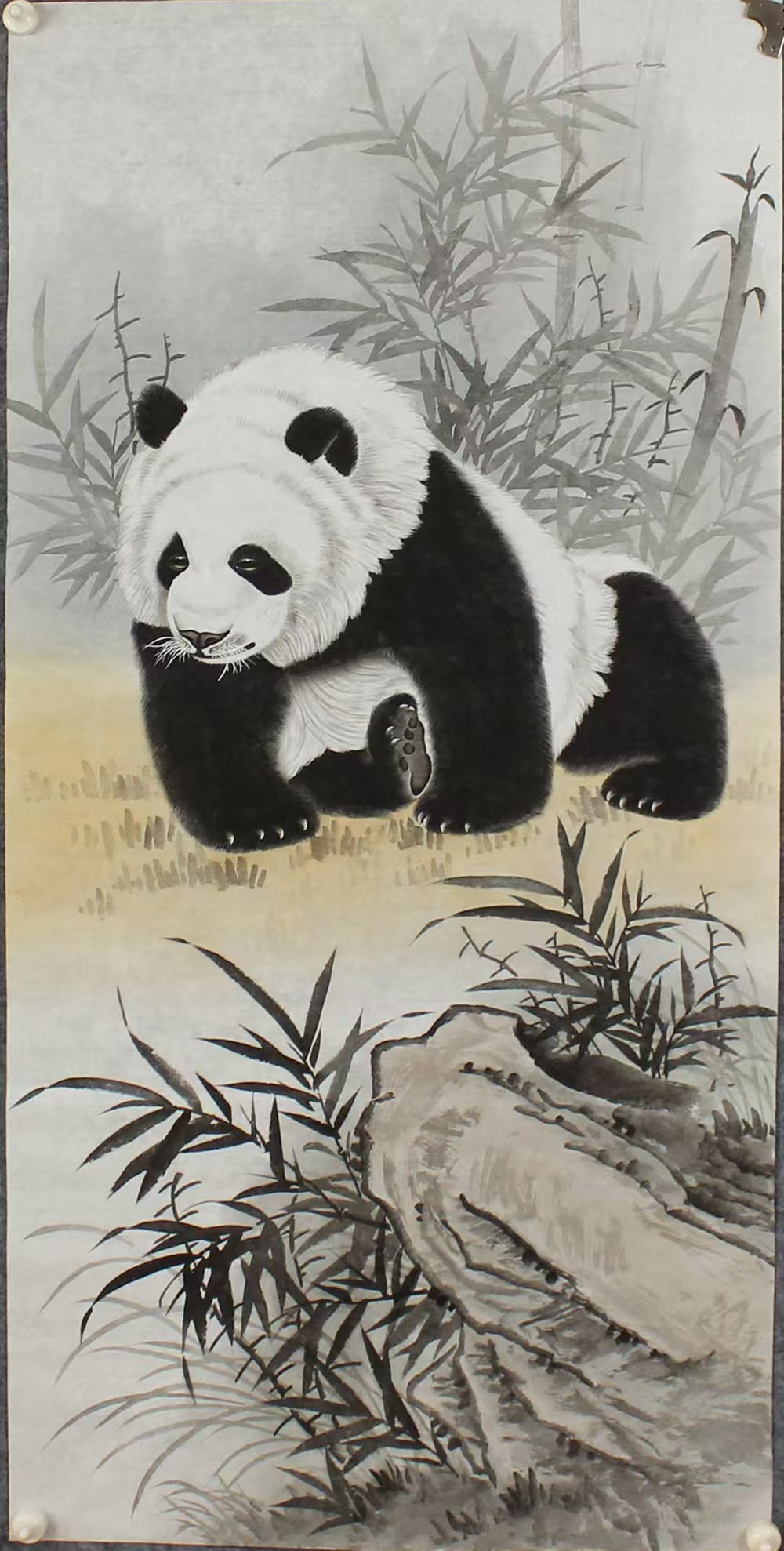
- Symphony of black and white: the soft texture of the panda’s fur is rendered in both thick and light ink, the strong bones of the bamboo joints are outlined in burnt ink, and the layers of the bamboo leaves are dyed in light ink, showing the flavor of ink and wash between the contrasts of black and white;
- White space: the “white as black” technique is used in the background to create a sense of clouds and mist, and the outlines of the mountains and rocks appear in the depths of the bamboo forest, transmitting oriental aesthetics and philosophies in a symbiosis of reality and emptiness.
- Detailed portrayal of both form and spirit:
- The panda’s eyes are punctuated with light ochre, revealing spirituality in its simplicity; the bamboo leaves are distributed in a staggered manner with “individual” and “intermediate” methods, with the rhythm of sparseness and density like natural growth; the rocks are chapped with strong strokes, forming a contrast between rigidity and softness with the flexibility of the bamboo grove.
Detailed depiction
- Panda naive and funny:
- The panda is seated on the ground, its front paws resting lightly on a bamboo branch, its fur dyed in layers of light ink with a wet brush, the ink color changing from light to dark to simulate the transition of light and shadow, and the ear with a burnt ink border to enhance the sense of three-dimensionality;
- The bamboo branch slants out from the panda’s side, the bamboo joints are outlined with “iron line drawing”, the bamboo leaves are differentiated by light and dark ink colors on the front and back, and the tips of the leaves are slightly curled as if they are trembling with the wind.
- Bamboo Forest:
- Distant view of the bamboo bushes with light ink sweeping, like a fog hidden; near the rocks to axe-chopping method to show the coarse texture, moss points sparse and dense;
- Ground weeds are embellished with withered brush strokes, echoing with a few clusters of new shoots by the panda’s feet, concealing the natural cycle of “endless life”.
Artistic Value
- The double metaphor of cultural symbols:
- The panda, as a national treasure of China, symbolizes peace, while the bamboo forest signifies a gentleman with an open mind and a temperate spirit, and the combination of the two conveys the oriental philosophy of “harmony between the strong and the soft, and the symbiosis of all things”;
- The inscription in running script, “You can’t live without bamboo,” is on the upper left, and the vermilion seal, “Guan Zi Zi Zai,” is on the lower right, reflecting the literati tradition of poetry, calligraphy, painting, and sealing as an integral part of Chinese painting.
- Unity of technique and mood:
- Inheriting the ink and bamboo brushwork of Wentong in the Song Dynasty and integrating the realistic technique of modern animal painting, the painting has the elegance of traditional ink and wash and the affinity of contemporary aesthetics.
Suitable Scene
- Study and tea room: hang it next to the bookcase or tea table, with bamboo furniture and celadon tea sets, creating the elegant “leaning on the bamboo to watch the bear, sipping tea and reading scrolls”;
- Children’s room/parent-children’s space: the panda’s naivety inspires children’s hearts, and the bamboo rhyme conveys traditional culture, combining the functions of aesthetic education and cultural enlightenment;
- Corporate living room: it symbolizes the corporate spirit of “carrying things with virtue and flexibility” and conveys the Chinese cultural heritage.
Purchase Notes
- Framing suggestions:
- Traditional vertical scroll: moon white damask cloth inlaid, with ebony shaft head, ancient paste framing to prevent deformation;
- Modern framing: original wood thin frame + matte cardboard, weakening the traditional heavy feeling, suitable for Scandinavian and Japanese style.
- Conservation Tips:
- Moisture and light avoidance: storage humidity <55%, avoid direct sunlight leading to the yellowing of rice paper;
- Professional cleaning: use a soft brush to gently sweep the floating dust along the direction of the ink marks, avoid wiping with a wet cloth;
- Regular display: long-term roll hiding easy to cause ink color adhesion, it is recommended that the ventilation 1-2 times a year.
**✨ Beyond the Painting **
- Hidden inscription: Zheng Banqiao’s poem “A branch and a leaf are always related to love” is inscribed in fly-head script at the crevices of the rocks, which needs to be viewed with the light turned sideways;
Collector’s significance
Bamboo Forest Panda – Ink and Rhythm is not only a condensation of ink techniques, but also a dialog between nature and humanity. When the panda sits in the bamboo forest, one can see the spirit of all things; when the bamboo shadows sway, one can realize the style of a gentleman. Hanging this painting in the room, there is no need to decorate, there is a fragrance of ink, injecting an oriental Zen feeling of returning to the basics into modern life.

 Product Reviews
Product Reviews
Write A Review
Related Products