




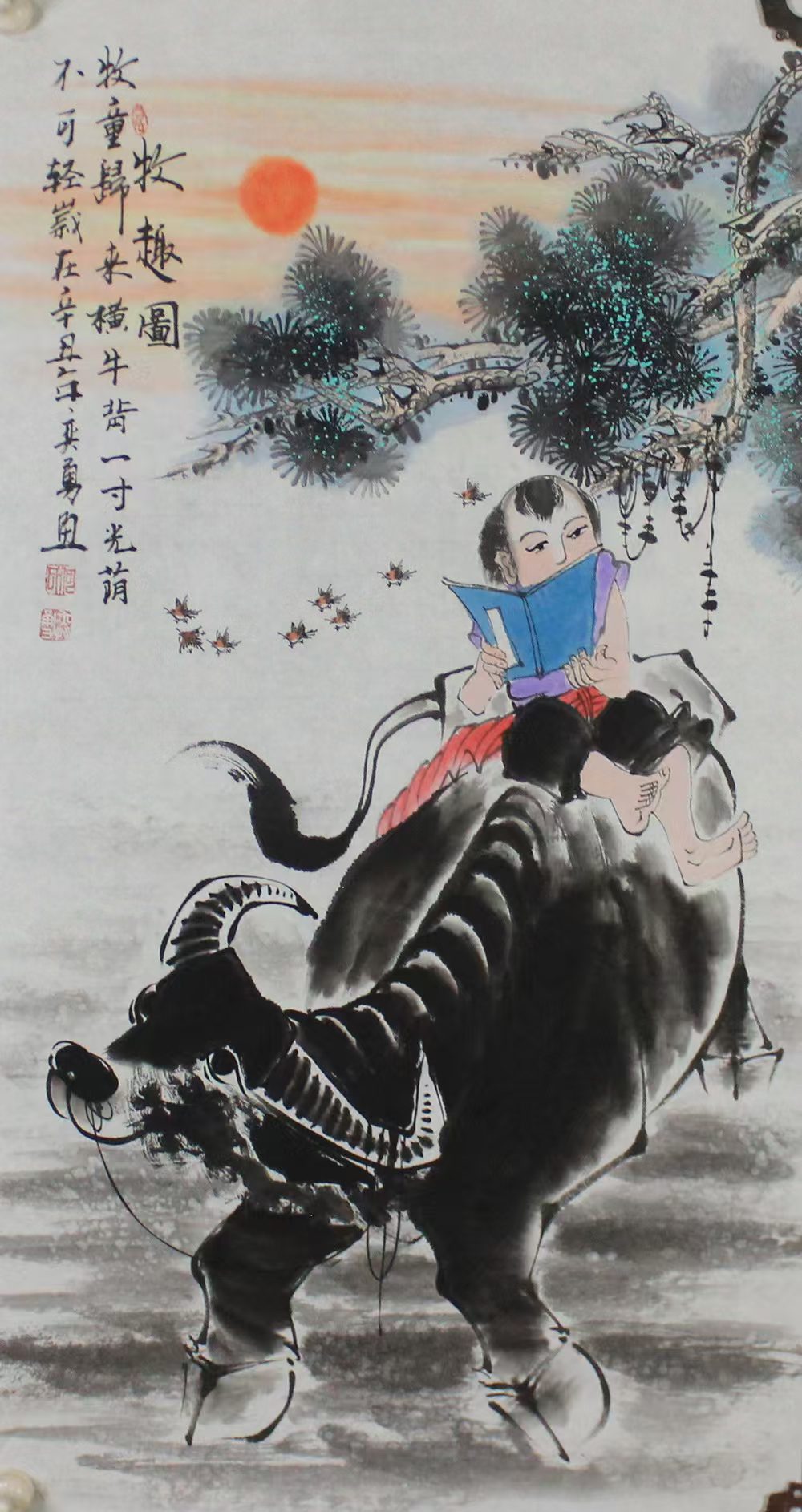
Ink and wash idyllic painting "Shepherd Boys Reading Diligently - Returning to the Pasture in Xin Chou
Single Size
0 Review
*Size
100cm x 55cm "Three Feet Full"
$860.00$1,000.00
Special Features:




Description
Paintings featured
- Elegant expression of traditional ink:
- Blending of dryness and moisture: the shepherd boy’s clothing pattern is outlined in light ink with a medium stroke, and the folds of the lapel are slightly chapped, showing simplicity and animation; the cow’s fur is chapped with dry strokes of burnt ink, leaving white on the abdomen to emphasize the sense of volume, and the hooves of the cow are stuttered with thick ink as if they were treading on the ground, which is calm and thick.
- Poetic rendering: the sunset in the background with ochre from thick to light staining the sky, pine branches with burnt ink and thirsty brush strokes, pine needles fine brush clusters such as umbrellas, and the inscription “can not be light” to form a philosophical dialogue of “pines and cypresses are evergreen, time passes easily”.
- The narrative of farming and reading is interwoven with movement and static:
- In the stillness, there is movement: the shepherd boy rides the ox sideways, holding a book with his head bent down, his brows lowered in concentration, his fingertips lightly twisting the pages, the ink lines on the spine of the book are clearly recognizable, and his sleeves are slightly raised in the wind, which is a metaphor for the concentration of the “undistracted mind”;
- Hidden in the movement: the old cow walks slowly with its head hanging down, its sinewy lines are dyed with light ink to show its strength, the cow’s tail swings gently to drive away the flies, and the pine branch stretches out diagonally in the wind, which constitutes a visual rhythm of “movement against silence” with the shepherd boy’s quiet reading.
Detailed depiction
- Subtle portrayal of living beings and artifacts:
- The shepherd boy: wearing a bamboo hat, with gabion lines densely woven with intersecting fine threads; an ochre cloth belt around his waist, with knots like woven grasses; his feet on grass shoes, with the soles in withered brushwork showing the coarseness of the grass stems, and the tips of his toes in light ochre with traces of soil, showing the childishness of the countryside.
- The old ox: the eyes of the ox are dotted with thick ink, the corners of the eyes are slightly dyed with rouge to show the tame demeanor; the horns of the ox are written in burnt ink with a thirsty brush, and the texture of the roots is like the wheel of an ancient tree, which is a metaphor for “a ploughing ox accompanied by a reader, diligent in every year”.
- Scroll and pine scene: the open pages of the book with light ink outlines, the handwriting vaguely like fly-head lowercase; the background of the main trunk of the pine to “crab claw chapped” performance of the texture of the bark, the pine needles fine brush clusters such as umbrella, and the inscription “not light years” to form the time of day Echoing the imagery.
- The inscription and the seal have a deep meaning:
- 画面右上方题字“不可輕歲在辛丑正丑丑丑丑”,行书笔意洒脱恣肆,落款“牧童歸來橫牛峽牛啃一寸光荫”钤“牧趣圖”朱文印, The seal carving is simple and clumsy, implying the teaching of “Cherish the time and study diligently”;
- The lower left corner of the seal is inscribed in clerical script as “牧趣圖”, forming a triangular composition with the pine branch and the arc of the cow’s back, which is in line with the aesthetic concept of “poetry, calligraphy, painting, and sealing”, which is an integral part of traditional calligraphy and painting.
Artistic Value
- Visual interpretation of farming and reading culture:
- The scene of a shepherd boy reading on the back of a cow alludes to the Confucian ideals of the Analects of Confucius, “Plowing is also a source of discouragement; learning is also a source of wealth,” condensing the values of “plowing to nourish one’s body, and reading to brighten one’s mind” into a symbol of ink and watercolors;
- A contemporary continuation of the tradition of literati painting:
- Inheriting the realistic spirit of Li Di’s “Cattle Herding” from the Southern Song Dynasty, integrating the tradition of the inscription poem of Shen Zhou’s “Night Sitting” from the Ming Dynasty’s Wumen School of Painting, and reproducing the layering of classical ink and wash with “ochre dyeing the twilight color, and charcoal ink writing the bones of the pine”;
- Emotional resonance across time and space:
- The inscription of “Don’t be light” is like a morning bell in the evening drum, awakening people to cherish “slow reading time” in the contemporary fast-paced life, which has both aesthetic value and warning significance.
Suitable Scene
- Study room/tea room: mounted as antique vertical axis hanging, and line-bound ancient books, celadon tea ware co-displayed, to create a humanistic mood of “cultivation and study passed down to the family for a long time, poetry and books will continue to grow in the world”;
- Children’s room/educational space: the image of a shepherd boy studying hard can be used as an aesthetic teaching material, conveying the teaching of “black hair does not know how to study hard in the morning, and white hair regrets being late in studying”;
- Cultural Exhibition Hall/Art B&B: As the theme exhibit of “Local Memory”, it is juxtaposed with the agricultural poems of “The Book of Songs” and traditional farming tools to stimulate the viewers to think about the farming civilization.
Purchase Information
- Framing suggestions:
- Traditional: moon white damask cloth mounted on a scroll with a boxwood header, reinforcing the elegance of the literati;
- Modern: light gray linen backing with dark curry metal suspension frame, suitable for new Chinese style, minimalist space.
- Conservation Guide:
- Moisture and light: the humidity of the storage environment should be less than 60%, and avoid direct sunlight to cause yellowing of the paper;
- Anti-folding: the scrolls should be wrapped in acid-free cotton paper and placed upright in a brocade box when stored.
- Wipe the dust lightly with a soft brush.
**✨ Core Highlights**
- Metaphor of light: The sunset “one inch of light” is rendered in ochre gradient, and the inscription “cannot be taken lightly” forms a visual warning that “twilight urges one to be diligent”;
- The unity of heaven and man: the gentle drooping head of the old ox and the concentrated reading posture of the shepherd boy allude to the Taoist cosmology of “symbiosis between nature and humanity”;
- Literary code: the stem and branch of the inscription “Zheng Chou” and the pines and cypresses’ strong texture together constitute the symbol of the literati style of “not withering in the cold years”.
Collector’s significance
The “Shepherd Boy Studying Diligently – Returning to the Pasture in Xinchou” uses ink as a boat and a cow as a case, carrying a volume of books and roaming between the twilight and the pine winds. When the fingertips of the shepherd boy skim over the yellow pages of the book, and when the inscription of the year Xinchou is solidified as a motto of time, this painting is not only a condensation of ink and wash techniques, but also an idyllic poem dedicated to the civilization of cultivation and study. Hanging this painting will turn your room into a place where you can “read the Spring and Autumn to know the taste of the world, and slowly lead the cow to send the slanting sun”, guarding a poetic time in the hustle and bustle of the world.

 Product Reviews
Product Reviews
Write A Review
Related Products