




Ink and wash idyllic painting "Piccolo without a Cavity - Returning to the Pasture in Xinchou
Single Size
0 Review
*Size
100cm x 55cm "Three Feet Full"
$860.00$1,000.00
Special Features:




Description
Paintings featured
- Spiritual writing in traditional ink:
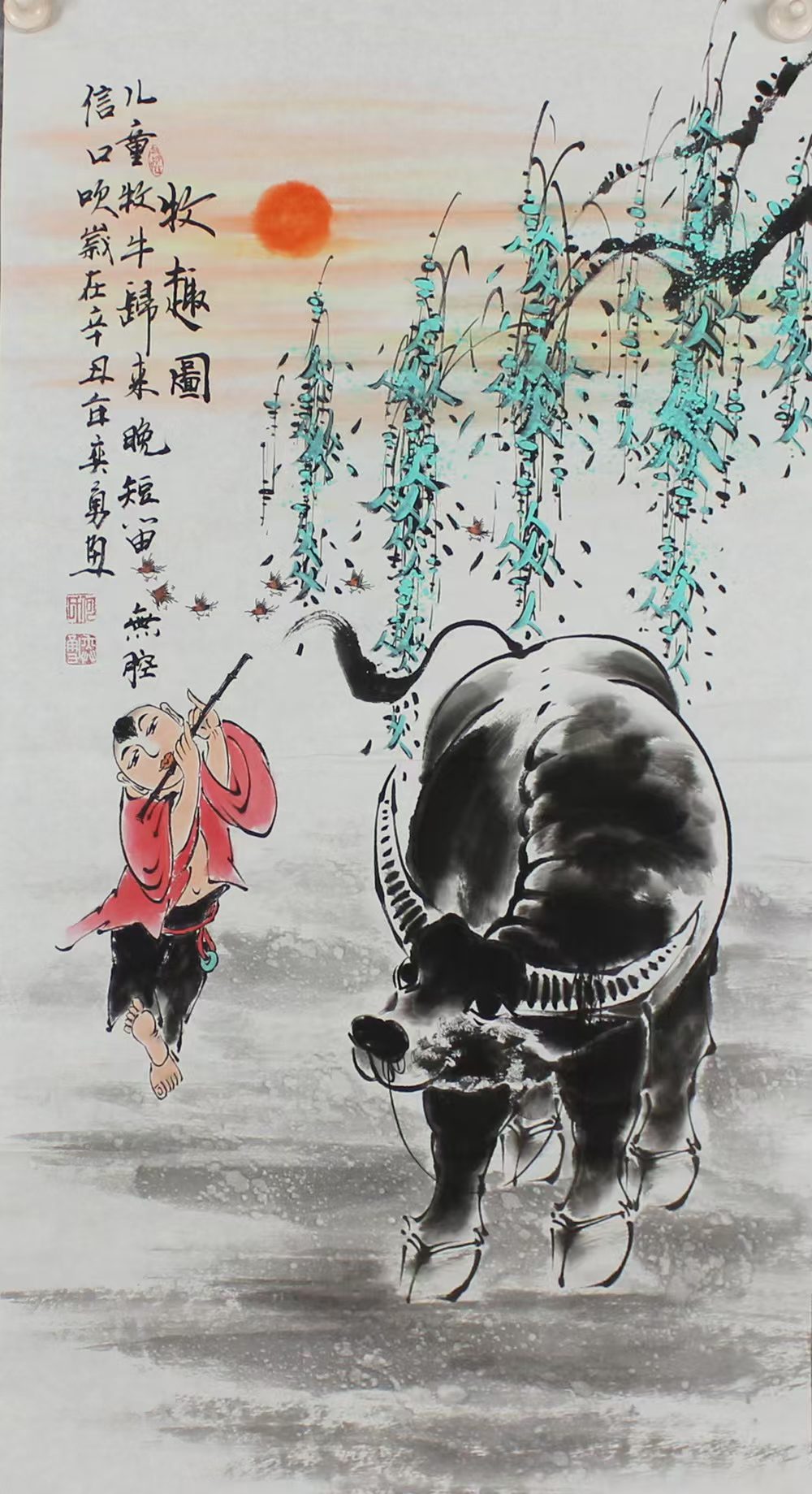
- Contrast: the red coat of the shepherd boy is thinly colored with vermilion, the folds of the coat are outlined in light ink with a medium stroke, the hide of the cow is chapped with burnt ink and dry brush, the abdomen is left white to highlight the sense of volume, and the hooves of the cow are painted in thick ink as if they were treading on the ground with a sound;
- Poetic rendering: the setting sun in ochre from thick to light coloring the sky, willow branches with fine brush and wet ink outlines, swaying in the wind like a curtain hanging, and the sound of the flute of the shepherd boy to form a “sound and scenery mingling” of the mood.
- A symbiotic narrative of childishness and wildness:
- The shepherd boy sits on the back of a cow, his bare feet swaying lightly, holding a piccolo and playing with a smile on his face, the holes of the flute are painted with a fine brush, the fingertips are pressed in a lifelike manner, and the corner of his red coat is rolled up in the wind, revealing his mischievous nature;
- The old cow walks slowly, the gnarled flesh and muscles are colored with light ink to show the strength, the tail of the cow is curled up to drive away the flies, and the lowered head and eyes seem to be listening to the sound of the flute, which creates a natural understanding of “one movement, one static” with the pastoral child’s animation.
Detailed depiction
- Vivid portrayal of characters and living beings:
- The red collar and sleeve edges of the shepherd boy’s red coat are outlined in rattan yellow, the belt around his waist is twisted with ink lines like grass ropes, his bare feet and ankles are dyed with light ochre, and the tips of his toes are dotted with ink to show the rustic atmosphere of soil staining;
- Cow’s eyes with thick ink, eyes slightly dyed carmine red, cow’s horns burnt ink hook writing such as the old tree gnarled branches, cow hooves texture to “crab claw chapping” presents coarse texture, a metaphor for “plowing oxen, hoofprints leave marks”.
- The inscription is intertwined with the literary vein of the picture:
- In the upper right of the picture, the inscription reads, “A child’s cattle return late, and a piccolo flute is blown without accent”, with a sound brushwork in running script, and the inscription “Yiyong in the year of Xinchou” is inscribed with a seal in vermilion script, “Blowing with accent”, and the seal engraving is simple and clumsy, echoing the sound of the flute and the casualness of the age. In the lower left corner, “Pastoral Interest” is inscribed in Chinese, echoing the theme of the flute’s casual sound and unrestrained age;
- In the lower left corner, “Pastoral Interests” in clerical script, together with the willow branches and the curved line of the cow’s tail, form a triangular balance in the picture, concealing the traditional literati’s interest in integrating “poetry, calligraphy, painting, and sealing”.
Artistic Value
- A classic reproduction of the ink field:
- Inheriting the realistic brushwork of Li Song’s “Cattle Drawing” from the Southern Song Dynasty, integrating the vivid charm of Ren Bonian’s figure paintings from the Qing Dynasty, and breaking the silence of the ink color with “Cinnabar Dots for Children” to achieve the visual focal point of “a little bit of red in the midst of ten thousand ink bushes”;
- It is the emotional carrier of local memories:
- The imagery of a shepherd boy playing a piccolo “without a voice” alludes to Wang Anshi’s ideal of seclusion, “but I doubt that my life is in the Peach Orchard”, and sublimates the interest of a child in the countryside into a spiritual support for “returning to the basics”;
- Cultural dialog across time and space:
- The willow branch symbolizes the classical poetic sentiment of “folding the willow to send off”, while the red-clothed shepherd boy is like a punctuation mark, injecting vitality into the ink and light colors, combining both ancient meaning and contemporary aesthetic value.
Suitable Scene
- Study/tea room: framed as an antique vertical scroll hanging, with thread-bound books, ceramic tea utensils, to create a “flute accompanied by reading, ink refreshing the heart” of the elegant space;
- Children’s room/parent-children’s space: the innocent image of the shepherd children can inspire children’s interest, and the red clothes and willow green form a warm color tone, which conveys the aesthetic concept of “nature and growth”;
- Cultural Exhibition Hall/B&B: As the theme exhibition of “Native China”, the ink and water garden awakens the nostalgic memories of urbanites.
Purchase Information
- Framing suggestions:
- Traditional style: moon white damask cloth mounted on a scroll with a boxwood header to reinforce the elegance of the literati;
- Modern style: light gray cotton linen backing with dark green metal frame, suitable for new Chinese style, wabi-sabi style space.
- Conservation Tips:
- Anti-fading: Avoid direct sunlight, and it is recommended that the red vermillion part of the scroll be refilled by a professional artist every three years to fix the color;
- Anti-fraying: When storing the scroll, it should be wrapped in acid-free cotton paper and placed upright in a brocade box.
- Wipe the dust lightly with a soft brush.
**✨ Core Highlights**
- The sound of the flute is incorporated into the painting: the interest of the piccolo’s “no accent” is expressed through the poem and the loose posture of the shepherd boy, breaking through the visual limitations and making the viewer “hear the sound of the flute”;
- Year and month symbols: the direction of the willow branches and the point where the cow’s hooves fall allude to the chronological flow of the “xin chou” stem and branch, which frames the instantaneous scene as a time allegory;
- Philosophy of color: the cinnabar red coat is like a flickering flame in the ink and wash tone, symbolizing “the innocence of the child”, and the ochre twilight color forms a dialogue between warm and cold, implicating the Taoist way of “yin and yang”.
Significance of the Collection
The Piccolo Uncensored – Returning to the Pasture in Xinjiu” uses ink as the rhythm and the flute as the medium, condensing the shepherd boy’s pure heart into the square inches of the cow’s back. When the willow brushes the evening breeze of the Xinchou year, and when the red coat dyes the twilight, this painting is not only a display of ink and wash techniques, but also an eternal pastoral song dedicated to the countryside and the innocence of children. Hanging this painting will transform your living room into a spiritual place where “the sound of the flute penetrates the forest, and the heart returns to the idyllic garden”.

 Product Reviews
Product Reviews
Write A Review
Related Products