




Ink and wash idyllic painting "Let's Blow on the Years - Hengdou Makou Interest
Single Size
0 Review
*Size
100cm x 55cm "Three Feet Full"
$860.00$1,000.00
Special Features:




Description
Paintings featured
- Spiritual writing in traditional ink:
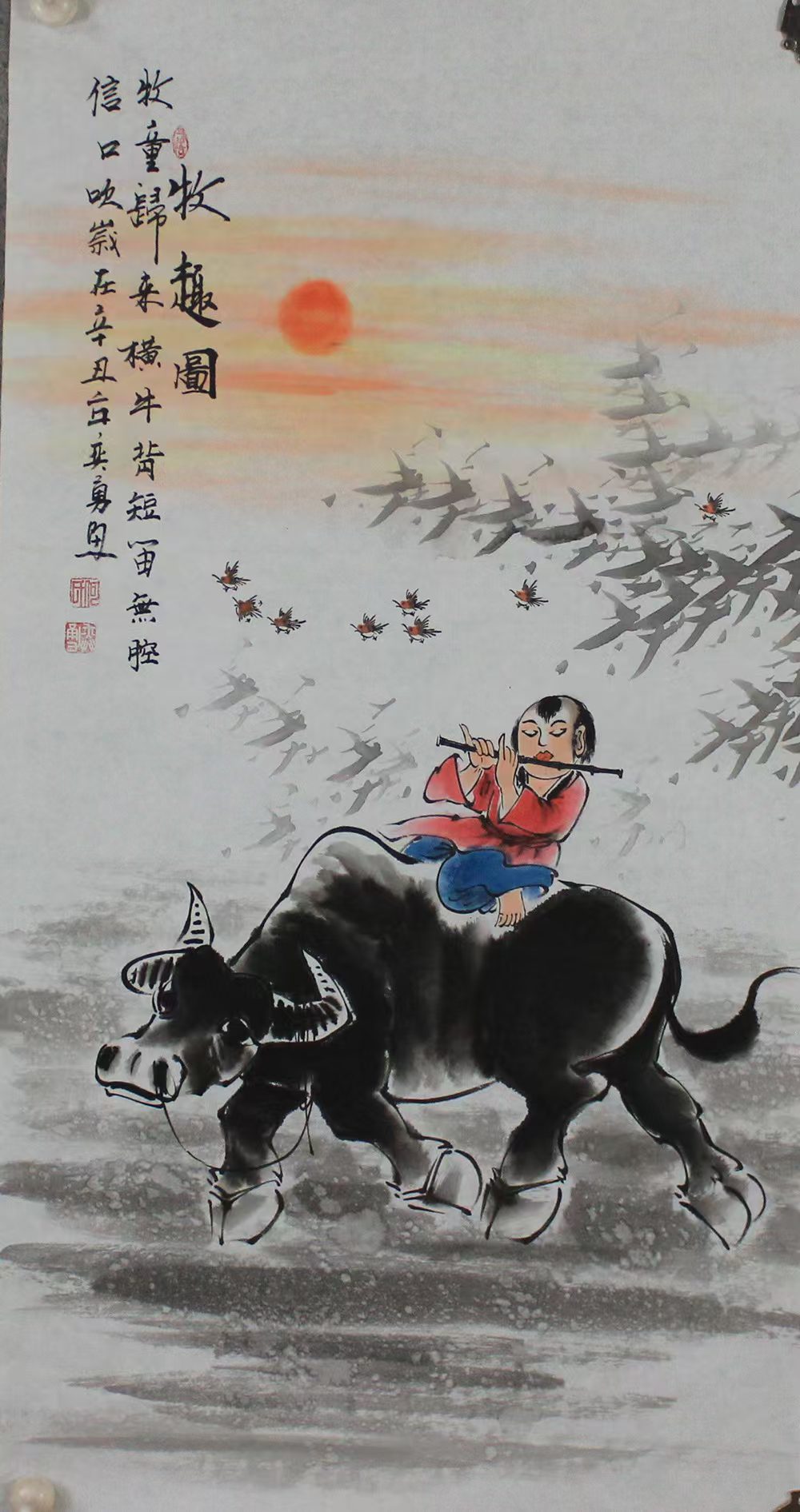
- Blending of dryness and moisture: the shepherd boy’s clothes are outlined in light ink with a medium stroke, and the folds of his clothes are slightly chapped to show the simplicity of the painting; the cow’s body is chapped with burnt ink and dry strokes, the abdomen is left white to emphasize the sense of volume, and the hooves of the cow are in thick ink as if they were knocking against the earth, which is calm and thick.
- Poetic rendering: the setting sun in the background is dyed in ochre from thick to light in the sky, and the birds are shaped by bone-less strokes, with lines of wings like calligraphic skimming, which forms the mood of “sound and scenery blending” with the inscription “piccolo without a cavity”.
- This is an idyllic narrative of movement and stillness:
- Dynamic vital ity: the shepherd boy straddles the cow’s back, holding the piccolo diagonally, his lips slightly opening as if playing, his red coat rolling with the wind, his bare feet gently swaying, his toes dotted with traces of soil in light ochre, showing all of the countryside’s childish interest;
- Hidden in the silence: the old cow walks slowly with its head hanging down, the gnarled flesh and sinews are dyed with light ink to show its strength, and the cow’s tail is curled up to drive away the flies, forming a visual balance of “motion against stillness” with the oblique swiping of the birds.
Detailed depiction
- Subtle portrayal of living beings and artifacts:
- The shepherd boy and the piccolo: the red coat is thinly dyed with vermilion, the collar and sleeve edges are outlined in rattan yellow, and the belt at the waist is twisted with ink threads like grass ropes; the holes of the piccolo are painted with fine brush strokes, and the cracks of the flute are outlined with “flying white brush strokes,” which alludes to the idea that “the flute grows old with age, but the sound comes from the innocence of nature. “The holes in the flute are painted with fine brush strokes.
- The old cow and the bird: the cow’s eyes are dotted with thick ink, and the corners of the eyes are slightly dyed with rouge to show the tame demeanor; the cow’s horns are chapped with burnt ink like the ancient wood, and the hoof texture is presented with “crab claw chapping” to show the coarse tread marks; the bird’s wings are swept out with light ink, and the form is simple and concise, such as the leaping notes in the twilight.
- The inscriptions and seals are interesting:
- The inscription on the upper right of the picture is “Blowing at the age of one’s own mouth to buy real leather at a factory – a shepherd boy returning from a fight with a short flute on his back without any accent”, with a freehand style of writing in running script, and inscribed with a seal in vermillion script “Pastoral Interests”, with a simple and clumsy seal impression, which, together with red and vermillion and ochre twilight, constitutes “Sky-Earth-Human”;
- In the lower left corner, “牧趣圖” is inscribed in clerical script, forming a triangular composition with the arc of the cow’s back and the slant of the flying bird, which is in line with the aesthetic concept of “poetry, calligraphy, painting, and sealing” as a whole in traditional calligraphy and painting.
Artistic Value
- Modern expression of traditional techniques:
- Inheriting the realistic spirit of Li Di’s “Cattle Herding” from the Southern Song Dynasty, and integrating the color techniques of the Ming Dynasty’s Wumen School, the painting uses “burnt ink chapping” to express the texture of the cow’s body, and “boneless” to render the flying birds, reproducing the layering of the classical ink and watercolors;
- The symbols of idyllic philosophies are translated:
- The piccolo’s “no accent” alludes to Zhuangzi’s “heavenly music is invisible”, and the old ox’s head symbolizes “virtue carries things”, sublimating the rural scene into the philosophy of “symbiosis between nature and humanities”. The old ox with its head hanging down symbolizes “virtue carries things”, sublimating the countryside scene into a philosophical pattern of “symbiosis between nature and humanity”;
- The sympathetic emotion is transmitted across time and space:
- The collision of warmth and coldness between the red-clad shepherd boy and the twilight birds, and the dialectal humor of the inscription, “Buying Leather from a Factory” (or “The shepherd boy fights on the back of the bull, and plays a flute like a leather flute”) add to the pleasure of interpretation, and combine both vernacular memories and the infectious power of contemporary art.
Suitable Scene
- Living room/study: framed as an antique vertical scroll, displayed together with wooden furniture and celadon tea ware, creating an immersive idyllic mood of “flute sound through the forest, the mind follows the shadow of the cow”;
- Tea room/cultural space: with bamboo curtains and ceramic pots, the picture of twilight and the aroma of tea mingle, sublimating the literati’s elegant interest of “living in idleness and nourishing the mind”;
- Educational institutions/children’s room: the innocent image of the shepherd boy can inspire children’s interest, and the vivid composition of the red coat and the flying birds convey the concept of “cherish time and grow naturally”.
Purchase
- Framing suggestions:
- Traditional: Indigo damask vertical scroll with ebony shaft head, reinforcing the ancient charm of ink and wash;
- Modern style: light gray linen backing with matte black aluminum frame, suitable for new Chinese style and minimalist space.
- Conservation Guide:
- Moisture-proof and light-proof: store at less than 60% humidity, and avoid direct sunlight that will cause the cinnabar to fade;
- Anti-folding: the scrolls should be wrapped in acid-free cotton paper and placed upright in a brocade box when stored.
- Wipe the dust lightly with a soft brush.
**✨ Core Highlights**
- Sound and scenery: the piccolo’s “no accent” is expressed through the loose posture of the shepherd boy and the gesture of the inscription, which makes the viewer feel like hearing the rhythm of the flute in the quietness;
- Eggs in the literary vein: the inscription, “Ligong buys genuine leather,” may be a dialectal harmonic (e.g., “Ligong” harmonizes with “shepherd boy,” “genuine leather” is a dialectal harmonic), and the inscription, “Ligong buys genuine leather,” may be a dialectal harmonic. “Genuine leather” is a metaphor for the texture of a cow’s back), adding interest to the interpretation;
- Philosophy of color: the red vermilion in the ink tone is like a flickering flame, symbolizing “the innocence of the child”, and the ochre twilight forms a dialogue between cold and warm, implicitly hiding the Taoist “yin and yang” way of life.
Significance of the Collection
The “Faithful Blowing of Children – Hengdou Pastoral Interest” uses ink as the rhyme and oxen as the boat, carrying a piece of flute with no accent through the twilight fields. When the bare feet of the cowherd boy gently nudges the back of the cow, and when the flying bird skims over the dialect in the inscription, this painting is not only a condensation of technique, but also an eternal love letter to the simple countryside. Hanging this painting, you can turn your living room into a spiritual dwelling where “the sound of the flute falls on the ground and your heart is at peace with the countryside”, guarding a piece of pastoral autumn colors in your heart amidst the hustle and bustle of the earthly world.

 Product Reviews
Product Reviews
Write A Review
Related Products