




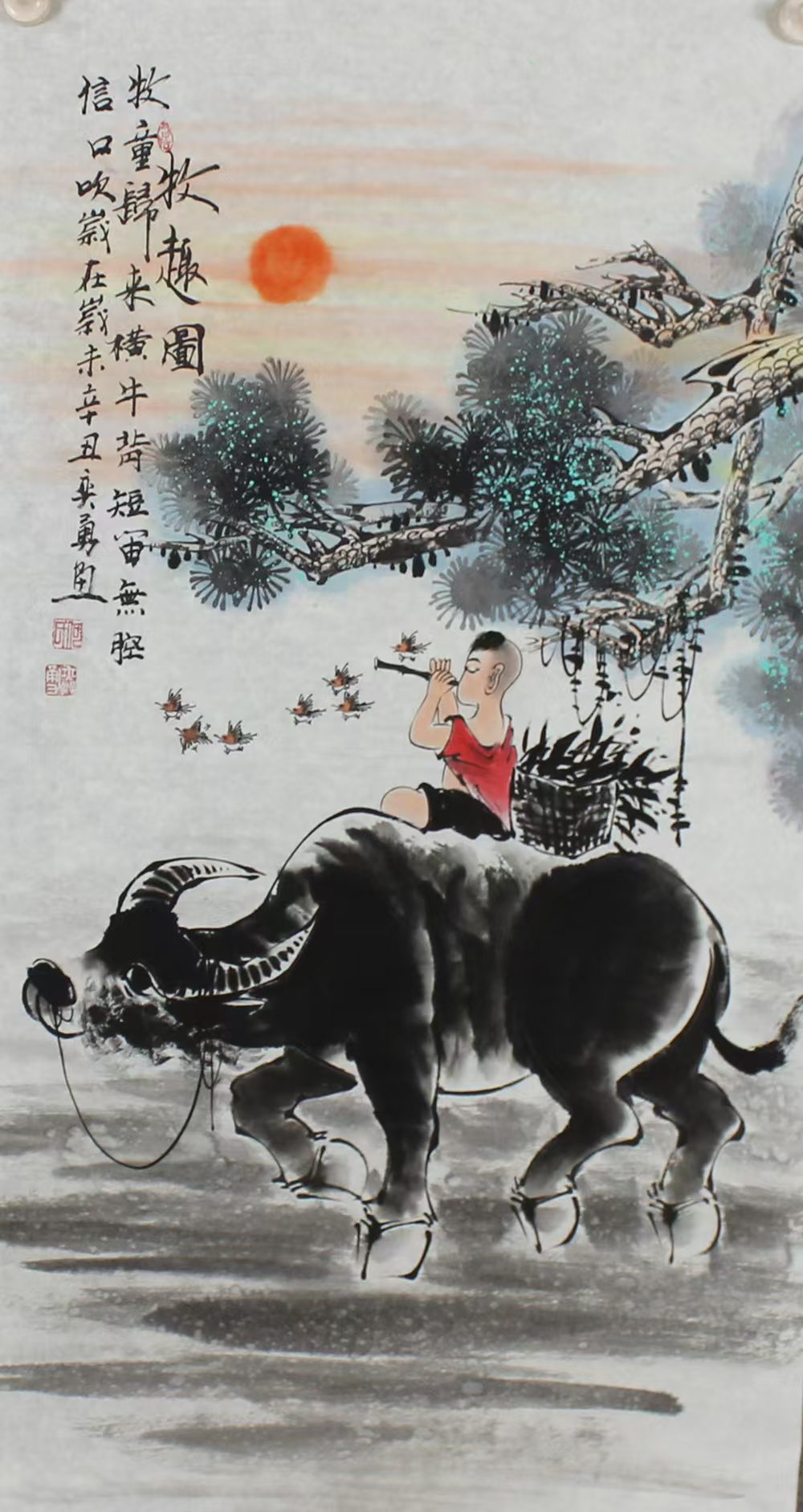
Ink and wash idyllic painting "Flute Whispering at the Age of Twilight - Returning to the Pasture in Xinjiu
Single Size
0 Review
*Size
100cm x 55cm "Three Feet Full"
$860.00$1,000.00
Special Features:




Description
Paintings featured
- Poetic condensation of traditional ink:
- Symphony of dryness and moistness: the shepherd boy’s clothing pattern is outlined in light ink with a medium stroke, and the folds of the lapel are slightly chapped, showing the simplicity and dynamism; the cow’s body is chapped with burnt ink and dry strokes, the abdomen is left white to show the volume, and the cow’s hooves are thickly inked as if they were knocking on the earth;
- Autumn twilight rendering: the red sun in the sky with vermilion from thick to light halo, the edge of the dense mist; the background of the pines in burnt ink and thirsty brush hook branches, pine needles fine brush cluster, and the sound of the flute of the shepherd boy to form a “pine waves and flute” mood.
- The idyllic narrative intertwined with motion and static:
- The shepherd boy sits horizontally on the back of a cow, holding his piccolo obliquely, his lips slightly opened as if playing, his eyes lowered as if intoxicated by the rhythm, his bare feet gently swaying and dyed with light ochre mud marks, and his sleeves rolled up as if dancing with the wind;
- The old cow walks slowly with its head hanging down, the gnarled flesh and sinews are colored with light ink to show its strength, the tail of the cow is curled up to drive away flies, and the pine branch is stretched out diagonally with the arc of the cow’s back to form the visual rhythm of “rigidity and flexibility”.
Detailed depiction
- A subtle dialog between living beings and nature:
- The belt around the shepherd boy’s waist is lightly dyed with rattan yellow, and the texture of the rope knot is like the winding of grass; the holes of the piccolo are painted with fine brush strokes, and the cracks of the flute are sketched with “flying white strokes”, which is a metaphor for “the flute grows old with age, but the sound comes from the innocence of nature”;
- Cow’s eyes with thick ink, eyes slightly dyed rouge show tame; cow’s horns ink chapped like ancient wood, hooves and hooves nail staccato brush like an axe chisel to leave a mark, pine roots to “crab claw chafing” to show the force of the ground, and the inscription “years not” to form “roots and the inscription “years yet” form the metaphor of “root system”.
- The inscription and the seal have a deep meaning:
- In the upper right of the picture, the inscription in cursive script reads, “A shepherd boy returns and crosses the backs of the cows; the piccolo flute has no accent and is blown without a sound”, with a brush stroke like an autumn wind sweeping away the leaves, and the inscription “The year is in the year of the Xinchou” is inscribed with a seal in vermilion script “Blowing out the year with a sound”, with a seal engraving in Chinese characters. The blade is simple and clumsy, forming a triad of “heaven, earth and man” with the red sun and the pines;
- In the lower left corner, “Pastoral Interest” in clerical script, forming a triangular composition with the cow’s hooves on the ground and the pine branches reaching out diagonally, concealing the principle of “succession and conjunction” in traditional calligraphy and painting.
Artistic Value
- Contemporary echoes of literati painting:
- Inheriting the realistic spirit of Li Di’s “Cattle Herding” from the Southern Song Dynasty, and incorporating the vivid charm of Hua’s talkative figure paintings from the Qing Dynasty, the artist breaks the silence of ink and wash with “vermilion sand pointing at the sun”, and achieves “a bit of red in the ink” as a visual focus;
- A symbolic translation of agricultural aesthetics:
- The piccolo’s “cavity-less” playing alludes to Zhuangzi’s “celestial music is invisible”, and the pine symbolizes the literati spirit of “withering after years of cold”, which sublimates the idyllic scene into the “unity of heaven and man”. The idyllic scene is sublimated into the philosophical pattern of “the unity of heaven and mankind”;
- Emotional resonance across time and space:
- The bare feet of the shepherd boy and the hoof marks of the cows form the narrative of “people and living beings in common”, and the collision of warm and cold colors between the red dress and the pine needles, combining both vernacular memories and the expressive power of contemporary art.
Suitable Scene
- Study/tea room: framed as an antique vertical scroll, displayed together with bamboo bookshelves and ceramic glazed tea utensils, creating an elegant literary environment of “flute accompanied by reading, pine shadows into the ink stone”;
- Cultural Exhibition Hall/Art B&B: As the theme exhibits of “Native China”, juxtaposed with the agricultural poems of “The Book of Songs” and traditional farming tools, it awakens the rural nostalgia of city dwellers;
- Corporate lobby: the red sun symbolizes “the rising sun” and the diligence of the shepherd boy alludes to “the way of heaven rewards the diligent”, which is suitable for financial, cultural and creative enterprises to convey their cultural values.
Purchase
- Framing Proposal:
- Traditional: Indigo damask framed as a hand scroll with a rosewood box, reinforcing the ceremonial feeling of “unfolding the scroll to view the year”;
- Modern style: dark grey linen backing with bronze aluminum alloy frame, suitable for new Chinese style and industrial style space, focusing on the visual tension of the red sun.
- Conservation Guide:
- Avoid light and moisture: avoid direct sunlight that causes the vermillion to fade, and activate the moisture-proof box when the humidity is higher than 65%;
- Anti-breakage: the scrolls should be wrapped in acid-free cotton paper and placed upright in a brocade box when stored.
- Wipe the dust lightly with a soft bristle brush.
**✨ Core Highlights**
- Sound and Scene Recreation: The piccolo’s “no accent” is expressed through the loose posture of the shepherd boy and the wild and cursive strokes of the poem, making the viewer feel like hearing the rhythm of the flute in the quietness;
- Age and Month Codes: The xin ugly stem and branch, the pine’s wheel of the year, and the ox’s hooves form a “triple time scale”, sublimating the instantaneous scene into an eternal allegory;
- Philosophical symbols: the red sun hangs in the air like an insignia, which alludes to the Taoist principle of “The Way is Simple”, and the pine branch and the ox’s back form “the curvature and the straightness are born from each other”, which hides the I Ching principle of “the iterative use of rigidity and softness”. The pine branch and the back of the ox form “the mutual growth of straightness and curvature”, hiding the theory of “the repeated use of rigidity and flexibility” of the I Ching.
Significance of the Collection
The “Flute Talking at the Age of Twilight – Returning to the Pasture in Xinchou” uses ink as the rhyme and the ox as the boat, carrying a piece of flute with no accent through the twilight color of the pines. When the bare feet of the shepherd boy gently point at the back of the cow, and when the inscription of the year Xinchou solidifies the time, this painting is not only a condensation of the ink technique, but also a love letter to the farming civilization. Hanging this painting will turn your room into a spiritual home where “the sound of the flute passes through the forest, and the heart returns with the shadow of the cow”, guarding a piece of your heart’s autumn pastoral song in the middle of the bustling city.

 Product Reviews
Product Reviews
Write A Review
Related Products