




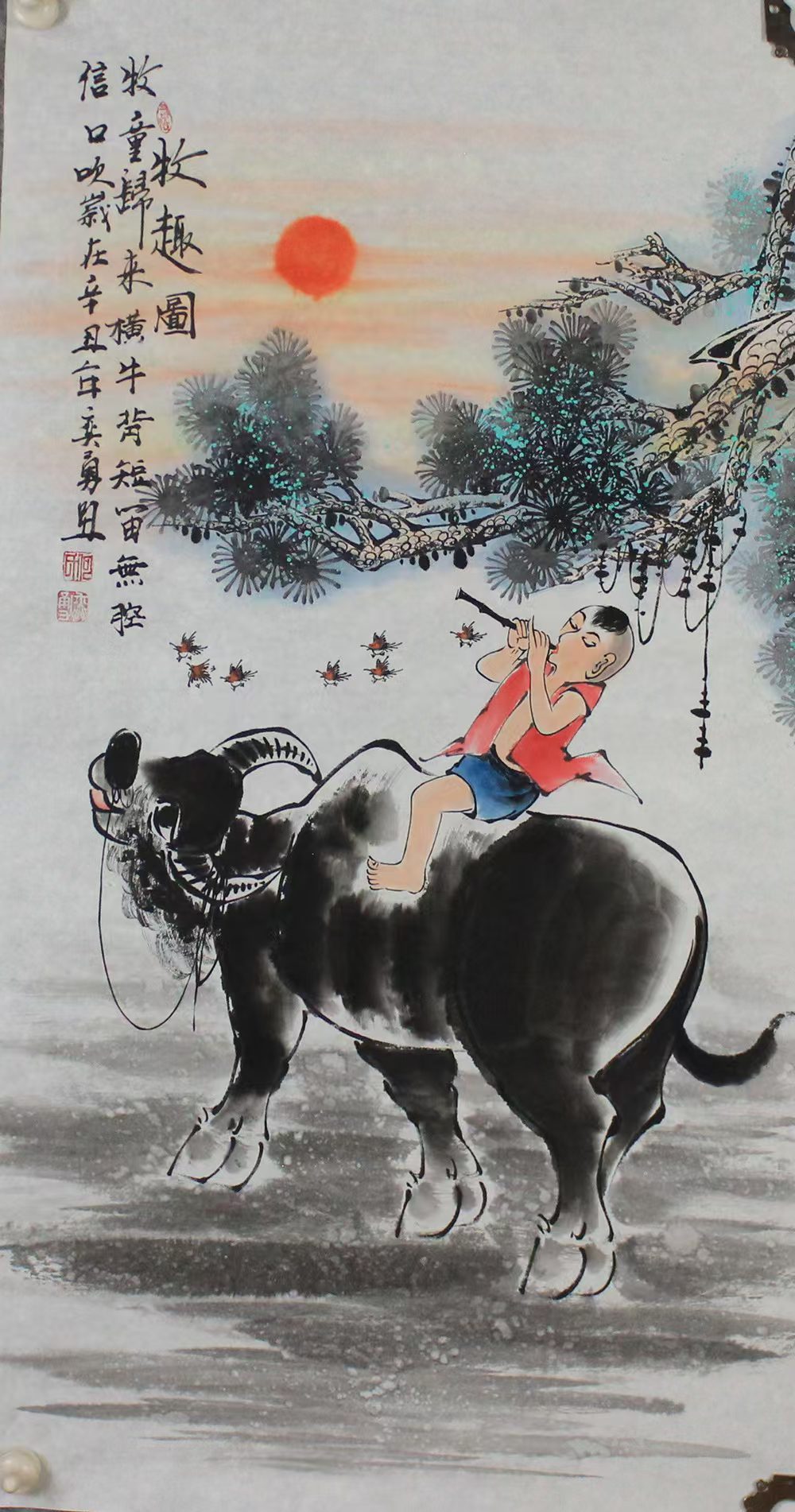
Ink and wash idyllic painting "Blowing at the Age of Faith - Returning to the Pasture in Xinjiao" (信口吹歲-辛丑牧归)
Single Size
0 Review
*Size
100cm x 55cm "Three Feet Full"
$860.00$1,000.00
Special Features:




Description
Paintings featured
- Spiritual writing in traditional ink:
- Contrast: the shepherd boy’s clothes are outlined in light ink with a medium stroke, and the folds of the clothes are slightly chapped to show the simplicity; the cow’s fur is chapped with a dry brush in burnt ink, the abdomen is left white to emphasize the sense of volume, and the hooves of the cow are in thick ink as if they were knocking against the earth, which is calm and thick.
- Color accent: the background sunset with ochre gradient halo, pine needles with blue dots, cinnabar dots shepherd boy belt, in the ink tone like a starburst leaping, breaking the lonesomeness.
- An idyllic narrative intertwined with motion and stillness:
- The shepherd boy sits horizontally on the back of a cow, holding a piccolo obliquely, his lips slightly open as if he were blowing out of his mouth, his eyebrows lowered in intoxication, his bare feet lightly shaking and staining the mud marks, and his sleeves rolled up as if he were dancing with the wind;
- The old cow walks slowly with its head hanging down, the gnarled flesh and sinews are dyed with light ink to show its strength, the cow’s tail is curled up to drive away the flies, and the pine branches are stretched out diagonally in the wind, which forms a rhythm of “sound and scenery blending” with the wild cursive brushwork of the inscription “praise for the face of the horizontal teeth”.
Detailed depiction
- Subtle portrayal of living beings and artifacts:
- The shepherd boy: wearing a bamboo hat with gabion stripes densely woven with intersecting fine lines; an ochre cloth belt around his waist with a knot like a grass weave; the holes of the piccolo are painted with fine strokes, and the cracks on the body of the flute are sketched out with “flying white strokes,” alluding to the fact that “the flute grows old with age, but its sound comes from the innocence of the sky. This is a metaphor for “the sound of the flute grows old with age, but the sound comes from innocence.
- The old cow and pine scene: cow eyes with thick ink, eyes slightly dyed rouge show tame; cow horns ink chapped like ancient wood, pine needles fine brush clusters such as umbrellas, trunks to “crab claw chapped” to show the coarse texture, and the title “Sharp courage” seals Constitutes the literati style of “not withering in the cold years”.
- The inscription and the seal have a deep meaning:
- In the upper right of the picture, the inscription in cursive script reads, “A shepherd boy blows his age on the back of a cow”, and the inscription, “Shuangyong in the year xinchou,” is inscribed with an inscription in vermilion, “Blowing his age,” with a simple and clumsy seal-carving technique, echoing the colors of vermilion and ochre in the twilight. The simple technique of the seal carving is echoed by the cinnabar sash and the ochre twilight color, concealing the triad of “heaven, earth, and man”;
- In the lower left corner, the corner of the seal, ‘Makki tu’, in clerical script, forms a triangular composition with the slanting pine branches and the arc of the cow’s back, in keeping with the aesthetic concept of the integration of poetry, calligraphy, painting, and sealing in traditional Chinese painting and calligraphy.
Artistic Value
- A contemporary continuation of the literati’s idyllic paintings:
- Adapting the poetic meaning of Lei Zhen’s “Evening in the Village”: “The shepherd boy returns to cross the back of the cow”, inheriting the realistic brushwork of Li Di’s “Cattle Herding” of the Southern Song Dynasty, and reproducing the layering of classical ink and watercolor by using “burnt ink to write the bones of the cow, and bone-less coloring of the twilight clouds”;
- A symbolic translation of farming aesthetics:
- The piccolo’s “no accent” alludes to Zhuangzi’s “celestial music is invisible”, and the old cow walking slowly with its head hanging down symbolizes “virtue carries things”, sublimating the countryside scene into the philosophy of “the unity of heaven and man”. The countryside scene is sublimated into the philosophical pattern of “the unity of heaven and mankind”;
- Emotional resonance across time and space:
- The bare feet of the shepherd boy and the hoof marks of the ox constitute the narrative of “people and living beings living together”, while the swaying pine branches and the inscription convey the eternal theme of “returning home”, which combines both vernacular memory and universal emotional value.
Suitable Scene
- Living room/study: framed as an antique vertical scroll, displayed together with wooden furniture and celadon tea ware, creating an immersive idyllic mood of “flute sound through the forest, the mind follows the shadow of the cow”;
- Tea room/cultural space: with bamboo curtains and ceramic pots, the picture of twilight and the aroma of tea mingle, sublimating the literati’s elegant interest of “living in idleness and nourishing the mind”;
- Educational institutions/children’s room: the innocent image of the pastoral children can inspire children’s interest and convey the concept of “cherish time and grow naturally”.
Purchase
- Framing suggestions:
- Traditional: Indigo damask mounted as a scroll with an ebony header to enhance the ancient charm of ink;
- Modern: light grey linen backing with matte black aluminum frame, suitable for new Chinese and minimalist spaces, highlighting the visual focus of the vermilion sand band.
- Conservation Guide:
- Moisture and light avoidance: storage humidity should be less than 60%, avoid direct sunlight leading to yellowing of the paper;
- Anti-folding: the scrolls should be wrapped in acid-free cotton paper and placed upright in a brocade box when stored.
- Wipe the dust lightly with a soft brush.
**✨ Core Highlights**
- Sound and Scenery: The piccolo’s “no accent” is expressed through the loose posture of the shepherd boy and the poem inscribed in wild cursive, which makes the viewer “hear the rhythm of the flute” in the quietness;
- Age and Month Codes: The xin chou stem and branch, ox hoof tracks, and pine and cypress wheel of the year form a “triple time scale”, sublimating the instantaneous scene into an eternal allegory;
- Literary veins intertwined: the inscription “Shuangyong” may be the author’s spiritual self-report (it is recommended to combine it with local cultural evidence), and the vermilion seal “吹歲” is like the eye of a painting, which sublimates idyllic interest into a philosophical carrier.
Collector’s significance
With ink as the string and cows as the boat, “Blowing for the Years – Returning to the Pasture in Xinchou” plays a pastoral song in the twilight. When the sound of the shepherd boy’s flute sweeps over the sparse shadows of the pine branches, and when the inscription of the Year of Xinchou is solidified as a motto of time, this painting is not only a condensation of ink techniques, but also an eternal love letter to the countryside and the innocence of children. Hanging this painting can turn the room into a spiritual dwelling where “the sound of flute falls on the ground and the heart is at peace with the countryside”, guarding a piece of autumn pastoral in the hustle and bustle of the earthly world.

 Product Reviews
Product Reviews
Write A Review
Related Products