




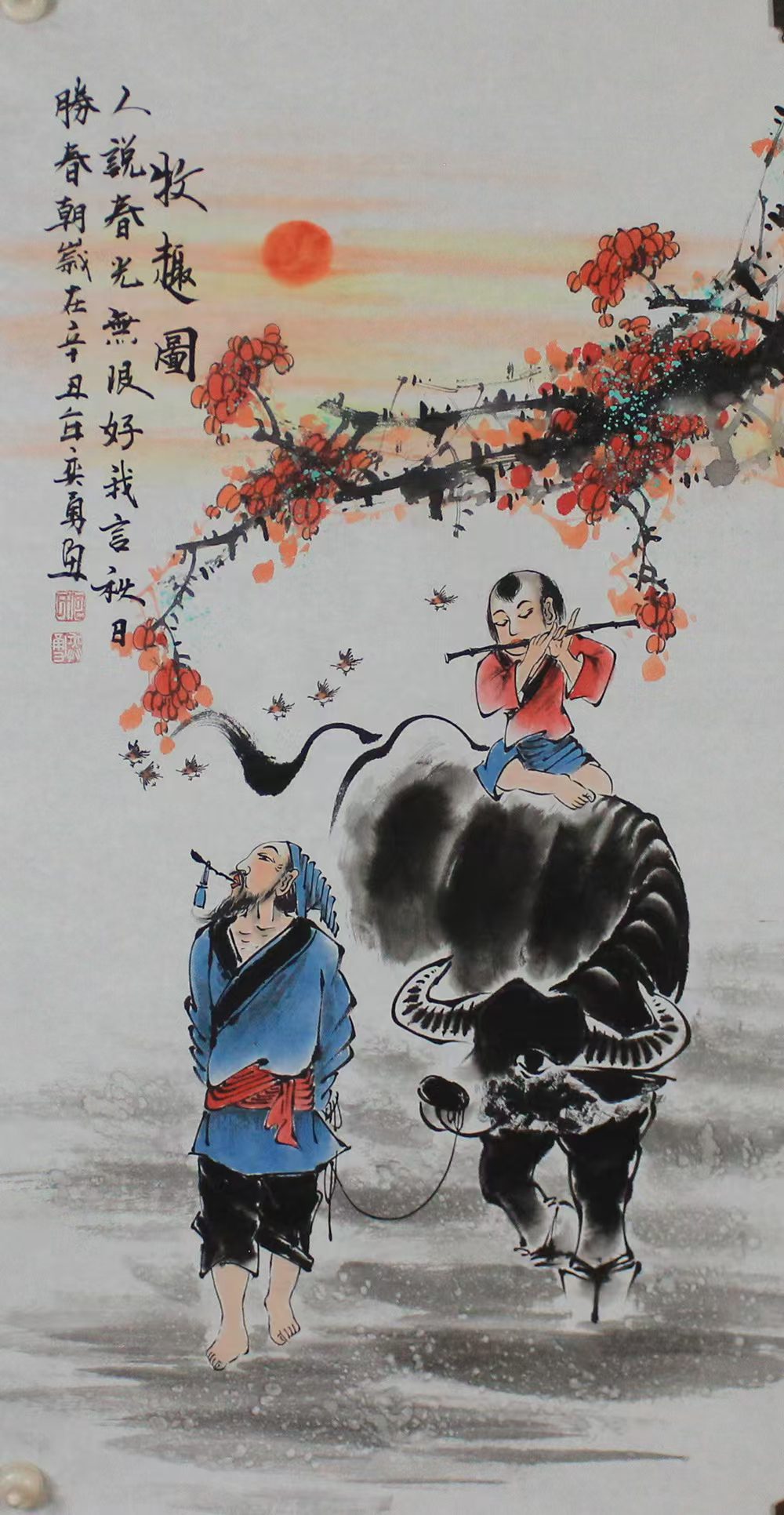
Ink and field painting "I Speak of Autumn - Xinjiao Pastoral
Single Size
0 Review
*Size
100cm x 55cm "Three Feet Full"
$860.00$1,000.00
Special Features:




Description
Paintings featured
- A dual symphony of ink and poetry:
- Layers of ink: the autumn sky is rendered in light ink, the red sun is dyed with layers of vermilion, and the edges of the painting are diffused like a light mist; the withered branches are outlined in burnt ink with a thirsty brush, and the red fruits are painted with a touch of rouge, which reveals the fun of “autumn fruits” between the blending of colors and ink;
- Movement and static: the shepherd boy playing the flute looks up and closes his eyes, his fingertips lightly pressing the holes of the flute, and his sleeves roll with the wind; the shepherd boy leading the oxen holds the rope sideways, and his feet step on the straw sandals, and the old oxen walk slowly with their heads hanging down to form a visual rhythm of “sound and movement, shape and static”.
- The symbolic expression of autumn imagery:
- The red sun hangs high in the sky like a seal in the sky, and the red fruits on the branches form a “size echo”, implying that “the autumn sun warms things, and the fruits reward hard work”;
- The old cow’s fur is chapped with dry brush strokes to show the texture, the tail of the cow is curled to drive away flies, and the hooves of the cow leave traces on the ground, permeating the details with the texture of the age of “plowing oxen carrying the years”.
Detailed depiction
- Subtle portrayal of characters and living creatures:
- The flute-playing shepherd boy is wearing an indigo shirt, with the pattern outlined in light ink and a medium stroke, and the cuffs of his sleeves are trimmed in rattan yellow like autumn leaves trimmed in gold; his bare feet are on the back of the ox, and the tips of his toes are stained with light ochre, which reveals the childishness of the countryside;
- The cowherd boy is wearing an ochre cloth belt around his waist, holding a hemp rope with a fine brush and a spiral outline, with a clear texture of the rope knot, forming a texture contrast with the coarse ink dots of the ox’s nose ring chain;
- The old bull’s eye contour with rouge micro-dye, white highlights in the eyes as containing autumn water, the bull’s horns burnt ink chapped like ancient wood, hooves and nails thick ink like knocking on the earth.
- The inscription and the picture of the vein of each other:
- In the upper left of the picture, a poem is inscribed in cursive script, “People say that the spring light is not very good, but I say that the autumn day is better than the spring day”, with a brush stroke like the autumn wind sweeping away the leaves, and the inscription is inscribed with a seal in vermilion script, “Shengchunchao”, which is written in the year of xinchou, and the year of the folder, the day of the folder. The seal carving is free and unrestrained, with the red sun and red fruits forming the visual focus of “Three Reds in Autumn”;
- In the lower right corner, “Pastoral Interests” is inscribed in clerical script, forming a triangular composition with the cow’s hooves on the ground and the branches stretching out diagonally, which is in line with the traditional calligraphy and painting principle of “starting, continuing, turning, and merging”.
Artistic Value
- A reproduction of the literati tradition of poetry and painting:
- Adapting the poetic meaning of Liu Yuxi’s Autumn Words, reconstructing the idyllic narrative from the rebellious perspective of “Autumn is better than Spring”, inheriting the tradition of Shen Zhou’s “Reclining Journey” in the Ming Dynasty, and giving ink and wash the sinews of literature;
- Contemporary Translation of Vernacular Aesthetics:
- The red-clothed shepherd boy and the red fruit branches form color symbols, breaking the light and elegant tone of the ink and wash, and alluding to the “hot surge of life force in autumn”, echoing the theory of “eye-catching color” in modern art;
- The emotional resonance of farming civilization:
- The scene of two children herding cows is not only an echo of the ancient meaning of “the sun is setting and the sheep and cows are coming down” in the Book of Songs, but also conveys the eternal theme of “coexistence between human beings and living creatures” through the sound of the flute and the details of the rope.
Suitable Scene
- The main wall of the living room: framed as a wide vertical scroll, paired with log furniture and rough ceramic ornaments, creating an immersive idyllic experience of “seeing the autumn mountains through the window, and smelling the shepherd’s flute when you enter the house”;
- The academy/cultural center: as the theme exhibit of “Autumn Poetry and Painting”, juxtaposed with the poems of “Autumn Sound Fugue” and “Autumn Night in the Mountain Dwelling”, it builds a space for classical aesthetics education;
- Tea room/Zen room: the picture of autumn twilight and red fruits creates the Zen meaning of “withering and flourishing”, suitable for displaying with plain tea mat and bamboo incense, enlightening the viewers to think about the way of time and light.
Purchase
- Framing Proposal:
- Traditional: Indigo damask mounted as a hand scroll, with a rosewood box, highlighting the literati’s interest in “scrolling and watching the fall”;
- Modern style: dark gray linen backing with matte aluminum alloy suspension frame, suitable for minimalist space, focusing on the visual impact of the picture red sun.
- Conservation Guide:
- Anti-moisture and anti-moth-eaten: the humidity of the storage environment should be less than 60%, and it is recommended to unroll and ventilate the serigraphic replica once a year;
- Anti-folding: the scrolls should be wrapped in acid-free cotton paper and placed upright in a brocade box when stored.
- Wipe the dust lightly with a soft-bristled brush.
**✨ Core Highlights**
- Poetry and painting break through the wall: the poem “Victory over the Spring Dynasty” and the autumn scene in the picture form a “text-picture corroboration”, transforming literary imagination into visual ink language;
- The three reds of autumn: the child in red, the red fruit, and the red seal leap like flames against the ink background, alluding to the Taoist metaphor of “three births for all things”;
- Soundscape recreation: the flute child’s tilting his head and the soaring brushwork of the poem create a “silent rhythm”, allowing the viewer to perceive the melodiousness of the autumn pastoral song in silence.
Collector’s significance
With ink as the string and autumn as the score, “I Speak of Autumn – Xinchou Pastoral” plays the double music of idyllic poetry and painting on the back of a cow. When the flute of the shepherd boy passes through the red fruits, and when the inscription of the year of Xinchou solidifies the words of time, this painting is not only a condensation of the ink technique, but also a confession to the autumn. Hanging this painting, you can turn your living room into a place where “a crane in the clear sky pushes up the clouds, and brings poetic feelings to the blue sky”, guarding a side of your heart’s autumn field amidst the hustle and bustle of the city.

 Product Reviews
Product Reviews
Write A Review
Related Products