




Zhao Zhiqian – Chrysanthemum’s “Planting” Consciousness: The Carnival of Life Between Goldstone and Ink and Brush
Written by oriental-art on April 17, 2025
When Monet was chasing the light and shadow of water lilies in the Giverny Gardens, in the old mansion in the ancient city of Shaoxing, a master artist of the late Qing Dynasty was reshaping the soul of chrysanthemums with the power of gold and stone. The autumn chrysanthemums under Zhao Zhiqian’s brush are neither the symbols of seclusion under Tao Yuanming’s hedge, nor the exquisite specimens in the palace gallery, but the declaration of life dipped in thick ink – those flowers blossoming on rice paper, with the majesty of the Qin-Han monumental inscriptions flowing from the roots and stems, and the passion of the North-South fusion bursting out from the petals, have accomplished an unprecedented visual revolution in the collision between goldstone brush and ink. In the collision of jinshi brush and ink, it accomplishes a visual revolution that has never been seen before.
I. Golden Graphite Rhyme Casts the Soul of Chrysanthemum
Zhao Zhiqian has transformed the three generations of Jijin characters into chrysanthemum tendons. The jagged branches and trunks in the picture are actually three-dimensional translations of the inscriptions of the Scattered Plates, and those seemingly random staccato twists and turns conceal the bursting power of cast bronze; the jagged strokes on the edges of the leaves are clearly the distorted reorganization of the Han Dynasty’s Zhang Qian Stele’s clerical calligraphic wave-falls. This extreme exploration of painting with calligraphy makes every chrysanthemum a readable text of gold and stone.
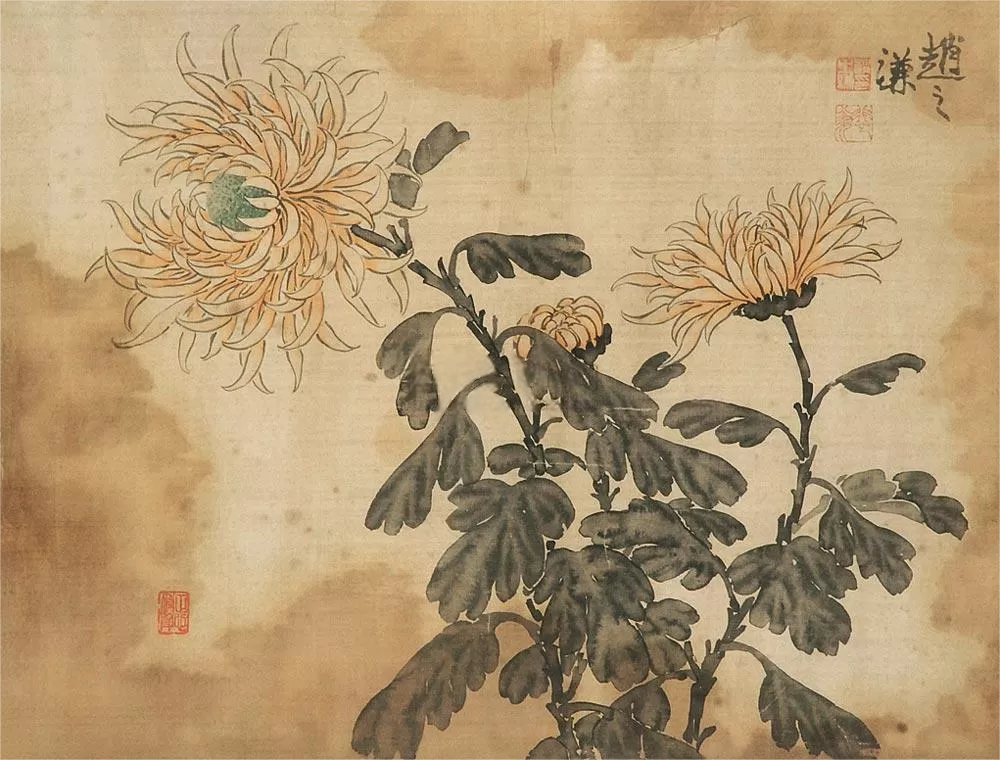
The black and white philosophy in the picture subverts the traditional view of color setting. Zhao Zhiqian simulates the biting cold of autumn frost with the scorching thirst of the hanging ink, suggests the nourishment of the morning dew with the haloing of the rising ink, and builds a complete color narrative through the withering wetness and intensity of the ink. In Ink Chrysanthemum, he even uses pure ink to represent white chrysanthemums – the emptiness squeezed out of the white space of the petals is more spiritually luminous than any white pigment.
The intervention of seals creates a multi-dimensional space. The “Sad Container” seal in vermilion in the lower right corner of the picture is not only a signature, but also forms a geometric dialog with the chrysanthemum leaves by its jagged border; the group of collector’s seals in the left corner of the picture creates a superimposed shadow of time through the difference in the degree of tatteredness of the seal faces. This innovation of incorporating seals into the overall composition makes the art of seal carving an integral part of painting for the first time.
II. Visual Poetry of Symphonic Symphony of Form and Meaning
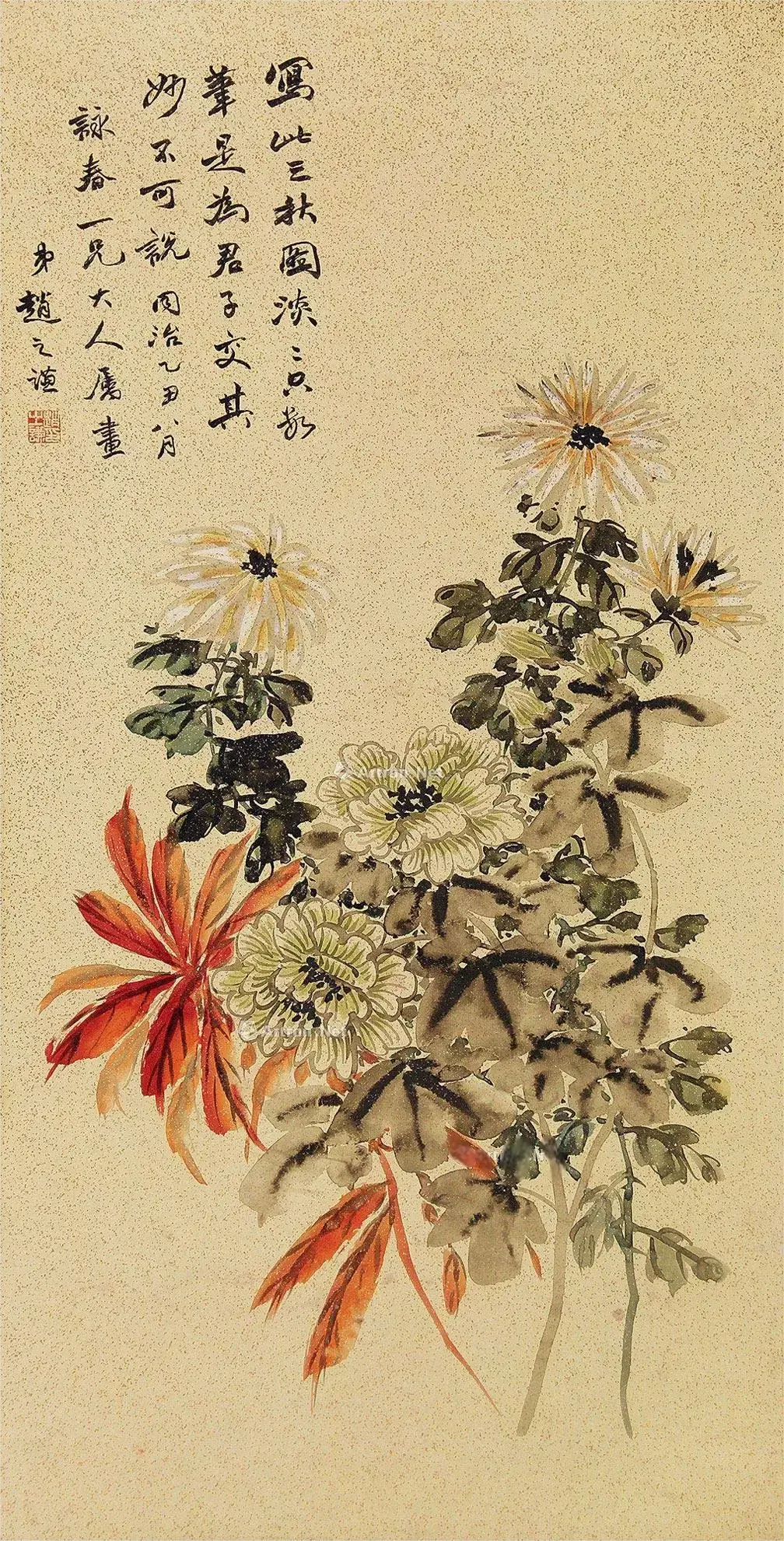
Zhao Zhiqian’s compositional rules are full of architectural wisdom. In “Autumn Chrysanthemums”, the tilted trunk breaks the traditional bending program and pierces the tension of the picture at a 30-degree angle, which is comparable to the fly-rail structure of a Gothic church; in “Good Colors of the Chrysanthemums in Chung Yeung”, the chrysanthemum bushes hanging upside down, through the antagonistic relationship between gravity and growth, create the first visual paradigm of “against the grain” in the history of Chinese paintings.
The dynamic freezing in the picture is shocking. The trembling frequency of the tentacles of the winged insect is transformed into the swiftness and astringency of the brush; the dewdrops that are about to fall are calculated by the speed of ink dispersion on the raw rice paper to create a perfect moment of solidification. This mathematical capture of movement trajectory touches the essence of dynamic expression half a century earlier than Duchamp’s Nude Woman Descending a Staircase.
The aesthetics of mutilation reaches new heights here. The edges of insect-infested chrysanthemum leaves simulate the gnawing traces of time with the technique of flying white; the broken bamboo joints of the fence present the vicissitudes of history with the texture of goldsmith’s topography. These deliberate “imperfections” share the same aesthetic gene with the unfinished sense of Rodin’s Age of Bronze.
III. The Mirror Dialogue of Eastern and Western Chrysanthemums
Before the blazing brushstrokes of Van Gogh’s Sunflowers, Zhao Zhiqian’s Ink Chrysanthemums show another possibility of Oriental Expressionism. The former uses swirling blocks of color to chase sunlight, while the latter captures autumn frost with staccato lines; the Dutch painter pursues the passionate blossoming of life, while the Chinese master is enthralled by the philosophical contemplation of existence. When these two works were exhibited side by side at Sotheby’s night show, art historians discovered the twin origins of Expressionism.
Genetic traceability of chrysanthemums in Japanese Rinpoche art. The decorative lines of Ogata Koulin’s Chrysanthemum Screen are clearly derived from Zhao Zhiqian’s jinshi brushwork; the chrysanthemum motifs in Kayama Matabezo’s modern prints have a spatial division that mirrors the compositional laws of the Autumn Chrysanthemums. This aesthetic inheritance across the East China Sea continues today in contemporary Japanese design.
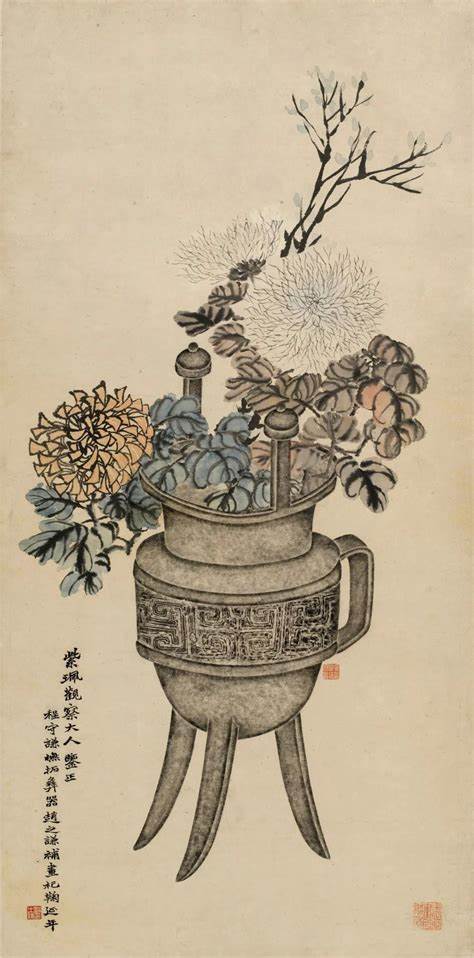
Eastern deconstruction of Western still life paintings. When Chardin’s copper pots and lemons triggered amazement at the Paris Salon, Zhao Zhiqian was deconstructing the inherent properties of things with a brush – the ceramic pots under his brush are both containers for flower arrangements and carriers of inscriptions and topographies; the chrysanthemums are both ornamental objects and the scene of brush and ink experiments. This philosophical treatment of physicality opens up a new dimension of perception for modern art.
IV. Echoes of Goldstone in Modern Art
Oriental brushwork in expressionist painting. In Kokoschka’s wild brushstrokes, Zhao Zhiqian’s spirit of writing is clearly swaying; in Sutin’s distorted still life paintings, the compositional gene of “Remnant Chrysanthemum” can be recognized. These coincidental creations testify to the forward-looking nature of Zhao Zhiqian’s artistic language.
Goldstone Translation in Abstract Painting. Motherwell’s Elegy for the Spanish Republic series, with its black blocks cut in a way that bears a striking resemblance to the treatment of Zhao Zhiqian’s seals’ sidebars; and Tomblay’s circular lines can be seen as a contemporary reincarnation of the deconstructed goldsmith’s script. When these Western masterpieces are juxtaposed with Ink and Chrysanthemum, the ancient aesthetics of goldsmithing reveals its universal value.
The rebirth of chrysanthemums in contemporary installation art. Xu Bing’s Behind the Story reconstructs Zao Zhiqian’s layers of ink and brushwork with synthesized materials, and Cai Guoqiang’s gunpowder blasts recreate the moment of gold and stone bursts on rice paper. In the Chinese Pavilion at the Venice Biennale, these contemporary creations prove that Zhao Zhiqian’s artistic revolution is still underway.
When existentialism was being talked about in the cafes on the left bank of Paris, Zhao Zhiqian’s chrysanthemums had long since completed the carnival of life on rice paper. These autumnal chrysanthemums, rooted in gold and stone and blooming in ink and brush, are both the extinct sound of literati painting and the precursor of modern art. In the digital era of image proliferation, they remind us that the real art revolution is not in the old or new medium, but in the depth of observation; the eternal aesthetic value is not in pleasing the times, but in transcending time. When these oriental chrysanthemums blossom across the ocean, what they bring with them is not only the subtle skills of Chinese art, but also the revelation of creation that transcends civilization – that is the strength of monumental engraving to counter frivolity, the depth of ink and brush to resist shallowness, and the power of life that bursts out eternally from the collision of goldsmith’s stone and Xuanpaper.
Site Reviews
Write A Review